
Five Elements
Water Element Meaning in Wu Xing Philosophy: Flow & Depth
Explore the Water Element Meaning in Wu Xing Philosophy through classical texts, seasonal cycles, symbolism, and thoughtful modern use.
Water Element Meaning in Wu Xing Philosophy: Flow, Storage, and Renewal
The Water Element Meaning in Wu Xing Philosophy extends far beyond rivers, rain, oceans, or the color blue. Water describes a way in which change occurs: movement descends, scattered resources gather, visible activity becomes quieter, and potential is preserved until another phase can begin.
Water is often associated today with adaptability, wisdom, intuition, and stillness. These interpretations can be useful, but they become more meaningful when connected to Water’s classical movement, seasonal position, and relationships with the other four phases.
This guide examines those foundations while clearly separating early philosophical sources, later systems of correspondence, and modern reflective applications.
What Does the Water Element Mean in Wu Xing?
In Wu Xing, Water represents a pattern of:
- Descending
- Moistening
- Gathering
- Storing
- Deepening
- Adapting to surrounding form
- Preserving capacity before renewed growth
A concise definition would be:
Water is the Wu Xing phase of downward movement, inward gathering, stored potential, and adaptive continuity.
Water may appear quiet without being inactive.
A winter reservoir, an underground current, a deep lake, and a river finding its way around stone all express different dimensions of the Water phase.
Its meaning does not come from Water being inherently calm, beneficial, or spiritual. It comes from observing how Water behaves and how that behavior relates to a wider cycle of change.
Why “Five Phases” Is More Accurate Than “Five Elements”
The familiar English translation of Wu Xing is “Five Elements,” but “Five Phases” or “Five Processes” often communicates the philosophy more accurately.
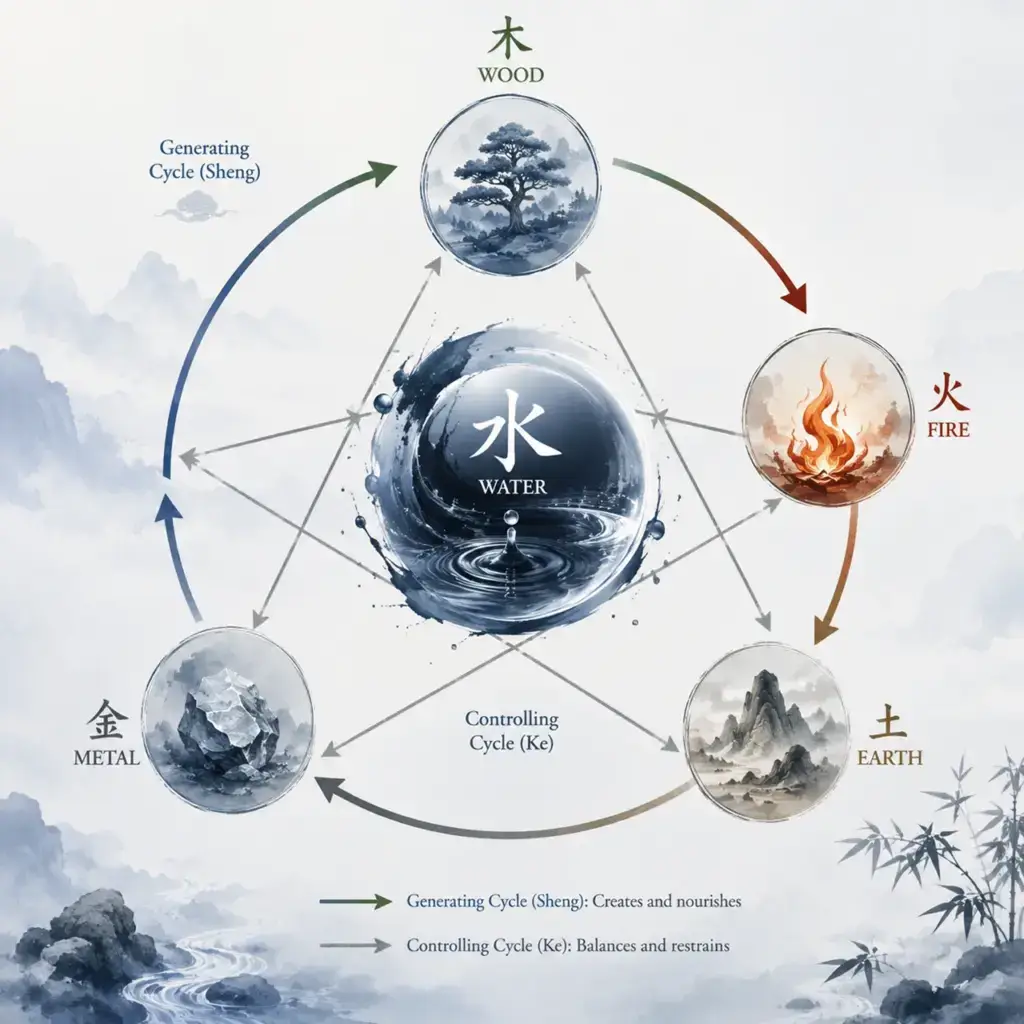
Wood, Fire, Earth, Metal, and Water are not simply five permanent substances separated from one another. They describe changing and interdependent processes connected through cycles of generation and regulation.
Water Is a Pattern, Not Only a Material
Literal water can demonstrate Water qualities, but something does not need to contain liquid to be interpreted through the Water phase.
Water language may also describe:
- A season of conservation
- A project moving from activity into review
- Information settling before a decision
- Resources being gathered rather than immediately used
- A quiet stage that protects future capacity
The most useful Wu Xing question is therefore not only:
What is this made of?
It is also:
How is this process moving?
Questions That Reveal a Water-Like Process
Is it moving beneath surface appearances?
Is it gathering what has become scattered?
Is it conserving limited resources?
Is it adapting to the actual shape of present conditions?
Is it preparing the foundation for later development?
These questions preserve Wu Xing as a relational framework rather than turning it into a fixed system of labels.
Two Classical Ways of Understanding Water
Two influential classical descriptions can help explain Water, but they belong to different philosophical contexts.
水曰润下 — Water moistens and descends.
The statement identifies moistening and downward movement as Water’s characteristic action.
Moistening
Moistening suggests gradual contact, penetration, and support.
Water can reach small spaces, enter overlooked areas, and maintain conditions required by other forms of life. Its influence does not need to dominate a scene in order to matter.
In a modern reflective context, moistening can suggest:
- Supporting a process without becoming its visible center
- Maintaining continuity during a slower period
- Allowing information to reach neglected areas
- Preventing a system from becoming overly rigid
Descending
Water seeks lower ground.
Philosophically, this can suggest moving beneath appearances, returning attention to foundations, and allowing excess activity to settle into a deeper reserve.
Descending does not automatically mean decline.
Within a cyclical model, downward movement may be part of gathering what is needed for later development.
A project, decision, or season can move inward without becoming unproductive.
“The Highest Good Is Like Water”
Chapter 8 of the Daodejing begins with the image that “the highest good is like water.”
The passage praises water for benefiting living things without contention and for remaining in low places that others may avoid.
This is not a technical definition of the Water phase within Wu Xing. Instead, water is used as a philosophical image for conduct close to the Dao.
Water does not insist that every obstacle conform to its preferred shape. It follows terrain, enters available space, and continues without needing to dominate attention.
Related, but Not Identical
The Hong Fan helps explain Water’s functional character within Five Phase thought.
The Daodejing uses water to examine humility, non-contention, adaptability, and conduct aligned with natural conditions.
Combining these perspectives creates a richer interpretation, but they should not be presented as the same doctrine.
Water, Wu Wei, and Adaptive Action
Water is frequently connected with wu wei, often translated as non-action, non-forcing, or effortless action.
Wu wei does not mean complete passivity. It refers more closely to avoiding unnecessary force and responding in ways that fit the actual conditions of a situation.
Water provides a useful image because it does not insist on maintaining one rigid form. It changes according to the channel, container, temperature, or terrain while retaining its continuity.
Adaptability Is Not Aimlessness
A river responds to the land, but it still moves.
Adaptability becomes meaningful when it allows action to continue with less resistance and less waste.
Without direction or boundaries, flexibility can become drift. This is why Water should be considered alongside Earth, which channels it, and Wood, which shows what stored Water can eventually support.
A Modern Reflective Application
A Water-inspired response to difficulty might involve:
- Observing before reacting
- Looking for the actual shape of the problem
- Reducing unnecessary confrontation
- Gathering information before making a commitment
- Choosing a sustainable route rather than the most dramatic one
These are modern reflective applications inspired by Water imagery. They are not guaranteed formulas taken directly from an ancient text.
Traditional Water Element Associations
These correspondences did not all emerge at the same time.
They developed across different historical periods and fields, including cosmology, calendrical thought, medicine, ritual, and aesthetics.
They should therefore be understood as parts of Chinese correlative thought rather than as modern scientific causation.
| Aspect | Traditional Water Association | Careful Modern Explanation |
|---|---|---|
| Season | Winter | Reduced outward growth, storage, and dormancy |
| Direction | North | Directional category in later correlative systems |
| Color | Black or very dark tones | Depth, concealment, and winter darkness |
| Movement | Downward and inward | Settling, gathering, and entering lower places |
| Climate | Cold | Seasonal slowing and contraction |
| Taste | Salty | Historical correspondence, not dietary advice |
| Planet | Mercury | Traditional astronomical correspondence |
| Life stage | Storage | Capacity retained before renewed emergence |
| Body correspondence | Kidneys and bladder | Traditional medical classification |
| Emotional correspondence | Fear | Historical correspondence, not a diagnosis |
| Sensory correspondence | Ears and hearing | Traditional medical-correlative category |
Why Winter Belongs to Water
Winter is not associated with Water simply because it contains rain, ice, or snow.
Winter represents storage rather than complete inactivity.
Visible growth decreases, while seeds, roots, and other forms of life preserve capacity beneath the surface.
Water expresses a similar movement toward depth, conservation, and hidden potential.
Does Blue Represent Water?
Modern diagrams often use blue because it immediately communicates literal water.
Traditional correspondence systems more commonly associate Water with black or very dark tones. Deep blue may still work in contemporary design, but it is more accurate to describe it as a modern visual interpretation rather than the only classical answer.
Color alone does not create a complete Water symbol.
A stronger design may connect color with movement, inscription, material, season, or a complete Wu Xing composition.
Is Fear Transformed Into Wisdom?
Traditional Chinese medical and correlative systems associate fear with Water.
Some modern interpretations extend this relationship by presenting wisdom, discernment, or calm observation as constructive Water qualities.
This may be useful as reflective language, but “fear becoming wisdom” should not be presented as a universal classical formula or psychological treatment.
Yin Water and Yang Water
Water can display both yin and yang qualities.
A still, dark pool may appear strongly yin. A broad river, powerful current, or storm-driven sea may express greater yang activity.
This does not create two new elements. It shows how one phase can appear differently under different conditions.
In later systems combining yin-yang, the Five Phases, and the Ten Heavenly Stems:
- Ren 壬 is associated with yang Water.
- Gui 癸 is associated with yin Water.
This distinction belongs to a more specific calendrical and interpretive framework. It should not be introduced as though every basic discussion of Wu Xing must divide people into Water personality types.
| Expression | Common Later Imagery | Reflective Interpretation |
| Yang Water / Ren Water | Large rivers, oceans, broad currents | Scale, momentum, and response to complex conditions |
| Yin Water / Gui Water | Rain, dew, mist, small springs | Subtle nourishment, observation, and gradual influence |
Yang Water: Broad Movement
Yang Water imagery emphasizes scale and visible momentum.
A large river does not remain fixed, yet it can maintain a recognizable direction over a long distance.
As a modern reflection, this may suggest adapting while continuing through complexity rather than demanding that every condition remain predictable.
Yin Water: Subtle Influence
Yin Water imagery emphasizes smaller and less visible forms of moisture.
Rain, dew, mist, and springs can gradually change an environment without becoming its dominant visual feature.
As a reflective image, this may suggest patient development, attentive observation, or support that works beneath the surface.
Important Limitation
Ren Water and Gui Water should not be used to diagnose character from a single preference, behavior, birth year, or jewelry choice.
They belong to larger traditional systems and require more context than a general introductory article can provide.
Water in the Wu Xing Generating Cycle
Metal Generates Water
Traditional explanations vary.
Moisture may gather on cool Metal surfaces, water sources may be connected with mineral-bearing landscapes, and Metal’s contracting quality may be interpreted as moving toward Water’s deeper storage.
The relationship is best understood as part of the inherited generating sequence rather than as a modern chemical claim.
Water Generates Wood
Water generates Wood in the traditional generating cycle.
This relationship is easier to observe directly: plants require moisture, and the storage associated with winter precedes spring emergence.
In reflective terms, Water may represent the preparation, attention, or resources that make Wood-like growth possible.
Generating Does Not Mean “More Is Always Better”
Too much water can damage a plant just as too little can prevent growth.
Wu Xing relationships depend on proportion, timing, and context. The generating cycle describes support, not unlimited accumulation.
Water in the Wu Xing Regulating Cycle
The traditional regulating sequence is:
Wood regulates Earth → Earth regulates Water → Water regulates Fire → Fire regulates Metal → Metal regulates Wood
For Water, the key relationships are:
- Earth regulates Water.
- Water regulates Fire.
H3: Earth Regulates Water
Earth regulates Water by containing, directing, or redirecting its movement.
Soil, riverbanks, and channels show how structure can give flow a clearer course.
This relationship prevents Water from being reduced to unlimited freedom. Movement becomes useful when it has direction.
A modern reader might ask:
- What boundary gives this project a clearer course?
- Where has flexibility become avoidance?
- What structure would allow resources to accumulate?
- Which decision needs a more defined container?
Water Regulates Fire
Water can reduce flame and heat.
Symbolically, cooling, pausing, and gathering can regulate the excessive outward activity associated with Fire.
Water is not inherently superior to Fire. Fire transforms stored capacity into visible action, while Water preserves the resources that prevent activity from consuming everything too quickly.
The phases work through relationship, not through a hierarchy of good and bad qualities.
Water as Storage Rather Than Stagnation
One of Water’s most useful ideas is the difference between storage and stagnation.
Both may appear quiet from the outside, but they are not the same.
Productive Storage
A quiet period may still be productive when:
- Information is being gathered
- Skills are being developed privately
- Resources are being conserved
- A decision is waiting for sufficient context
- Unnecessary activity is being reduced
- The foundation for later work is becoming stronger
Stagnation
Stillness becomes less useful when it only postpones a necessary decision or allows fear to determine every action.
Water does not remain in one place under every condition. It gathers, changes state, follows gradients, and eventually continues.
Storage preserves capacity; stagnation prevents movement without creating a stronger foundation.
Five Practical Questions
When a project or routine slows down, consider:
- What is being preserved?
- What still needs to be understood?
- Which activity is consuming resources without adding value?
- What boundary would restore direction?
- What future development could this period support?
This is a modern reflective exercise inspired by Water’s place in Wu Xing. It is not an ancient ritual or predictive method.
Is Water the Same as the Kan Trigram?
No.
Water is one of the Five Phases. Kan is one of the Eight Trigrams used in the Yijing and Bagua traditions.
Later correlative systems connected Wu Xing, yin-yang, seasons, directions, and trigrams. Water is frequently associated with Kan, but the two terms are not interchangeable.
Water and Kan are related, but they belong to different symbolic structures.
For a wider comparison, read Bagua vs Yin Yang.
Why the Distinction Matters
A product displaying the Kan trigram should be described as a Kan or Bagua design.
A Water-inspired object may instead express Water through:
- The Chinese character 水
- A complete Five Phase arrangement
- Wave or river imagery
- Winter symbolism
- Dark visual tones
- A relationship with Metal and Wood
- Flowing or descending composition
Clear identification is more useful than describing every dark or wave-shaped object as a Water symbol.
Is Wu Xing Exclusively Daoist?
No.
Wu Xing has been used in Chinese cosmology, medicine, ritual, political thought, calendrical systems, aesthetics, Confucian traditions, Daoist traditions, and other areas of cultural life.
It should not be described as a framework invented or owned exclusively by one tradition.
Why Water Still Belongs on a Daoist-Inspired Site
Daoist texts and traditions repeatedly use water to examine adaptability, humility, non-contention, natural timing, and the relationship between visible action and quieter processes.
A Daoist-inspired interpretation is therefore meaningful when it remains transparent about the broader history of Wu Xing.
The most credible approach is not to claim ownership of the Five Phases, but to explain how Daoist thought provides one influential way of understanding Water.
Are There Water Element Personality Traits?
Modern personality articles often associate Water with:
- Adaptability
- Intuition
- Sensitivity
- Observation
- Strategic patience
- Privacy
- Creativity
- Emotional depth
These descriptions may encourage self-reflection, but they are not complete personality diagnoses.
Wu Xing describes changing modes and relationships. A person may show Water-like behavior in one situation and Wood-, Fire-, Earth-, or Metal-like behavior in another.
Better Questions Than “Am I a Water Person?”
Consider asking:
- When do I adapt effectively?
- When does flexibility become loss of direction?
- What am I gathering before acting?
- Which decision needs greater depth rather than greater speed?
- Where would a stronger boundary improve movement?
- What stored capacity is ready to become visible growth?
These questions preserve Water as a flexible reflective category without turning it into a fixed identity claim.
Thoughtful Ways to Bring Water Qualities Into Daily Life
Working with Water symbolism does not require a dramatic lifestyle change or a room filled with blue objects.
The strongest applications are usually small, clear, and deliberate.
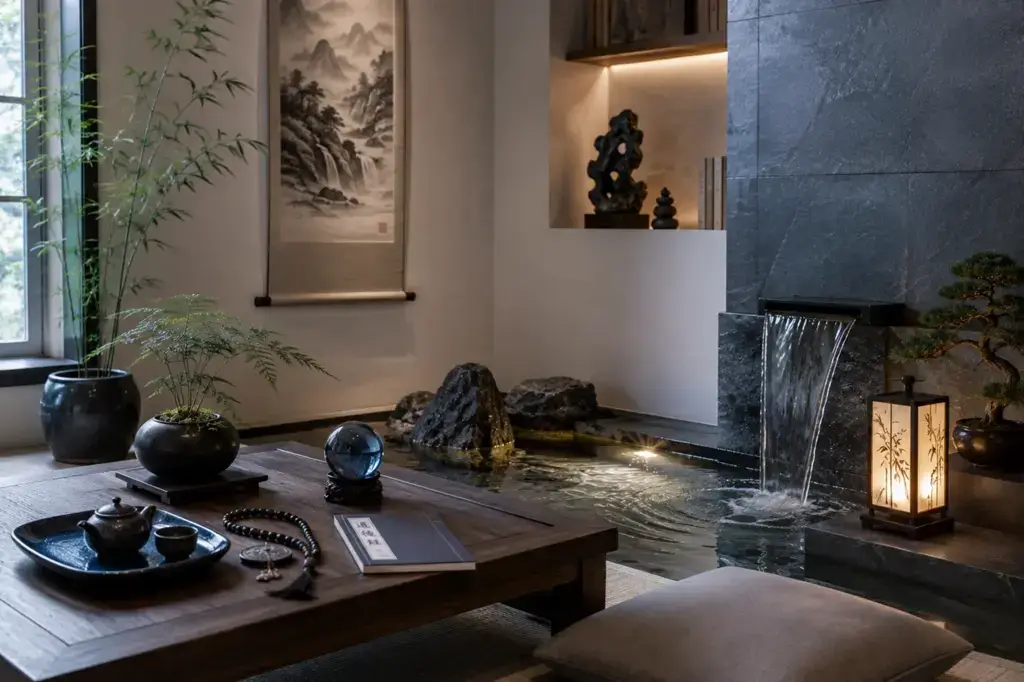
Create a Place for Undistracted Review
A desk corner, reading chair, or small shelf can be reserved for slower reading, planning, or reflection.
The purpose is not to guarantee a particular external result. It is to make quiet attention easier by giving it a visible place.
Use Flowing Forms
Curved lines, wave-like engraving, layered contours, and descending compositions can suggest Water without relying on literal ocean imagery.
Work With Dark Visual Depth
Black, charcoal, dark blue, deep grey, and dark metallic surfaces can create visual concentration.
Darkness alone does not make an object Water-themed. The effect becomes more coherent when color is supported by symbol, form, material, or context.
Use Tactile Objects as Personal Cues
A smooth stone, engraved metal object, bead, or small desk piece may serve as a physical cue to pause, review, or release unnecessary tension.
Black obsidian is sometimes used in modern Water-inspired styling because of its dark appearance and polished texture. It should not be described as a universally established classical Wu Xing requirement.
Choose Fewer, Clearer Objects
Water-inspired design often works best when the surrounding space is not visually crowded.
A single object with identifiable symbols usually communicates more clearly than several unrelated items grouped under a broad “Water energy” label.
Explore Water Through Visible Design
A Quieter Expression of the Water Phase
Flowing lines, dark metal tones, Water inscriptions, and carefully arranged Wu Xing symbols can make an abstract philosophical idea visible in everyday life.
Daoism Light approaches these objects as cultural designs and personal reminders rather than guaranteed solutions.
FAQ
What does Water represent in Wu Xing?
Water represents moistening, descending, gathering, storage, depth, adaptability, and the preservation of potential before renewed growth.
Why is Water associated with winter?
Winter reduces visible outward growth while roots, seeds, and other forms of life preserve capacity beneath the surface.
Is Water literally an element?
“Element” is the familiar English translation, but “phase” or “process” more accurately communicates Wu Xing as a dynamic relational system.
Is Water always yin?
Water is strongly associated with yin qualities such as cold, darkness, depth, and inward movement, but it can display both yin and yang expressions.
What is the difference between Ren Water and Gui Water?
In later systems using the Ten Heavenly Stems, Ren is associated with yang Water and Gui with yin Water. This is a specialized classification rather than the complete meaning of Water in Wu Xing.
What generates Water?
Metal generates Water in the traditional generating cycle.
Is Water the same as Kan?
No. Water belongs to Wu Xing, while Kan is one of the Eight Trigrams. Later systems associate them, but they remain different categories.
Can Water symbolism be used in a home office?
Yes. Flowing forms, dark accents, Water inscriptions, or a small Wu Xing object can add a thoughtful cultural detail to a desk, shelf, or reading area.
Do Water-inspired objects guarantee personal change?
No. They can function as cultural, aesthetic, or contemplative reminders, but they should not be treated as guarantees of health, emotional, financial, or professional outcomes.
Conclusion
The Water phase offers more than a color, season, or personality label.
It describes how change can continue through descent, gathering, storage, adaptability, and eventual renewal.
The Hong Fan gives Water its functional direction: it moistens and descends. The Daodejing adds another philosophical image: water supports living things without competing and remains close to low places.
Together, these ideas reveal a form of strength that does not depend on constant expansion.
Some progress takes place beneath the surface.
Flexibility still benefits from direction, and renewed growth often depends on what has been quietly preserved beforehand.
Author Note
Written by the Daoism Light editorial team
This article was created for readers who want to explore Daoist symbols in a clear, modern, and culturally respectful way.
Here, we approach Daoist-inspired objects through their symbolic depth, historical background, and thoughtful role in everyday life. We do not present these pieces as magical guarantees or exaggerated spiritual shortcuts. Instead, we see them as cultural, aesthetic, and contemplative anchors—meaningful accents that bring a sense of intention, balance, and quiet beauty into modern spaces.
Related Articles
- Wood Element Meaning in Wu Xing Philosophy
- Fire Element Meaning in Wu Xing Philosophy
- Earth Element Meaning in Wu Xing Philosophy
- Metal Element Meaning in Wu Xing Philosophy
- Bagua vs Yin Yang
- How Daoism Influences Feng Shui