Five Elements
Metal Element Meaning in Wu Xing Philosophy: Clarity, Boundaries & Modern Life
Explore Metal Element Meaning in Wu Xing Philosophy, including refinement, boundaries, autumn symbolism, Five Phase relationships, and modern design.
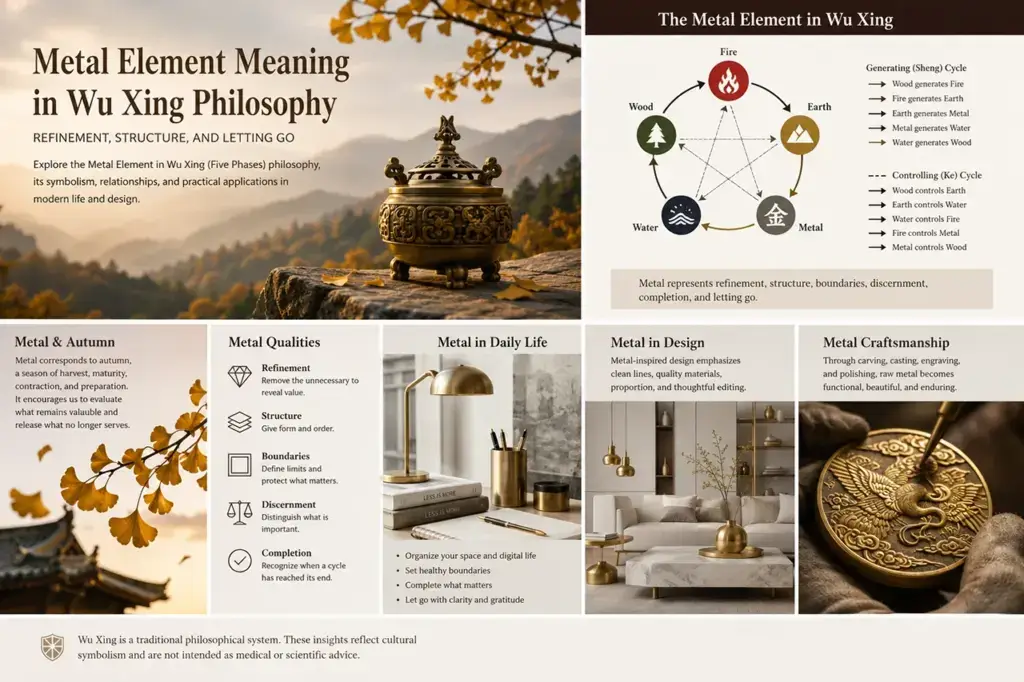
Metal Element Meaning in Wu Xing Philosophy: Refinement, Structure, and Letting Go
Introduction: Rediscovering the Meaning of Metal in Everyday Life
Wu Xing (五行) is often translated as the Five Elements, but it is more accurately understood as the Five Phases, Five Movements, or Five Processes. It describes dynamic patterns through which natural conditions emerge, develop, interact, mature, and change.
Understanding the Metal Element Meaning in Wu Xing Philosophy therefore requires looking beyond physical materials.
Metal is not simply gold, silver, iron, copper, or brass. It represents a phase of refinement, contraction, structure, distinction, and completion.
Metal is the point at which expansion gives way to selection. It asks what should remain, what has completed its purpose, and what can be released.
A piece of raw metal becomes useful through extraction, heat, shaping, polishing, and skilled craftsmanship. Symbolically, this process reflects the ability to reduce distraction, establish clear boundaries, complete unfinished work, and preserve what has lasting value.
In contemporary life, Metal can be understood through ideas such as:
- thoughtful organization
- healthy boundary setting
- careful editing
- craftsmanship
- purposeful simplicity
- knowing when to complete and release
This does not mean Wu Xing should be reduced to productivity advice or interior styling. Metal remains part of a larger traditional framework involving seasonal change, Five Phase relationships, and cultural symbolism.
Its themes also continue to influence contemporary design, personal reflection, material craftsmanship, and the thoughtful arrangement of everyday spaces.
What Does Metal Represent in Wu Xing Philosophy?
To understand Metal in Wu Xing, it is helpful to compare it with the broader movement of the Five Phases.
| Phase | Chinese | Primary Movement | Symbolic Theme |
|---|---|---|---|
| Wood | 木 | Rising and expanding | Growth, initiative, development |
| Fire | 火 | Spreading outward | Expression, intensity, transformation |
| Earth | 土 | Centering and supporting | Stability, connection, transition |
| Metal | 金 | Contracting and refining | Structure, distinction, completion |
| Water | 水 | Descending and storing | Adaptation, depth, conservation |
Metal appears after the expansive activity of Wood and Fire and the stabilizing role of Earth. It represents the stage when growth is assessed, shaped, gathered, and brought toward completion.
The Chinese character 金 can refer to metal and, in some contexts, gold. Within Wu Xing, however, its meaning is broader. It reflects qualities associated with substances that can be formed into tools, vessels, instruments, ornaments, and structures.
| Metal Quality | Symbolic Meaning |
|---|---|
| Refinement | Removing what is unnecessary to reveal greater value |
| Structure | Giving ideas, materials, or actions a clear form |
| Precision | Paying attention to proportion, detail, and execution |
| Boundaries | Defining where something begins, ends, or belongs |
| Discernment | Distinguishing what matters from what distracts |
| Completion | Recognizing when a process has reached a meaningful end |
| Release | Allowing what is no longer useful to leave |
These qualities are closely connected.
Refinement requires boundaries. Completion requires the ability to stop expanding. Clear structure supports precision, while release prevents order from turning into unnecessary accumulation.
The Core Symbolism of the Metal Element
Metal as Refinement and Craftsmanship
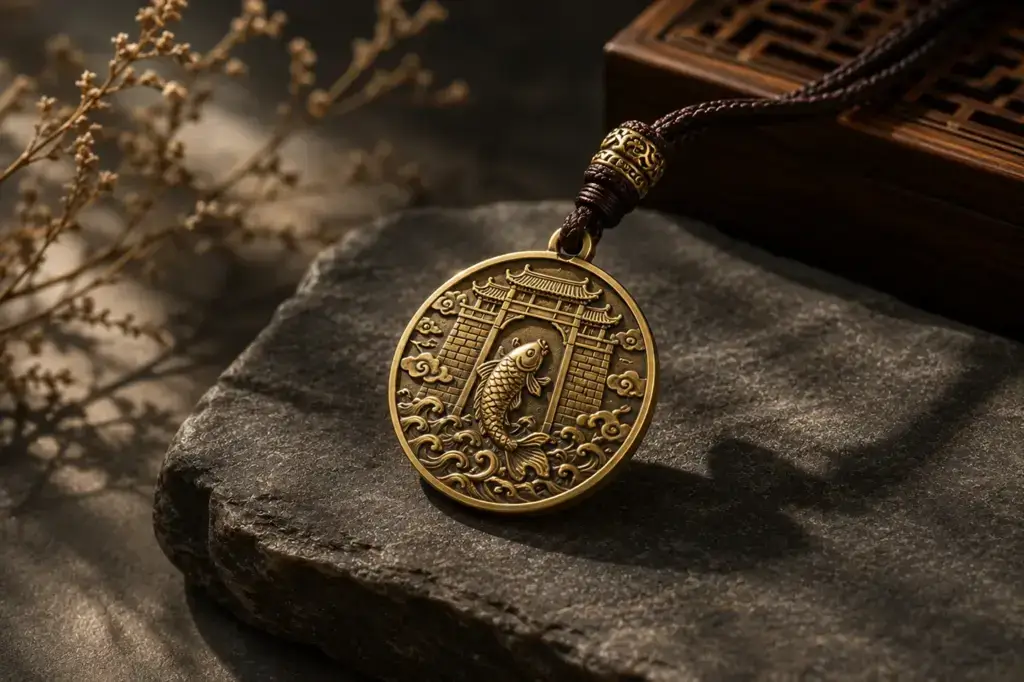
A handcrafted brass object offers a useful visual metaphor for Metal.
The object begins as raw material. It must be selected, heated, cast or shaped, carved, polished, and finished. Every stage reduces uncertainty and gives the material a more deliberate form.
The movement can be summarized as:
Raw material → selection → shaping → refinement → purposeful form
This is one reason Metal is associated with craftsmanship. Good metalwork depends not only on strength but also on proportion, patience, controlled pressure, and attention to detail.
In daily life, this principle can apply beyond physical materials.
A writer edits a draft. A designer removes unnecessary decoration. A business improves an unclear process. A person reviews commitments and decides which ones deserve continued attention.
Metal is therefore not simply the power to cut away. It is the discipline to refine without removing what gives something meaning.
Metal as Structure and Healthy Boundaries
Wood grows outward. Fire expresses and spreads. Metal gathers and defines.
This inward movement is why Metal is often connected with boundaries. A boundary gives shape to an object, a room, a responsibility, or a relationship. Without some form of boundary, growth can become scattered and difficult to sustain.
In contemporary language, well-expressed Metal qualities may include:
- knowing what is and is not your responsibility
- protecting time for important work
- creating clear expectations
- limiting unnecessary commitments
- organizing information into usable categories
- saying no without unnecessary hostility
A healthy boundary is not a wall against all connection. It is a clear structure that makes respectful connection easier to maintain.
Metal becomes overly rigid when boundaries turn into emotional distance, excessive judgment, or inflexible control.
Its deeper lesson is not simply to become stricter. It is to create enough structure for clarity while leaving enough openness for change.
Metal and Autumn: Completion and Letting Go

In traditional Wu Xing correspondence, Metal is associated with autumn.
Spring brings emergence. Summer brings outward activity. Earth gathers and stabilizes. Autumn then marks maturity, harvest, contraction, and preparation for winter.
This does not make autumn a negative season. It is a necessary phase in which nature stops directing all resources toward expansion.
Leaves fall. Seeds are gathered. Crops are harvested. The landscape becomes clearer as excessive growth recedes.
Metal’s relationship with autumn therefore includes:
- evaluating what growth has produced
- preserving what remains useful
- acknowledging completion
- releasing what has naturally ended
- preparing for a new cycle
“Letting go” is sometimes presented as an emotional slogan. In the Metal phase, however, release comes after observation and discernment.
The question is not simply:
“Can I remove this?”
A more Metal-oriented question is:
“Has this fulfilled its purpose, and what deserves to remain?”
This distinction gives Metal a reflective quality. It encourages completion rather than endless accumulation.
Traditional Correspondences of the Metal Element
Chinese correlative systems connect each phase with seasons, directions, colors, climates, emotions, and bodily systems.
These relationships belong to traditional cultural and medical frameworks. They should not be treated as modern scientific diagnoses or used as substitutes for professional medical or psychological support.
| Aspect | Traditional Metal Association | Reflective Modern Interpretation |
|---|---|---|
| Season | Autumn | Maturity, review, and completion |
| Direction | West | Sunset, transition, and contemplation |
| Color | White | Clarity, simplicity, and open visual space |
| Material Tones | Silver, gold, brass, and metallic finishes | Precision, craftsmanship, and refined surfaces |
| Movement | Inward contraction | Focus, organization, and reducing excess |
| Climate | Dryness | Separation, preservation, and reduced expansion |
| Emotion | Grief | Recognizing loss and allowing release |
| Taste | Pungent | A traditional correspondence within Chinese medicine |
| Organ Systems | Lungs and large intestine | Traditional associations involving breathing, intake, release, and elimination |
| Life Stage | Harvest and completion | Reviewing results and preparing for transition |
The emotional association with grief is especially easy to misunderstand.
Traditional frameworks do not suggest that people connected with Metal must always feel sad. Grief is associated with Metal because loss involves recognition, separation, and eventual release—the same movements expressed by autumn and contraction.
This is a cultural analogy rather than a clinical statement about mental health.
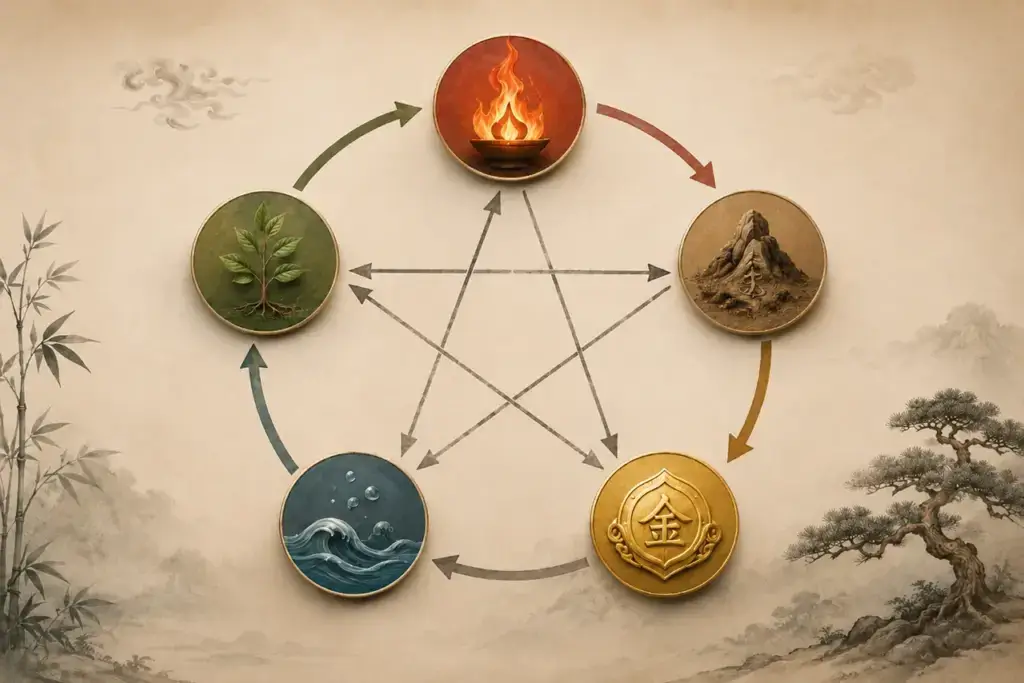
How Metal Relates to the Other Four Phases
Wu Xing is relational. No phase has a complete meaning when isolated from the other four.
The two best-known patterns are:
- the generating cycle, sometimes called the producing or nourishing cycle
- the controlling cycle, which creates limits and prevents unchecked expansion
These relationships are symbolic models rather than literal scientific processes.
Earth Generates Metal
Traditionally, minerals and ores are found within the ground. Symbolically, Earth provides the conditions from which Metal can be gathered and refined.
Earth represents support, stability, nourishment, and containment. Metal represents the clear structure that can emerge from that stable foundation.
Modern Reflection
In daily life, this relationship suggests:
- structure develops more effectively from a stable base
- refinement requires enough time and support
- good standards are difficult to maintain without reliable systems
- clear decisions often emerge after information has been gathered and centered
Earth without Metal may continue holding and accumulating. Metal helps Earth distinguish, organize, and complete.
Metal Generates Water
This relationship has been explained in several traditional ways, including the observation that moisture may gather on cool metal surfaces and the idea that refined Metal supports the transition toward Water’s inward, storing movement.
It should not be interpreted as a modern scientific claim that metal literally creates water.
Modern Reflection
Symbolically, Metal prepares the way for Water by completing, concentrating, and releasing.
Once unnecessary expansion has ended, attention can move toward depth, rest, storage, and adaptation.
In daily life, the sequence can be understood as:
clarify → complete → release → restore
Without Metal’s ability to finish and define, attention may remain scattered across unfinished activity.
Metal Controls Wood
The controlling relationship between Metal and Wood is often described through cutting, pruning, or shaping.
This does not mean Metal is harmful to Wood.
Wood represents growth, possibility, planning, creativity, and expansion. Metal provides the limits and tools that help growth develop into a sustainable form.
A tree that is never pruned may become dense or unstable. An idea that is never edited may remain unclear. A project without deadlines may continue expanding without reaching completion.
Modern Reflection
Symbolically:
- Wood creates possibilities.
- Metal selects and shapes them.
- Wood asks, “What can grow?”
- Metal asks, “What deserves form?”
When Metal becomes excessive, it can cut growth too early through criticism, perfectionism, or rigid standards.
When Wood becomes excessive, ideas may multiply faster than they can be organized.
The useful relationship is not domination. It is growth guided by discernment.
Fire Controls Metal
Fire controls Metal because heat can soften, melt, or reshape it.
Symbolically, Metal creates standards and structure, while Fire brings expression, movement, visibility, and transformation.
Fire tests whether Metal’s structure is adaptable or merely rigid.
Modern Reflection
A system may appear efficient until unexpected change arrives.
A personal boundary may seem clear until compassion or spontaneity is required. A design may be technically precise but still need warmth and expression.
Well-directed Fire prevents Metal from becoming cold or inflexible. Well-expressed Metal prevents Fire from becoming scattered or uncontrolled.
Structure should be strong enough to guide action but flexible enough to be reshaped when circumstances change.
Metal Element Personality and Behavioral Patterns
Some traditional interpretations use Wu Xing as a reflective framework for discussing personality tendencies.
Metal-associated qualities may include:
- direct communication
- clear standards
- appreciation for quality
- attention to detail
- reliability
- respect for structure
- ability to make distinctions
- preference for completion
These descriptions are not scientific personality categories.
A person is not permanently defined by one phase, and real character is influenced by personal experience, relationships, culture, work, and changing circumstances.
The more useful question is not:
“Am I a Metal person?”
A better question is:
“How are Metal-like qualities appearing in this part of my life?”
When Metal Qualities Are Underexpressed
Underexpressed Metal may be reflected through:
- difficulty deciding what matters most
- weak or inconsistent boundaries
- taking on too many responsibilities
- keeping objects, files, or commitments long after they remain useful
- beginning projects without creating a path toward completion
- unclear standards that change from moment to moment
The answer is not necessarily to become stricter.
A more useful response may be to introduce one clear structure at a time, such as defining a deadline, selecting three priorities, creating a simple storage system, or writing down what is outside your responsibility.
When Metal Qualities Become Excessive
Excessive Metal may be reflected through:
- perfectionism that prevents completion
- constant correction of minor details
- harsh internal criticism
- intolerance of ambiguity
- emotional distance disguised as discipline
- controlling systems that leave no room for creativity
- judging people mainly by efficiency or performance
In this pattern, more organization is not the answer.
A more constructive direction may come from Wood’s openness to growth, Fire’s warmth and expression, Earth’s patience, or Water’s adaptability.
Well-expressed Metal allows standards to serve life rather than dominate it.
What Well-Expressed Metal Looks Like
Well-expressed Metal combines qualities that may initially seem opposite:
- clarity without coldness
- discipline without punishment
- boundaries without isolation
- simplicity without emptiness
- standards without perfectionism
- completion without fear of change
- letting go without denying meaning
Wu Xing should not be understood as a system of maximizing one phase.
The aim is not to accumulate more Metal. It is to allow Metal to perform its proper role within a wider cycle.
Applying Metal Symbolism in Modern Daily Life
You do not need complicated rituals to explore Metal symbolism.
Its ideas can be translated into practical choices involving attention, space, boundaries, completion, and design.
Practice Aesthetic Pruning
Decluttering is often framed as removing as much as possible. Metal offers a more thoughtful approach.
The goal is not an empty room. It is a space in which important objects are easier to notice, use, and appreciate.
Ask:
- Does this object still serve a practical, aesthetic, or personal purpose?
- Is it being kept intentionally or only through habit?
- Does it support the function of this space?
- Would releasing it make something more meaningful visible?
This is closer to pruning than purging.
A gardener does not remove everything. The gardener removes selectively so the living structure can become clearer.
Reduce Digital Clutter
Modern clutter is not limited to physical possessions. It also includes:
- unread messages
- duplicate files
- unnecessary notifications
- unused subscriptions
- open browser tabs
- unclear task lists
- information saved without a future purpose
A simple Metal-inspired digital practice might include:
- turning off nonessential notifications
- creating a limited number of useful folders
- closing completed projects
- deleting duplicates
- choosing one trusted system for tasks and notes
The purpose is not perfect digital control. It is reducing friction so attention can move toward what deserves it.
Build Boundaries Around Attention
Time is often treated as the main limited resource, but attention may be even more fragile.
Metal-like boundaries can help define:
- when work begins and ends
- which messages require an immediate response
- how many projects can be active at once
- what information deserves continued attention
- which responsibilities belong to you
A boundary becomes more sustainable when it is clear, proportionate, and communicated without unnecessary aggression.
For example:
“I cannot take on another project this week” is clearer than silently accepting too much and becoming resentful later.
Metal asks for definition before exhaustion forces separation.
Create Completion Practices
Many modern systems focus on starting, growing, and optimizing. Fewer teach people how to finish.
A simple weekly or seasonal review can ask:
- What was completed?
- What remains genuinely important?
- What can be closed rather than postponed?
- Which unfinished task no longer deserves attention?
- What lesson should be carried forward?
Completion does not always mean achieving the original plan.
Sometimes it means documenting what was learned, deciding not to continue, and closing the process consciously.
This is not failure. It is disciplined release.
Metal Element Symbolism in Modern Interior Design
Metal-inspired interior design does not require filling a room with metallic objects.
The principle is more closely connected with proportion, editing, material honesty, and visual clarity.
| Design Choice | Metal-Inspired Quality |
|---|---|
| Clean geometric forms | Structure and definition |
| Brass or silver-toned accents | Material presence and craftsmanship |
| White or neutral space | Visual clarity |
| Limited focal objects | Discernment and emphasis |
| Well-defined storage | Order and accessibility |
| Measured negative space | Restraint and proportion |
| Repeated linear details | Rhythm and precision |
A room with too many hard, reflective surfaces may feel visually cold. A room with no structure or focal point may feel unfinished.
A more considered Metal-inspired interior combines refined materials with softer textures, natural forms, warm lighting, or living elements.
The aim is not a rigid formula. It is a space where structure supports attention and where each object has enough room to be understood.
How to Choose Metal-Inspired Cultural Objects
Crafted metal objects can make abstract ideas such as refinement, durability, and precision visually present.
Their value should come from material, symbolism, craftsmanship, practical use, and personal connection rather than exaggerated promises.
Common Misunderstandings About the Metal Element
Metal Only Means Gold or Silver
Wu Xing Metal includes physical associations with metal materials, but its philosophical meaning is much broader.
It describes refinement, contraction, boundaries, completion, and discernment. Gold and silver may visually express Metal, but they do not define its entire meaning.
Metal Automatically Means Money
The character 金 may mean gold or money in certain modern contexts, but Wu Xing Metal should not be reduced to financial symbolism.
Its traditional associations focus more broadly on seasonal movement, structure, distinction, refinement, and completion.
More Metal Objects Always Create a Better Result
Wu Xing focuses on relationship and proportion, not maximum quantity.
Adding more metallic objects does not automatically improve a space. Material, placement, texture, lighting, and the wider design context matter more.
Metal Defines a Fixed Personality Type
Traditional Metal personality descriptions are symbolic tendencies, not permanent labels.
Wu Xing is more useful as a language for observing patterns than as a tool for reducing people to fixed categories.
Metal Symbolism Replaces Professional Advice
Wu Xing can support cultural learning and personal reflection. It does not diagnose health conditions, treat psychological difficulties, or replace qualified professional care.
Traditional correspondences involving organs, emotions, or bodily systems should be studied within their historical context.
FAQ
What Does the Metal Element Mean in Wu Xing Philosophy?
In Wu Xing philosophy, Metal represents refinement, structure, clarity, boundaries, discernment, completion, and release. It describes a dynamic phase of change rather than only a physical material.
Why Is Metal Associated With Autumn?
Autumn is a season of harvest, contraction, maturity, and preparation. These movements reflect Metal’s symbolic role of gathering results, preserving what matters, and releasing what has completed its purpose.
What Are Common Metal Element Personality Traits?
Traditional descriptions often associate Metal with clarity, strong standards, precision, organization, reliability, and respect for boundaries. These are cultural interpretations, not scientific personality assessments.
What Does Excess Metal Mean?
As a reflective metaphor, excessive Metal may suggest rigidity, perfectionism, harsh judgment, emotional distance, or excessive control. It is not a medical or psychological diagnosis.
How Does Metal Relate to Wood in Wu Xing?
Metal controls Wood through the symbolic image of cutting, pruning, and shaping. Wood represents growth and possibility, while Metal provides selection, structure, and limits.
Is Wu Xing Scientifically Proven?
Wu Xing is a traditional philosophical and correlative system, not a modern scientific theory. It is best studied as part of Chinese intellectual, cultural, medical, and cosmological history.
Related Articles
Author Note
Written by the Daoism Light editorial team, this article was created for readers who want to explore Daoist symbols in a clear, modern, and culturally respectful way.
Here, we approach Daoist-inspired objects through their symbolic depth, historical background, and thoughtful role in everyday life. We do not present these pieces as magical guarantees or exaggerated spiritual shortcuts.
Instead, we see them as cultural, aesthetic, and contemplative anchors—meaningful accents that bring a sense of intention, structure, and quiet beauty into modern spaces.