
Five Elements
Wood Element Meaning in Wu Xing Philosophy
Explore the authentic Wood Element meaning in traditional Wu Xing philosophy. Discover how the Wood phase fosters growth, vitality, and mindful balance in daily life.
Wood Element Meaning in Wu Xing: The Philosophy of Growth and Renewal
When exploring traditional Chinese philosophy, understanding the Wood Element Meaning in Wu Xing opens a clear window into how ancient Chinese thought viewed growth, renewal, and natural movement. In the Five Elements system, Wood is not simply a material. It is a living phase of development — a way to describe how life rises, expands, adapts, and gradually takes form.
Unlike many Western uses of the word “element,” Wu Xing is better understood as a system of Five Phases or Five Movements. These phases describe how life changes, how patterns develop, and how one stage naturally supports or regulates another.
The Wood phase represents the dynamic, upward, and expansive movement of life itself. It is the energy of a seed pushing through the soil, a branch reaching toward light, and a new idea beginning to take form.
In this guide, we will explore the Wood Element beyond simple folklore. We will look at its traditional meaning, symbolic correspondences, role in the Wu Xing cycle, personality associations, and how this ancient idea can still offer insight for work, study, creativity, and everyday life.
At Daoism Light, we understand Wood as a cultural language of growth. It transforms abstract ideas such as flexibility, direction, renewal, and patience into symbols that can be felt and reflected on in daily living.
Quick Answer: What Does the Wood Element Mean in Wu Xing?
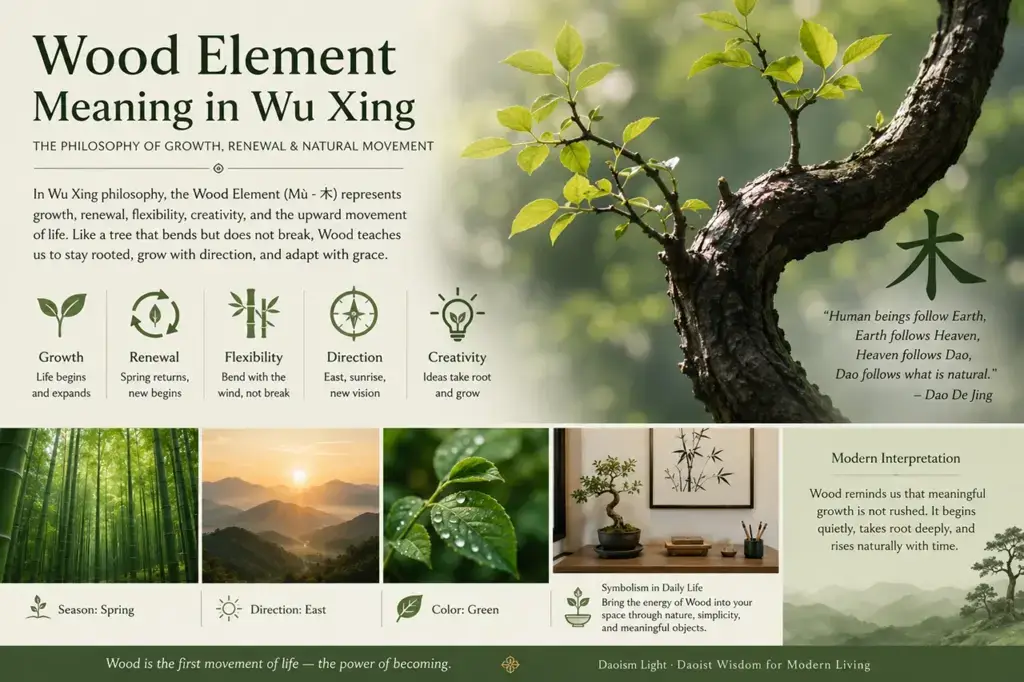
The Wood Element in Wu Xing refers to growth, renewal, flexibility, creativity, vitality, planning, and the beginning stage of development.
Wood is traditionally connected with:
- Spring
- East
- Green and cyan
- Upward movement
- Outward expansion
- New beginnings
- Creative planning
- Flexible strength
- Personal development
- Natural vitality
In simple language, Wood represents the process of becoming.
It is the phase where something begins to grow before it is fully formed. A new project, a study path, a business idea, a creative draft, a personal habit, or a life transition can all carry Wood-like meaning.
Wood suggests organic development. It reminds us that meaningful growth needs direction, patience, nourishment, flexibility, and the right environment.
What Is Wu Xing?
Wu Xing is often translated as “Five Elements,” but this translation can be slightly misleading. The word “element” may sound like a fixed substance, while Wu Xing describes movement, relationship, and change.
The five phases are:
- Wood
- Fire
- Earth
- Metal
- Water
Together, they form a traditional Chinese framework for understanding patterns in nature, time, behavior, seasons, design, medicine, cosmology, and cultural symbolism.
Wood is the phase of rising growth.
Fire is the phase of expression and brightness.
Earth is the phase of support and centering.
Metal is the phase of structure and refinement.
Water is the phase of depth, flow, and return.
These five phases are not isolated. They interact through cycles of support and regulation.
Wood matters because it is one of the clearest images of life beginning to move forward. It is not the finished tree. It is the living process of growth.
A Classical Daoist Lens: Growth Through Natural Movement
A helpful Daoist idea for understanding Wood is the phrase from the Dao De Jing: “Human beings follow Earth, Earth follows Heaven, Heaven follows Dao, and Dao follows what is natural.”
This does not explain Wood directly as a Wu Xing category, but it helps clarify the deeper worldview behind Wood symbolism. Growth is not treated as something forced from the outside. It is understood as a process that unfolds when movement, timing, environment, and inner direction come together.
Seen through this lens, the Wood phase is not only about “growth.” It is about growth that follows a natural rhythm — rising when conditions support it, bending when needed, and continuing without losing its direction.
What Is the Wood Element (Mù – 木) in Traditional Wu Xing?
In Chinese, Wood is written as 木 (Mù).
The character visually resembles a tree. The lower part suggests roots, the center suggests the trunk, and the upper lines suggest branches reaching outward. This simple written form carries a deep symbolic meaning.
But the true meaning of Wood in Wu Xing is not about a rigid piece of timber. It is about the action of a living tree.
A living tree grows upward.
It reaches outward.
It responds to sunlight.
It bends in the wind.
It remains rooted while expanding.
It adjusts to conditions without losing its direction.
This is why Wood is associated with growth, flexibility, vision, and renewal.
In traditional Wu Xing thought, Wood is the phase born from Water and the phase that supports Fire. Just as rain nourishes a seed, Water feeds Wood. As Wood grows, it can later fuel Fire.
Symbolically, this teaches an important idea: growth does not appear from nothing. It needs depth, rest, nourishment, and time before it can become visible expression.
Core Characteristics of the Wood Phase
The Wood phase can be understood through traditional correspondences. These are not rigid rules, but symbolic patterns used in Chinese philosophy and cultural interpretation.
| Wood Phase Correspondence | Traditional Meaning |
|---|---|
| Season | Spring |
| Direction | East |
| Color | Green and cyan |
| Movement | Upward and outward |
| Quality | Growth, renewal, vitality |
| Natural image | Living tree, branch, sprout, forest |
| Symbolic strength | Flexible strength |
| Emotional pattern | Frustration when restricted, kindness when balanced |
| Traditional Chinese Medicine correspondence | Liver and Gallbladder, mentioned as cultural context only, not medical advice |
These correspondences help explain why Wood is linked with beginnings, planning, creativity, and natural vitality.
Spring shows Wood as renewal.
East shows Wood as sunrise and direction.
Green shows Wood as living growth.
The tree image shows Wood as rooted but flexible strength.
Together, these ideas make Wood one of the most practical and relatable phases in Wu Xing philosophy.
The Symbolism of the Bending Tree
One of the best ways to understand the Wood Element is through the image of a bending tree.
A healthy tree is not stiff. It bends with the wind, adapts to changing weather, and continues to grow. This does not make it weak. It makes it alive.
This is the deeper wisdom of Wood.
Wood is not aggressive force.
Wood is not passive softness.
Wood is flexible strength.
In daily life, this symbolism is especially useful. Many people think strength means never changing. Wood suggests something more refined: the ability to adjust without losing direction.
A tree survives because it is both rooted and adaptable. It has a center, but it can respond. It has direction, but it does not become rigid.
For work, study, creativity, and personal change, Wood teaches a simple but powerful lesson:
Modern Interpretation:
Stay rooted, keep growing, and remain flexible enough to adapt.
This is why Wood is such a meaningful symbol for anyone beginning a new chapter, developing a skill, building a project, or learning to move forward with more patience.
Growth: The First Meaning of the Wood Element
The most direct meaning of Wood is growth.
But this growth is not forced. It is not rushed. It is not about pushing something before it is ready.
In Wu Xing philosophy, Wood represents natural growth under supportive conditions. A seed does not become a tree overnight. It needs soil, moisture, light, time, and space.
Human development works in a similar way.
A student needs repetition before confidence appears.
A writer needs drafts before clarity appears.
A business needs structure before stability appears.
A person rebuilding their life needs time before direction feels natural again.
Wood reminds us that real development is often quiet before it becomes visible.
Modern Interpretation:
Wood asks us to respect the early stage. The beginning of something may look small, but it already contains direction. The first draft, the first habit, the first lesson, the first decision, and the first step are all Wood-like moments.
Wood teaches that meaningful growth begins before the result can be seen.
Renewal: Why Wood Is Connected With Spring
Wood is traditionally associated with spring.
Spring is the season when life returns after stillness. Roots awaken. Shoots appear. Branches begin to move. The hidden becomes visible.
This connection makes Wood a symbol of renewal.
Renewal does not mean erasing the past. It means allowing a new stage to emerge from what already exists.
This is why Wood is meaningful for people who are:
- restarting after difficulty
- entering a new phase
- learning again
- rebuilding motivation
- beginning a project
- changing direction
- opening a creative path
Spring does not force life to appear all at once. It invites life to begin again.
Wood carries that same message.
Modern Interpretation:
A new beginning does not need to be dramatic. Sometimes renewal begins quietly: a cleaner desk, a new notebook, a better routine, a first conversation, or a decision to move differently.
H2: Direction: Why Wood Is Associated With the East
Wood is traditionally associated with the East.
The East is the direction of sunrise. Symbolically, sunrise suggests beginning, visibility, first movement, and new direction.
The East-Wood connection can be understood as poetic and philosophical:
East suggests sunrise.
Sunrise suggests beginning.
Beginning suggests renewal.
Renewal suggests growth.
Growth belongs to Wood.
This is the deeper symbolic logic.
In practical language, this relationship becomes a simple reflection:
Modern Interpretation:
Where is the sunrise in my life right now? In other words, where is something new trying to begin? Where do you need clearer direction? Where is growth asking for attention?
Creativity: Wood as the Phase of Beginning
Wood is closely connected with creativity because creativity begins before things are complete.
Before a painting becomes finished, there is a sketch.
Before a book becomes clear, there is a rough draft.
Before a product becomes real, there is an idea.
Before a business becomes visible, there is a plan.
All of these early movements belong to Wood.
Wood is the phase where inspiration becomes direction. It does not demand perfection. It asks for movement.
This makes Wood especially meaningful for:
- writers
- designers
- artists
- students
- teachers
- entrepreneurs
- makers
- planners
- people starting a new path
Wood helps us understand that creative work is not born fully formed. It develops through growth, adjustment, and repeated return.
Modern Interpretation:
Creativity needs room to grow. It also needs enough structure to avoid becoming scattered. This is why Wood works best when it has both freedom and direction.
Wood in the Wu Xing Generating Cycle
Wu Xing is not only a list of five phases. It is a relationship system.
One of the most important relationships is the generating cycle, where each phase supports the next.
In this cycle:
Water nourishes Wood.
Wood feeds Fire.
This means Wood does not appear from emptiness. It grows from depth, rest, reflection, and nourishment. These are Water-like qualities.
Once Wood grows, it can support Fire — expression, visibility, warmth, and action.
This is useful for real-life development.
Before you express yourself clearly, you often need time to grow.
Before a project becomes public, it needs development.
Before action becomes strong, direction must take root.
Wood is the bridge between inner preparation and outward expression.
Modern Interpretation:
Visible achievement often depends on invisible growth.
Wood in the Wu Xing Regulating Cycle
Another important Wu Xing relationship is the regulating cycle.
Traditionally, Wood regulates Earth, while Metal regulates Wood. This should not be understood as simple conflict. It is better understood as relationship, correction, and balance.
Wood can shape Earth because roots enter, hold, and change soil.
Metal can shape Wood because tools can cut, refine, and define wooden form.
Symbolically, this means growth needs both space and structure.
Without enough space, Wood cannot grow.
Without enough structure, Wood may become unfocused.
This is very practical in work, study, and creative development.
Creative growth needs discipline.
New ideas need boundaries.
Personal development needs openness and refinement.
A project needs vision, but also editing.
Modern Interpretation:
Wood becomes stronger when it has enough freedom to grow and enough structure to stay clear. Balanced Wood is not chaotic expansion. It is directed growth.
Wood Personality Meaning in Wu Xing
In symbolic interpretation, Wood-like qualities are often connected with vision, planning, initiative, growth, creativity, and compassion.
A person expressing balanced Wood qualities may appear:
- forward-looking
- creative
- motivated by growth
- interested in long-term goals
- open to new possibilities
- willing to begin new paths
- able to plan ahead
- expressive but purposeful
- kind when acting from clarity
- resilient during early development
However, Wood should not be treated as a fixed personality box. In Wu Xing philosophy, the Five Phases describe patterns, not permanent labels.
A person may experience Wood energy during a certain life stage. Someone starting a new business, learning a new skill, writing a book, rebuilding confidence, or planning a meaningful change may all be moving through a Wood-like phase.
When Wood is restricted, the same energy may feel like frustration, impatience, rigidity, or irritability. This does not mean Wood is negative. It means the growth impulse needs better space, support, rest, or structure.
A better question is not:
“Am I Wood?”
A better question is:
Modern Interpretation:
Where is Wood active in my life right now? This question makes the concept useful instead of limiting.
Wood Element Balance in Daily Life
Wood Element balance does not mean creating a perfect life. It means supporting growth in a steady, flexible, and sustainable way.
In daily life, Wood can be supported through:
- clear planning without over-control
- creative work without perfectionism
- physical movement that encourages flexibility
- time in nature
- spaces that feel open and alive
- steady routines that support long-term growth
- meaningful objects that remind you of direction
- patient development instead of rushed outcomes
This can be understood as a practical cultural framework.
Wood asks us to notice where growth is trying to happen, where we feel blocked, and where we may need either more freedom or more structure.
If you feel stuck, Wood may invite movement.
If you feel scattered, Wood may invite direction.
If you feel rigid, Wood may invite flexibility.
If you feel impatient, Wood may invite patience.
Wood is not about forcing life. It is about creating conditions where growth can continue.
Common Misunderstandings About the Wood Element
Misunderstanding 1: Wood Only Means Trees
Wood includes tree imagery, but it is broader than trees.
In Wu Xing philosophy, Wood represents growth, direction, expansion, flexibility, renewal, and the beginning stage of development.
Trees are the image. Growth is the meaning.
Misunderstanding 2: Wood Means Weakness
Because Wood can bend, some people may think it is soft or weak.
Actually, Wood represents flexible strength. A branch bends because it is alive. Rigidity is not the same as strength.
Misunderstanding 3: Wood Always Means Fast Growth
Wood does not mean rushing.
It represents natural growth under the right conditions. The pace may be slow, but the direction matters.
Misunderstanding 4: Wood Only Applies to a “Wood Personality”
Wood is not limited to one type of person.
Anyone beginning, rebuilding, learning, creating, or seeking direction can relate to Wood symbolism.
Practical Reflection: Where Is Wood Showing Up in Your Life?
To make Wood Element Meaning useful, it helps to reflect on simple questions:
- What is beginning in my life right now?
- What needs more time to grow?
- Where do I need clearer direction?
- What creative idea is asking for attention?
- Where am I forcing something that needs patience?
- Where am I waiting too long instead of taking the next step?
- What environment would better support my growth?
- Where do I need flexibility without losing direction?
- Where do I need structure without becoming rigid?
These questions turn the Wood Element from an abstract concept into a practical lens.
The purpose is not to predict life. The purpose is to notice patterns.
Wood helps us see where growth is trying to happen.
Final Thoughts
The meaning of the Wood Element in Wu Xing is about growth, renewal, direction, flexibility, creativity, vitality, and the early stage of becoming.
It is the movement of spring, the first upward reach of a branch, the beginning of a new idea, and the quiet decision to keep developing.
Placed into daily life, Wood offers a gentle and practical reminder:
Growth does not need to be rushed.
Direction does not need to be perfect before you begin.
Creativity does not need to be complete before it starts.
A new path can begin quietly and still become meaningful.
At Daoism Light, we see Wood as a cultural and symbolic language for understanding life’s natural development. Whether expressed through study decor, meaningful charms, brass accessories, or Daoist-inspired objects, Wood invites us to grow with patience, move with direction, and stay flexible enough to keep becoming.
FAQ
What does the Wood Element mean in Wu Xing?
The Wood Element means growth, renewal, direction, creativity, flexibility, vitality, and the beginning stage of development in Wu Xing philosophy.
What is the Wood Phase in Traditional Chinese philosophy?
The Wood Phase is one of the Five Phases in Wu Xing. It represents upward movement, spring, new beginnings, and the natural expansion of life.
What does Mù (木) mean?
Mù (木) means Wood. The character visually suggests a tree with roots and branches, making it a strong symbol of growth, rootedness, and upward movement.
What season is connected with the Wood Element?
Wood is traditionally connected with spring, because spring represents renewal, emergence, and the beginning of growth.
What direction is connected with the Wood Element?
Wood is traditionally associated with the East, which symbolically relates to sunrise, beginnings, and new movement.
What personality traits are linked with Wood in Wu Xing?
Wood-like qualities may include vision, planning, creativity, initiative, kindness, flexibility, and a desire for growth. These should be understood as symbolic patterns, not fixed personality labels.
What happens when Wood is too dominant?
In symbolic interpretation, excessive Wood may appear as frustration, impatience, stubbornness, or over-expansion. The balancing idea is to introduce more structure, boundaries, and refinement, which are associated with Metal in the Wu Xing system.
How can I bring Wood Element meaning into my space?
You can use plants, natural textures, green tones, vertical forms, organic shapes, symbolic desk decor, or Daoist-inspired objects that remind you of growth and direction.
Can I wear Wood Element symbolism?
Yes. Wood symbolism can be expressed through wooden beads, green-toned accessories, jade-inspired colors, organic shapes, or meaningful charms. These can serve as personal and cultural reminders.
Related Articles:
If you enjoy symbolic objects inspired by traditional Chinese culture, you may also explore Daoism Light’s Five Elements and desk decor collections. Each piece is designed as a cultural and aesthetic object for everyday spaces.
Author Note
Written by the Daoism Light editorial team, this article was created for readers who want to explore Daoist symbols in a clear, modern, and culturally respectful way.
Here, we approach Daoist-inspired objects through their symbolic depth, historical background, and thoughtful role in everyday life. We do not present these pieces as magical guarantees or exaggerated spiritual shortcuts. Instead, we see them as cultural, aesthetic, and contemplative anchors — meaningful accents that bring a sense of intention, balance, and quiet beauty into modern spaces.