Daoism
Why Brass Daoist Accessories Work: Meaning, Patina & Craft
Discover why brass Daoist accessories work well for engraved symbols, Wuxing Metal associations, natural patina, everyday wear, and modern craft.
Why Brass Is Popular in Daoist-Inspired Accessories
Brass Daoist accessories are easy to recognize.
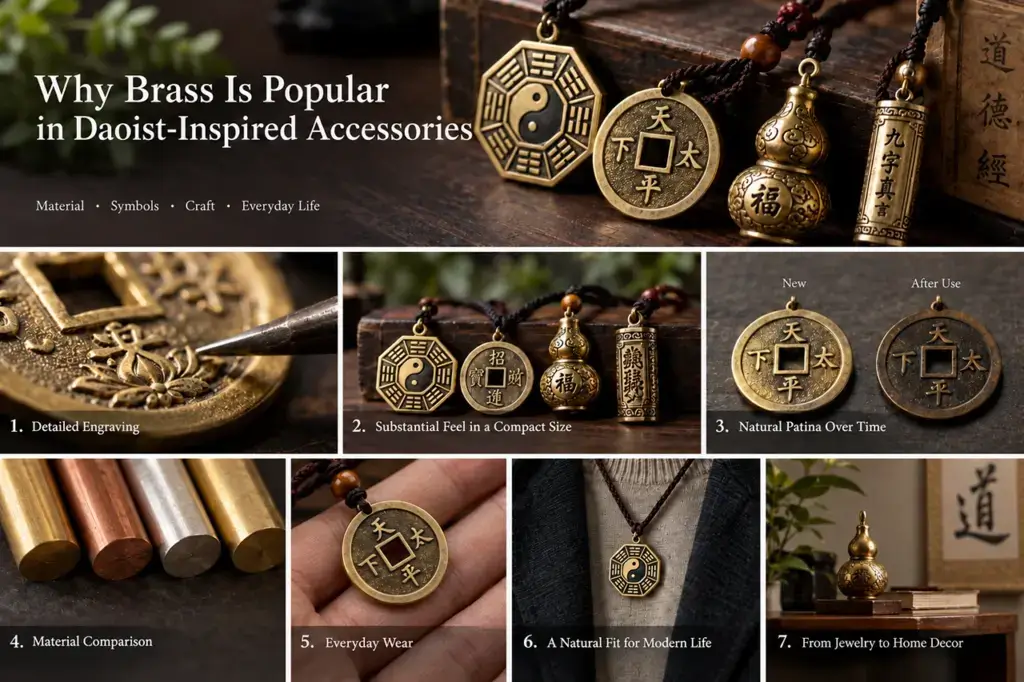
Warm metal tones, engraved Chinese characters, Bagua lines, Yin-Yang forms, traditional coin structures, and recessed details can give even a small pendant or hanging charm considerable visual depth.
But why brass?
The most useful answer has less to do with mysterious claims and more to do with how the material actually behaves.
Brass can support intricate engraving. It gives compact objects noticeable physical presence. Its warm surface works naturally with darkened recesses, cinnabar-filled engraving, braided cord, geometric lines, and traditional Chinese motifs.
It can also change gradually with use.
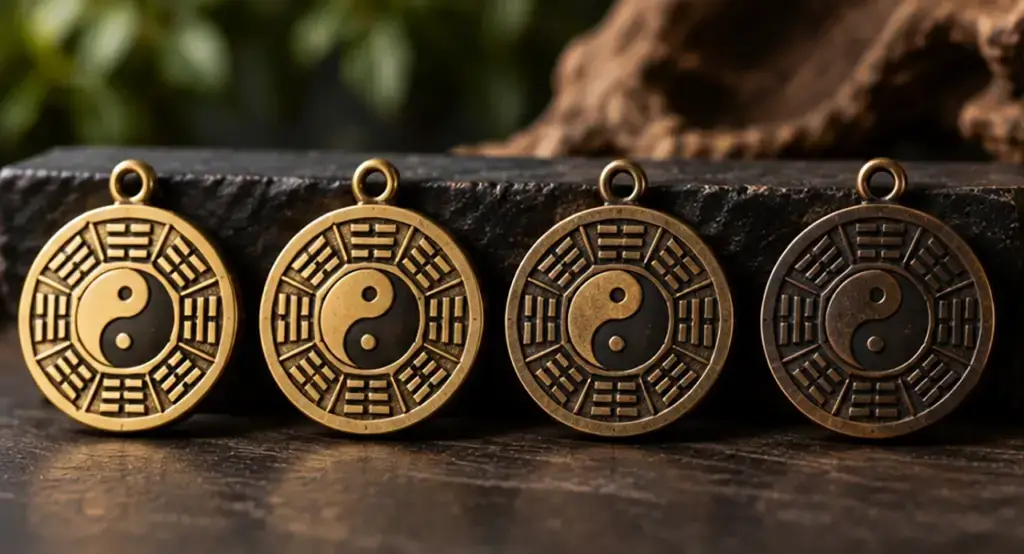
Rather than remaining visually static, untreated brass may develop deeper tones and subtle surface variation over time.
That combination makes brass particularly useful when material, craftsmanship, symbolism, and everyday use are meant to work together.
The Short Answer: Why Does Brass Work So Well?
Brass combines several qualities that suit Daoist-inspired design particularly well.
It can hold relatively fine detail, has a warm yellow-to-golden appearance, feels substantial in compact forms, accepts a wide range of finishes, and can develop visible surface character as it ages.
Brass is not one fixed formula. It is a family of copper-zinc alloys, so appearance and working properties can vary depending on composition and manufacturing method.
That flexibility matters because many Daoist-inspired accessories place a surprising amount of visual information into a very small area.
Brass Is a Material Choice, Not a Spiritual Shortcut
One distinction makes this subject much clearer:
Brass has physical properties. Daoist symbols have cultural meanings.
Those two things can support one another in design, but they are not the same thing.
A Bagua does not become more meaningful simply because it is made from brass.
A Yin-Yang image does not require a specific metal.
A Zi Wei Hui Symbol is not defined by the alloy beneath it.
Chinese religious and decorative traditions have used many materials across different periods, including bronze, copper alloys, wood, stone, ceramic, silver, gold, jade, and textiles.
The more useful question is therefore:
Why does brass work especially well for modern objects carrying Daoist-inspired imagery?
That question can be answered through material, craft, and visual design rather than exaggerated claims.
1. Brass Can Carry Dense Engraved Detail
Complex Symbols Need Clear Separation
Many Daoist-inspired designs depend on precise relationships between lines and characters.
Bagua trigrams require broken and unbroken lines to remain visibly distinct.
Chinese inscriptions need enough spacing and depth that individual strokes do not merge together.
Coin-inspired designs may combine a central opening, raised characters, borders, and secondary motifs within only a few centimeters.
A design that looks perfectly clear on a large screen can become unreadable once reduced to pendant size.
This is where material and production quality matter.
Depending on the alloy and manufacturing method, brass can be formed, machined, stamped, cast, or engraved with relatively fine detail.
For symbolic accessories, that means the material can support the composition instead of forcing the design to become overly simplified.
Surface Contrast Improves Readability
Good engraving is not simply about depth.
It is about contrast.
Raised brass lines can stand apart from darkened recesses, matte areas, textured backgrounds, or cinnabar-filled engraving.
This helps small characters, trigram lines, and border patterns remain easier to see.
The practical value is straightforward:
the symbol stays readable.
2. Brass Gives Small Objects Physical Presence
A compact brass pendant can feel surprisingly substantial.
That physical presence comes from more than weight alone.
Thickness, proportions, edge finishing, attachment points, engraving depth, and the shape of the piece all contribute to how it feels in the hand.
Heavier does not automatically mean better.
But when those elements are handled well, a solid brass accessory can feel more like a small piece of metalwork than a thin decorative token.
A Tactile Reminder in Everyday Life
Some people enjoy holding or turning a small metal object while reading, working, or thinking.
A brass pendant or pocket-sized charm can therefore become a simple tactile reminder to return attention to the present task.
That experience does not need to be described as a medical technique or invisible mechanism.
The material’s real weight and texture already create a distinct physical experience.
3. Brass Develops a Living Surface
One of brass’s most interesting qualities is that its appearance may change through ordinary use.
Air, humidity, skin oils, handling, storage, and surface finishing can gradually influence its color.
On frequently handled accessories, this may appear as a softer shine, deeper golden-brown areas, darker recesses, or subtle differences between high-contact and low-contact surfaces.
What Is Brass Patina?
Patina is the surface character that develops as metal interacts with its environment.
Not every piece ages in exactly the same way.
Skin chemistry, humidity, coatings, finishing methods, and frequency of use all influence the result.
Some owners prefer a bright polished surface.
Others prefer the deeper tone that develops over time.
Neither preference is more correct.
What matters most is understanding how the chosen material may change before purchase.
Patina and Ziran: A Modern Reflective Interpretation
Ziran (自然) is commonly translated as naturalness or spontaneity.
Traditional Daoist texts do not teach a specific doctrine about brass patina.
That distinction should remain clear.
However, as a modern reflective interpretation, an object that changes gradually through normal use can offer an interesting way to think about natural change.
The surface changes.
Evidence of touch accumulates.
Time becomes visible.
For readers interested in Daoist philosophy, this can be understood as a contemporary analogy to allowing natural change to unfold rather than as an ancient claim about brass itself.
4. Why Brass Fits Daoist Symbolic Design
Different symbols place different demands on a material.
Bagua — Precision and Geometry
Bagua imagery depends on structured relationships between broken and unbroken lines.
Even small inaccuracies can make the composition look crowded or unclear.
Brass works well with this type of geometry because raised and recessed lines can remain visually defined at compact scales.
The cultural meaning comes from the Bagua.
The brass helps make the structure readable.
Bagua and Yin-Yang often appear within the same composition, yet their structures and philosophical emphasis are different. Understanding Bagua and Yin-Yang as two related but distinct visual systems makes it easier to read combined designs more accurately.
Yin-Yang — Flow, Proportion, and Contrast
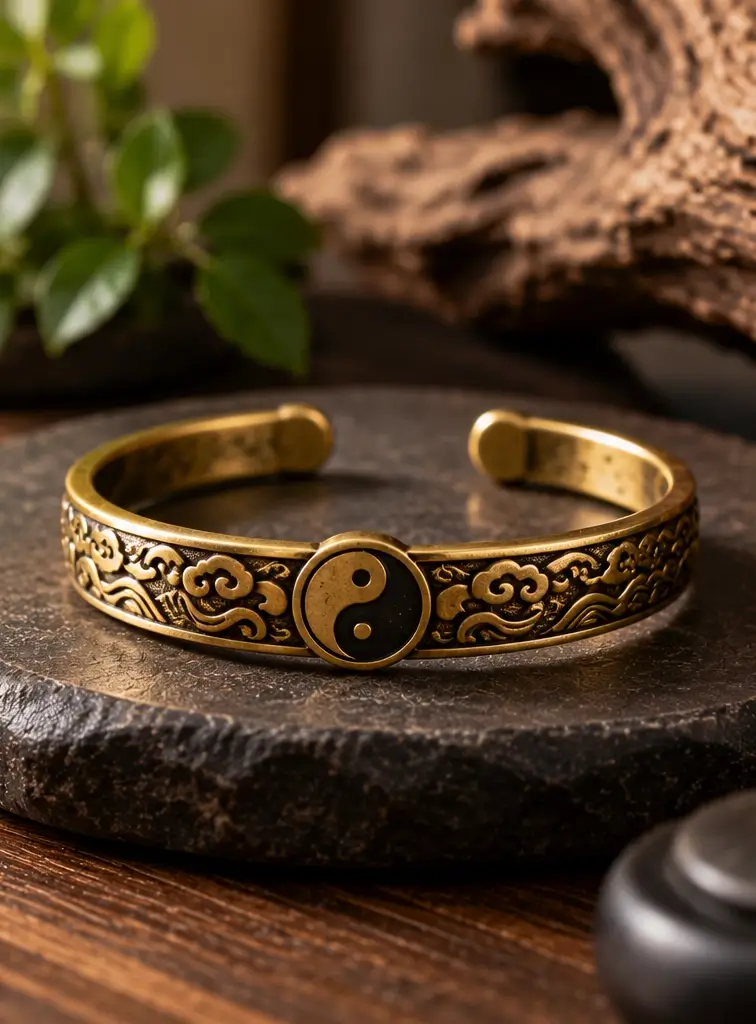
Yin-Yang imagery relies more on proportion, curve, and reciprocal form than dense inscriptions.
A warm brass surface can work effectively with polished, darkened, filled, or recessed areas.
This allows a relatively simple symbol to retain visual depth without excessive decoration.
The strongest designs depend less on adding more detail and more on getting proportion and boundaries right.
Wu Lou — A Recognizable Daoist Form
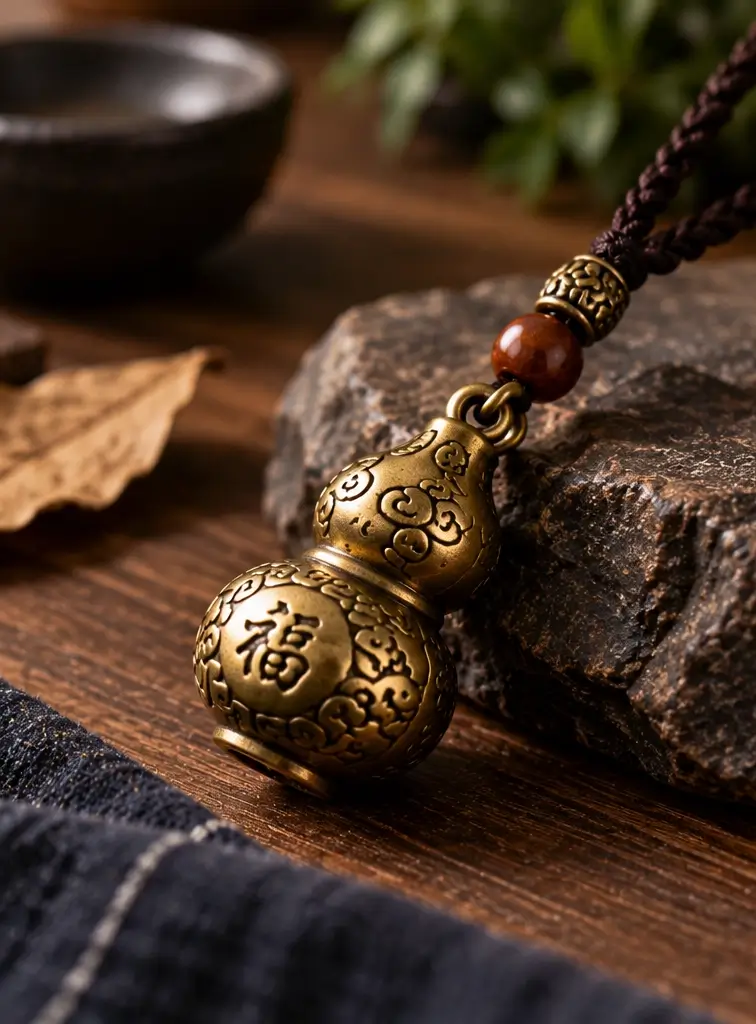
The Wu Lou, or calabash gourd, has long-standing associations with Daoist imagery and traditional representations of immortals and medicine.
That historical connection is already meaningful.
A modern brass Wu Lou can be appreciated for its recognizable silhouette, cultural associations, traditional visual history, and the way that form is translated into contemporary metalwork.
Its cultural value begins with form and history rather than with promises about outcomes.
Coin-Inspired Forms — Material and Shape Working Together
Traditional Chinese coin forms are another natural match for warm metal.
Round outlines, square central openings, raised inscriptions, and aged surfaces create a distinctive visual language.
Modern Five Emperor Coin-inspired accessories should still be clearly described as modern cultural designs rather than historical coins.
These designs draw directly from the visual structure of Five Emperor Coins, so understanding the coins themselves also helps distinguish historical currency from modern symbolic reproductions.
Material transparency strengthens credibility.
Character-Based Designs — Clarity Before Decoration
Text-heavy designs such as Zi Wei Hui Symbol compositions or Nine-Character inscriptions create another challenge:
line density.
If lines become too shallow or crowded, meaningful characters turn into visual texture.
When the inscription itself matters, legibility should come before decorative complexity.
More detail does not automatically mean better design if the characters themselves become difficult to recognize.
5. What Does Brass Mean in the Five Elements?
Wu Xing—Wood, Fire, Earth, Metal, and Water—is better understood as a framework of changing relationships and correspondences than as five literal materials.
Because brass is a metal, it can naturally support Metal (Jin) symbolism within Five Elements-inspired design.
Traditional Metal associations are often discussed alongside structure, definition, contraction, autumn, and the west.
Within Wu Xing, the Metal Element refers to more than physical metal objects. It occupies a broader place within a system of seasonal, directional, relational, and transformational correspondences. Understanding that wider context prevents Metal from being reduced to “anything made from metal.”
The Dui Trigram also belongs naturally in this discussion. Dui is traditionally associated with Lake, the west, autumn, communication, refinement, and Metal, which helps explain why jewelry, coins, metalwork, and finely worked surfaces can enter the same visual conversation.
In contemporary design, Five Elements accessories often express Wood, Fire, Earth, Metal, and Water through color, material, characters, engraving, and arrangement. A stronger design creates clear relationships between those choices rather than simply using five different colors.
However, a brass accessory being made from metal does not prove that it automatically produces a measurable “Metal energy.”
A more accurate way to describe the relationship is:
material symbolism reinforcing visual symbolism.
That connection can be culturally meaningful without being turned into a guaranteed result.
Brass vs Copper, Sterling Silver, and Brass-Plated Alloy
Metal Material Visual & Performance Comparison Table
| Material | Visual Character | Surface Change | Strengths | Things to Consider |
|---|---|---|---|---|
| Solid Brass | Warm yellow to golden tones | Can darken and develop patina | Detailed engraving, substantial feel, versatile finish | Requires care if a consistently bright finish is preferred |
| Copper | Red-orange to warm brown | Often shows noticeable surface variation | Distinctive natural color and strong metal character | Color change may appear more quickly |
| Sterling Silver | Cool white metallic tone | Tarnishes and can be polished | Refined jewelry appearance and crisp contrast | Usually higher material cost |
| Brass-Plated Alloy | Brass-like surface | Surface layer may wear | Lower cost or lighter construction may be possible | Base material may eventually become visible |
No material is automatically more culturally meaningful.
The better choice depends on design, finish, intended use, and the surface character the owner prefers.
Someone drawn to warm golden metal may prefer brass, while someone who likes stronger red-orange tones may prefer copper. A cool white-metal appearance may make silver more appealing for another wearer.
Solid Brass vs Brass-Plated: Why the Difference Matters
“Brass-colored” and “solid brass” are not the same thing.
A solid-brass component contains brass throughout its main body.
A brass-plated item uses a brass or brass-colored surface layer over another material.
This difference can affect wear, scratches, surface aging, weight, and what becomes visible over time.
What Can Buyers Check?
Read the Material Description
Look for clear wording such as:
Solid Brass、Brass-Plated、Brass-Tone、Copper Alloy
These terms should not be treated as interchangeable.
A product described only as “golden metal” or “brass color” does not automatically indicate solid brass construction.
Look at High-Wear Areas
Attachment holes, corners, edges, and raised sections tend to show wear first.
A different metal color appearing underneath may indicate plating.
Do Not Rely on a Magnet Test Alone
Many common brass alloys are non-magnetic.
But many other materials are also non-magnetic.
A magnet can provide one clue, but it cannot prove that a piece is solid brass.
Clear and accurate material disclosure is more useful than a single home test.
Can Brass Turn Skin Green?
For some people, yes.
Because brass contains copper, contact with moisture, sweat, cosmetics, and individual skin chemistry can occasionally leave temporary greenish marks on the skin.
This does not automatically mean that the piece is defective.
It also does not happen to everyone.
A practical approach is to keep the piece reasonably dry, wipe it after wear, and observe how your own skin responds.
If you experience persistent redness, itching, or irritation rather than simple removable discoloration, stop direct skin contact and check the product’s material specifications.
How to Care for Brass Daoist Accessories
Care should match the actual finish.
If You Prefer Natural Patina
Wipe the piece gently with a soft dry cloth after handling or wearing it.
Store it somewhere dry.
Allow the surface to change naturally.
There is no need to polish away every visible sign of ordinary use.
If You Prefer a Brighter Surface
Plain unfinished brass can sometimes be cleaned with a product specifically intended for brass.
However, symbolic accessories may also include cinnabar-filled engraving, darkened recesses, protective coatings, braided cord, wood, stone, or attached decorative components.
Aggressive polishing can brighten exposed brass while changing the contrast or finish that made the original engraving easier to read.
Why Lemon and Baking Soda Are Not Universal Advice
DIY brass-cleaning recipes often recommend acids or mild abrasives.
These methods may work on some plain unfinished brass surfaces, but they should not be treated as universal care advice.
Acid or abrasion can affect fill material, darkened recesses, surface coatings, attached components, and fine texture.
When the finish is unknown, start with the least aggressive option:
a soft dry cloth.
The Form–Surface–Time Test
A useful way to evaluate brass Daoist accessories is to consider three layers:
| Layer | Question to Ask | What It Reveals |
|---|---|---|
| Form | Is the symbol still clear at a small scale? | Proportion, geometry, and engraving quality |
| Surface | Does the finish help the design stay readable? | Contrast, depth, and surface craftsmanship |
| Time | Will normal wear still make sense aesthetically? | Whether the material suits long-term use |
This Form–Surface–Time Test is more useful than judging a symbolic accessory only by how dramatic it looks in a product photograph.
A strong cultural object should still make sense when examined simply as an object.
How to Choose a Well-Made Brass Daoist Accessory
Identify the Actual Symbol
A useful product description should tell you exactly what you are looking at.
Bagua?
Yin-Yang?
Wu Lou?
Zi Wei Hui Symbol?
Nine-Character Mantra?
Five Emperor Coin imagery?
A zodiac composition?
Vague descriptions such as “ancient energy symbol” provide very little cultural information.
Inspect the Engraving
Look closely at small Chinese characters, trigram lines, central motifs, repeated borders, and recessed areas.
Fine details should remain deliberately separated rather than merging into rough texture.
Look at Both Sides
If a piece uses a double-sided design, both sides should be shown clearly.
A product with two distinct symbolic compositions cannot really be understood from only one front-facing image.
Check Dimensions and Weight
Macro photography can make a 30 mm pendant appear much larger than it really is.
Actual dimensions and weight help you understand whether the piece will feel subtle, substantial, wearable, or better suited to hanging.
Check Material Transparency
A trustworthy page should make it reasonably clear whether a piece is solid brass, plated, cinnabar-filled, darkened, coated, or combined with other materials.
The more specific the material information, the easier it is to form realistic expectations before purchase.
Look at How Cultural Meaning Is Explained
A strong description separates historical background, traditional symbolism, modern interpretation, and personal meaning.
That is much more useful than relying on unverifiable promises.
Let Material and Symbol Guide the Choice Together
When comparing pieces in the Daoist Jewelry Collection, it is more useful to look beyond the first product image and consider whether the symbol is clearly identified, the material is accurately described, the engraving remains readable, both sides are shown when relevant, and the dimensions fit the way you intend to wear the piece.
A piece that works well over time should make sense in material, craftsmanship, and cultural explanation—not only in photography.
Why Brass Works in Modern Everyday Life
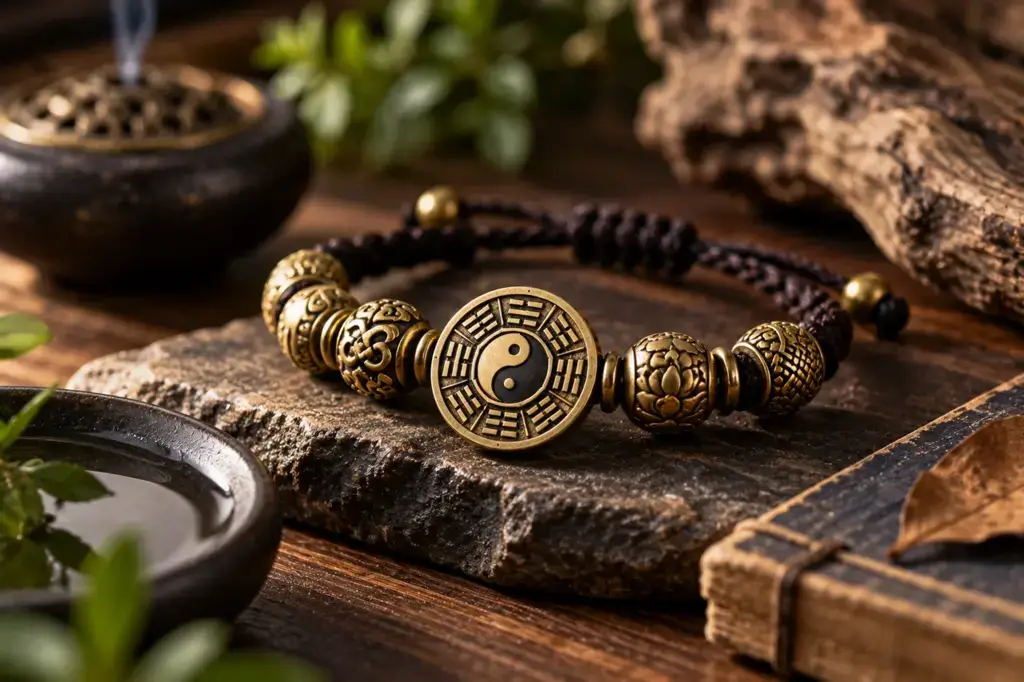
Traditional symbolism does not require traditional clothing.
Warm brass works naturally with linen, denim, cotton, leather, dark knitwear, wood, ceramic, stone, and neutral interiors.
A well-designed brass accessory therefore has two levels of readability.
From a distance, it can simply look like an interesting piece of metalwork.
Closer inspection may reveal Bagua lines, Chinese characters, a Wu Lou silhouette, coin structures, or another traditional composition.
That gradual discovery is one of the reasons brass works particularly well in contemporary Daoist-inspired design.
The same principle applies when symbolic objects move beyond jewelry and into shelves, desks, walls, or entryways. In Daoist home decor placement, material, scale, negative space, and room function matter more than treating placement as a fixed formula.
Choose the Symbol Before the Promise
Before buying a symbolic accessory, ask three questions:
What symbol is actually present?
Do I understand its cultural context?
Would I still appreciate this object if nobody promised me a particular outcome?
Those questions create a much stronger basis for choosing a piece.
You may like a Bagua design because of its geometry.
You may prefer Yin-Yang because of the way it expresses changing relationships.
You may be drawn to Wu Lou because of its recognizable form and place in Daoist art.
You may appreciate Five Emperor Coin-inspired designs because of their circular structure, square opening, and inscription layout.
Brass gives these symbols physical form.
Craftsmanship keeps them readable.
Cultural research explains why they matter.
Personal use determines the place the object eventually holds in everyday life.
FAQ
Will a brass pendant become darker over time?
It can. Untreated brass may gradually develop deeper tones or uneven surface variation through contact with air, humidity, skin oils, and regular handling. This is usually a normal material characteristic rather than a defect.
Can I wear a solid brass pendant every day?
Many people do, but water, sweat, perfume, cosmetics, and cleaning products can affect the surface. If you prefer a brighter finish, wipe the piece after wear and avoid prolonged moisture.
Can brass leave green marks on the skin?
Yes, it can happen for some people because brass contains copper. These marks are usually temporary and washable. Persistent redness, itching, or irritation should be treated differently and is a reason to stop direct skin contact.
Is a heavier brass pendant better quality?
Not necessarily. Weight can contribute to a substantial feel, but engraving clarity, proportions, edge finishing, attachment construction, and material accuracy are more useful indicators of overall quality.
Should I choose brass or copper for a Daoist-inspired accessory?
Choose based on appearance and how you want the piece to age. Brass usually has a warmer yellow-gold tone, while copper has a stronger red-orange character and often develops more noticeable surface change.
Final Thoughts
Brass does not need exaggerated explanations to be interesting.
Its real material qualities already make it well suited to Daoist-inspired accessories.
It can carry intricate symbols.
It gives small objects noticeable physical presence.
Its warm surface works naturally with Chinese traditional visual language.
And its appearance can evolve through ordinary use.
For someone interested in Daoist thought, that gradual change can also become a quiet modern reminder:
natural change does not always need to be resisted.
The strongest brass Daoist accessories make three things clear:
what the object is made from;
what its symbols actually refer to;
and why the object remains worth keeping even without exaggerated promises.
Author Note
Written by the Daoism Light editorial team, this article was created for readers who want to explore Daoist symbols in a clear, modern, and culturally respectful way.
We approach Daoist-inspired objects through cultural context, historical background, material character, craftsmanship, and their thoughtful role in everyday life.
Related Articles
- Metal Element Meaning in Wu Xing Philosophy
- Five Emperor Coins Meaning: History, Symbols, and Modern Interpretation
- Bagua vs Yin-Yang: What Is the Difference?
- Dui Trigram Meaning Explained
- How to Choose a Five Elements Bracelet