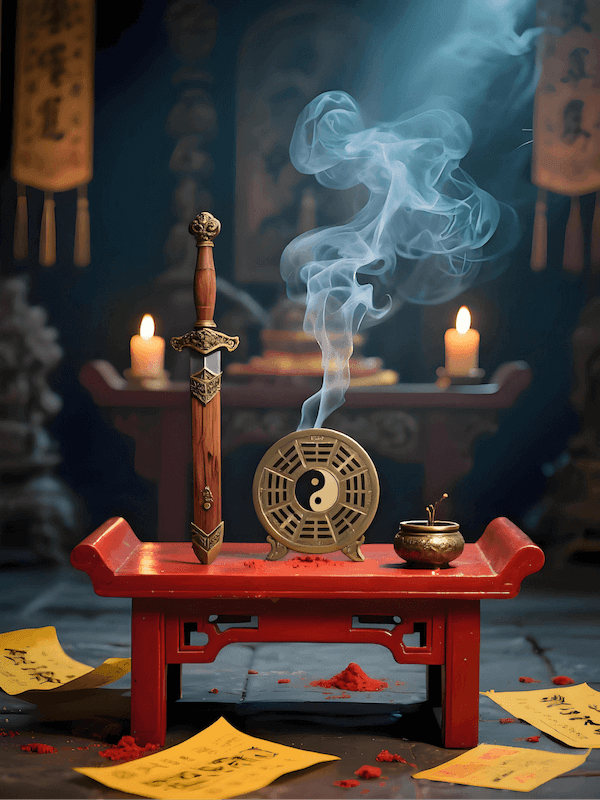
Daoism
Daoist Philosophy in Daily Life: 7 Practical Principles
Discover 7 practical Daoist principles for modern living. Learn how Wu Wei and Ziran can reduce friction at work, at home, and in relationships.
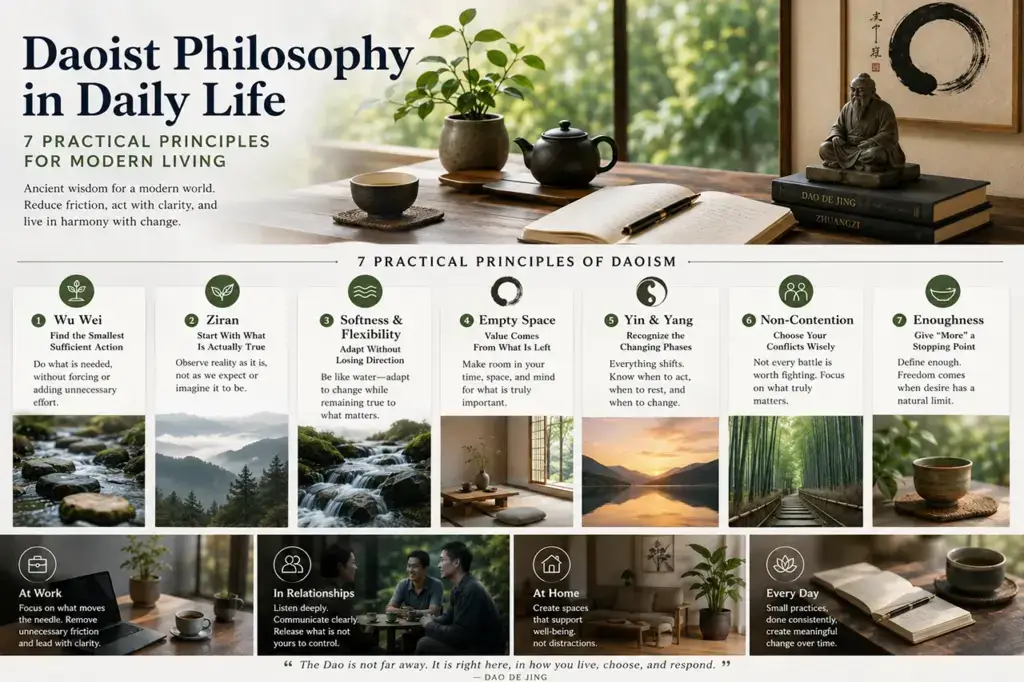
Daoist Philosophy in Daily Life: 7 Practical Principles for Modern Living
Daoist philosophy in daily life can begin with a surprisingly practical question:
Where are you using more force than the situation actually requires?
Modern life often teaches us to respond to difficulty by adding something: another productivity system, another meeting, another purchase, another explanation, or another attempt to control what happens next.
Daoist thought often begins in the opposite direction.
What is already happening? What are you adding that does not help? What can be simplified? And what is the smallest action that would genuinely change the situation?
These questions help explain why ideas associated with the Daodejing and Zhuangzi still feel relevant to work, relationships, decision-making, consumption, and the way we organize our homes.
For readers exploring Taoist philosophy in everyday life, this distinction matters. Daoism becomes less useful when reduced to inspirational slogans and more useful when it helps us examine conditions, effort, timing, and change.
If you are new to the tradition, start with what Daoism is and how the tradition developed.
Daoist philosophy does not give us a formula for controlling every outcome.
It offers a different way to understand how and when to act.
What Does Daoist Philosophy Change in Everyday Life?
Daoism is a broad Chinese philosophical and religious tradition with a history far more complex than any list of lifestyle rules.
Classical philosophical discussions are particularly associated with texts such as the Daodejing and Zhuangzi, while religious Daoism later developed additional institutions, texts, practices, rituals, and communities.
For a modern reader, three ideas provide an especially useful starting point:
- Dao (道): the Way, or the unfolding course and patterns of things
- Wu Wei (无为): action without unnecessary forcing
- Ziran (自然): naturalness, often carrying the sense of being “self-so”
Their practical value is not that they provide one correct answer for every situation.
They change the questions we ask.
Instead of:
How do I make reality follow my plan?
we can ask:
What kind of action actually fits these conditions?
That difference is the foundation for the seven principles that follow.
1. Practice Wu Wei: Find the Smallest Sufficient Action
Wu Wei is one of the best-known Daoist concepts and one of the most frequently misunderstood.
It is sometimes translated too casually as “doing nothing.”
A more useful modern explanation is non-forcing action: acting without adding unnecessary pressure, interference, or complication.
Imagine trying to open a door.
You push, but it does not move.
You could push harder.
Or you could first check whether the door opens toward you.
The example is simple, but the principle is important:
More effort is not always more effective.
A Simple Wu Wei Example
Suppose a project has stopped moving.
Adding more meetings, reminders, or urgency may feel productive. But if the real bottleneck is unclear decision ownership, clarifying one responsibility may achieve more than adding another process.
This is one practical way to understand Wu Wei in daily life.
The Smallest Sufficient Action
A useful modern way to translate this principle is:
Look for the smallest sufficient action.
Not the easiest action.
Not the least responsible action.
The smallest action that genuinely changes the conditions.
Try This Today
Before adding more effort, ask:
What is actually preventing movement here?
Then address the obstacle rather than automatically increasing pressure.
2. Practice Ziran: Start With What Is Actually True
Ziran (自然) is commonly translated as “naturalness” or “spontaneity.”
It should not be reduced to “do whatever feels natural.”
A more useful approach is:
Observe the character of a situation before imposing an unnecessary idea of what it should become.
Ziran in Personal Decisions
Imagine two people choosing careers.
One genuinely enjoys long periods of independent analytical work. The other becomes energized by conversation, collaboration, and fast-changing environments.
Neither is inherently better.
Difficulty begins when someone spends years trying to perform a version of life that is poorly matched with their temperament, abilities, or circumstances.
Ziran invites a different question:
What becomes possible when I stop pretending the conditions are different from what they are?
Separate Observation From Expectation
Write two sentences:
What is happening:
“Three people have delayed the decision.”
What I expected:
“They should already have agreed.”
The first describes conditions.
The second describes your relationship to those conditions.
Expectations are not automatically wrong. But when expectations are mistaken for facts, we start responding to an imagined version of the situation rather than the real one.
A Simple Ziran Practice
When something frustrates you, describe it once without using words such as:
should
always
never
obviously
supposed to
Notice what remains when expectation is temporarily removed.
3. Learn From Softness and Flexibility
Daoist texts frequently use images of softness, water, yielding, and flexibility to question the assumption that strength must always look rigid or forceful.
This does not mean becoming weak, indecisive, or unable to hold a boundary.
It means recognizing that adaptability can sometimes achieve what rigidity cannot.
A branch that never bends may break under pressure.
Water changes shape around obstacles without losing its direction.
The modern lesson is not:
“Always give way.”
It is:
Do not confuse stiffness with strength.
Flexibility in Decision-Making
Imagine you planned an entire week around one assumption, but the circumstances suddenly change.
A rigid response says:
“I already made the plan, so I must follow it.”
A more flexible response asks:
What part of the original goal still matters, and what part of the plan can change?
The goal may remain.
The method may not need to.
Flexibility Without Losing Direction
Adaptability is most useful when it preserves what matters while allowing the method to change.
You can change:
- timing
- sequence
- tools
- communication style
- route
- level of effort
without abandoning the underlying purpose.
A Practical Question
When a plan stops fitting reality, ask:
What needs to remain firm, and what is free to change?
That distinction often prevents unnecessary struggle.
Daoist Practice at a Glance
| Context | High‑Friction Mindset | Daoist Practice |
|---|---|---|
| Work | Add more meetings, reports, and monitoring | Identify the real bottleneck and take the smallest sufficient action — Wu Wei |
| Decision‑Making | Force the original plan after conditions change | Preserve the goal while allowing the method to adapt |
| Conflict | Correct every detail and try to win | Identify what truly needs a response and practice selective non‑contention |
| Home | Fill every empty area with more objects | Preserve useful open space and choose objects intentionally |
| Research | Keep searching because certainty feels safer | Recognize when the available information is sufficient to act |
The common thread is not “always do less.”
It is:
Do not add force, rigidity, complexity, or conflict unless it serves the situation.
4. Understand the Usefulness of Empty Space
One of the Daodejing’s most memorable observations is that usefulness often depends on what is absent.
The empty center helps make a wheel usable.
The empty interior makes a vessel useful.
Open space within walls allows a room to function.
For modern life, the principle is remarkably practical:
Not everything valuable has to be added.
Empty Space in a Schedule
A calendar filled to maximum capacity may look efficient.
It is also fragile.
One delayed conversation, unexpected task, or travel problem can put the entire day under pressure.
Intentional open time gives a schedule room to absorb reality.
Empty Space at Home
The same principle applies to physical space.
An object can often be appreciated more clearly when it is not surrounded by many competing objects.
A desk does not need to be empty.
It needs enough space to perform its purpose.
Empty Space in Conversation
Silence also has a function.
You do not need to fill every pause.
A few seconds may give another person time to think and give you time to decide whether your next sentence actually needs to be said.
Try Leaving One Thing Unfilled
Leave:
- ten minutes in the calendar
- part of a shelf
- a pause before replying
- one evening without another planned task
The empty space is not always unfinished space.
Sometimes it is what makes everything around it usable.
5. Use Yin and Yang to Notice Changing Phases
Yin and Yang are among the most recognizable concepts in Chinese thought.
They are often oversimplified as good versus bad, positive versus negative, or strong versus weak.
That misses their more useful meaning.
Yin and Yang describe relational and changing qualities.
Activity gives way to rest.
Expansion can be followed by contraction.
Speaking alternates with listening.
Brightness becomes meaningful in relation to darkness.
Historically, Yin-Yang theory belongs to the wider development of Chinese thought and should not be described as something created exclusively by Daoism.
Its relevance here lies in what it teaches us about transitions between modes.
Yin and Yang at Work
Modern work culture often rewards one side of the cycle:
produce
expand
speak
launch
respond
Useful work also requires:
review
listen
edit
pause
recover
observe
The aim is not to achieve a mathematically perfect 50/50 state.
Conditions keep changing.
The more useful question is:
Has one mode continued beyond the point where it remains useful?
Notice the Transition Point
After months of research, another month of research may add little value.
Action may now be needed.
After weeks of constant execution, another push may not improve the result.
Review may be needed.
Daoist thinking is especially useful at these transition points.
6. Practice Non-Contention: Choose Your Conflicts Carefully
Daoist texts repeatedly question unnecessary aggression, domination, and competition.
This does not require avoiding disagreement.
The practical insight is more precise:
Not every conflict deserves the same amount of energy.
Non-Contention Is About Selection
Imagine someone makes an inaccurate statement about you.
You could correct every detail.
You could clarify only the part that materially affects the situation.
Or you could decide that this particular misunderstanding requires no response.
Non-contention therefore asks a specific question:
Is this conflict worth entering?
Three Questions Before You Argue
Ask:
- Does this actually need correcting?
- Is this the right moment to correct it?
- What improves if I win this point?
Some issues deserve direct engagement.
Others do not.
Knowing the difference is part of practical judgment.
7. Practice Enoughness: Give “More” a Stopping Point
Modern consumer culture is extremely good at producing unfinished desire.
There is always a newer device, another course, another improvement, another productivity method, or another opinion to read.
Daoist philosophy repeatedly raises questions about accumulation and desire without a natural stopping point.
This is not an argument against possessions, comfort, beauty, ambition, or craftsmanship.
The deeper issue is whether enough has ever been defined.
Enoughness in Everyday Life
The principle can apply to:
- money
- possessions
- clothing
- information
- social media
- work
- hobbies
- research
- revisions
- self-improvement
Without a definition of enough, improvement has no finish line.
Define Completion Before You Begin
Before researching, expanding, editing, or improving something, ask:
What would enough look like here?
A project does not necessarily need another revision because another revision is possible.
A decision does not necessarily require another ten articles because more information exists.
Preparation does not automatically become better simply because it becomes longer.
“Enough” gives more a stopping point.

The Daoist Friction Test: Four Steps for Difficult Situations
The Daoist Friction Test is a modern Daoism Light editorial framework inspired by several Daoist ideas discussed above.
It is not an ancient Daoist ritual, historical formula, or traditional four-step teaching.
Use it when a situation begins to feel harder than it needs to be.
Step 1: What Is Actually Happening?
Describe the objective conditions without prediction, blame, or imagined motives.
Instead of:
“They clearly do not respect my work.”
begin with:
“They have not replied to the last two messages.”
Facts give you something real to respond to.
Step 2: Where Am I Adding Friction?
Check whether you are adding effort that does not improve the situation.
Possible signs include:
- repeating yourself
- excessive persuasion
- unnecessary urgency
- micromanagement
- perfectionism
- trying to control another person’s reaction
- adding activity because uncertainty feels uncomfortable
Step 3: What Is the Smallest Sufficient Action?
Identify the one action most likely to materially improve the conditions.
It might be:
- one clear email
- one decision
- one boundary
- one removed step
- one conversation
- one deliberate period of waiting
Step 4: What Can Remain Unresolved for Now?
Allow some uncertainty to remain when immediate closure is unnecessary.
Taking appropriate action does not mean controlling everything that happens afterward.
The Four-Step Test in Practice
Suppose an important email has not been answered.
Step 1 — What is actually happening?
The message has not been answered.
Step 2 — Where am I adding friction?
I am checking repeatedly and preparing several follow-ups.
Step 3 — What is the smallest sufficient action?
Send one clear follow-up.
Step 4 — What can remain unresolved?
The other person’s timing.
The principle behind the framework is simple:
Do not confuse friction with progress.
Where Do the Five Elements Fit Into Daily Life?
Wood, Fire, Earth, Metal, and Water are collectively known as Wu Xing (Five Elements).
They are frequently discussed alongside Daoist philosophy and Feng Shui, but historical accuracy matters.
Wu Xing developed within the wider history of Chinese correlative thought and has been used across philosophical, cosmological, medical, and cultural traditions.
It should not be described as an exclusively Daoist invention.
For modern readers, one useful way to approach Wu Xing is as a language of process and transformation.
| Element | Traditional Pattern | Reflective Modern Reading |
|---|---|---|
| Wood | Growth and emergence | Beginning, developing, expanding |
| Fire | Heat and expression | Activity, visibility, intensity |
| Earth | Centering and support | Consolidating, supporting, integrating |
| Metal | Contraction and definition | Refining, editing, setting boundaries |
| Water | Flow and adaptation | Adjusting, moving, responding |
This does not mean every person needs to identify themselves as one element.
A more practical question is:
What kind of movement does this situation need now?
An idea may need Wood-like expansion.
A complicated project may need Metal-like refinement.
A scattered period may benefit from Earth-like consolidation.
Changing conditions may call for Water-like adaptation.
Used this way, Wu Xing becomes a language for observing change rather than a rigid personality label.
How to Apply Daoist Philosophy at Work
Work is one of the clearest places to apply these ideas because modern organizations often mistake visible activity for useful movement.
Instead of asking:
How do I make everyone move faster?
ask:
What is slowing the system down?
Instead of:
How do I control every result?
ask:
What conditions make a good result more likely?
Instead of:
How do I look productive?
ask:
What actually needs to be completed?
Leadership and Wu Wei
For leaders, this becomes a question of where intervention adds value.
Sometimes leadership requires making a fast decision.
At other times, it means clarifying ownership, simplifying approval, removing a bottleneck, or allowing capable people to work without continuous interruption.
The aim is not less leadership.
It is more precise leadership.
For a deeper application of this principle, explore Wu Wei leadership in delegation, responsibility, and modern team management.
How to Apply Daoist Philosophy to Relationships
Relationships introduce a different question from non-contention.
Non-contention asks:
Is this conflict worth entering?
Relationships also require us to ask:
Which part of this interaction actually belongs to me?
You can communicate clearly.
You can establish a boundary.
You can listen without agreeing.
You can apologize without controlling whether the apology is accepted.
You can make a decision without controlling another person’s emotional response.
A Useful Relationship Boundary
Ask:
What is mine to say or do—and what response belongs to the other person?
This distinction preserves responsibility without turning another person’s thoughts, feelings, or timing into something you believe you must manage.
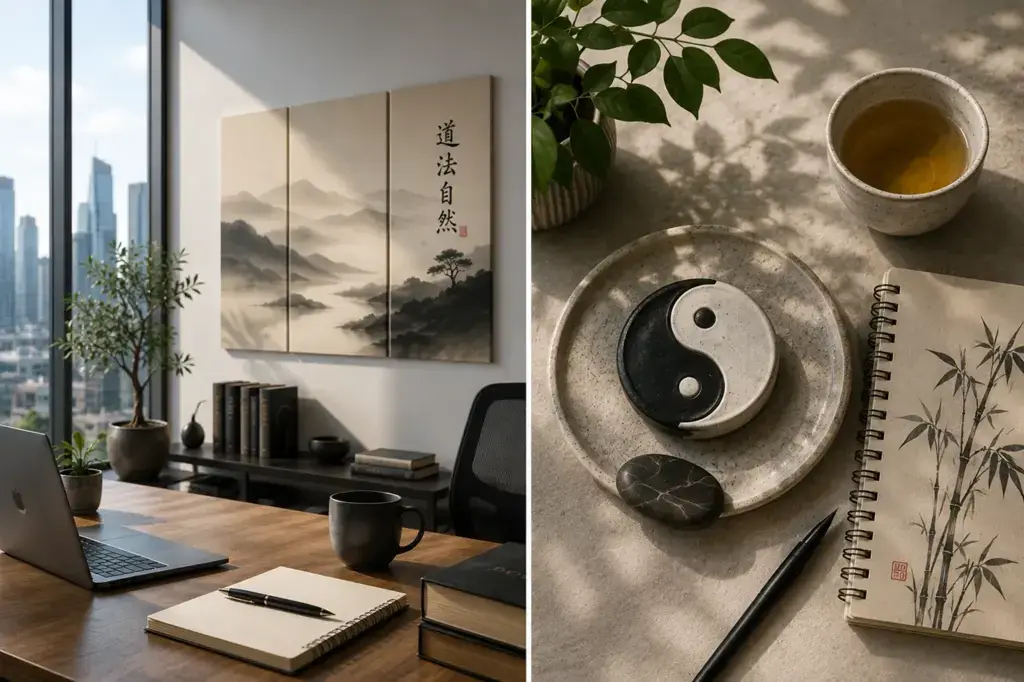
How to Apply Daoist Philosophy at Home
A home can make philosophical ideas visible.
That does not mean there is one correct “Daoist interior style.”
More useful principles include:
- leave room for movement
- choose objects deliberately
- use materials you genuinely appreciate
- give meaningful objects space to be noticed
- organize according to function rather than accumulation
- understand cultural symbols before displaying them
For a more detailed discussion of space, function, and symbolism, see our guide to Daoist home decor placement.
Why Physical Objects Can Matter
Abstract ideas are easy to forget.
Physical objects can become reminders.
A thoughtfully chosen Taiji symbol may remind someone to notice changing conditions rather than treating one state as permanent.
A Five Elements design may encourage thinking in processes rather than fixed categories.
A study-related cultural symbol may give a desk or reading area a clearer sense of intention.
Their most credible modern role is not to control external outcomes, but to give an idea a visible place in everyday life.
A Five-Minute Daoist-Inspired Daily Practice
You do not need an elaborate routine.
Try three short moments instead.
Morning: Observe
Before opening messages or social media, ask:
What are the actual conditions of today?
Notice your available time, responsibilities, energy, and priorities before deciding how the day should unfold.
Midday: Reduce
Identify one source of unnecessary friction.
Remove one step.
Clarify one decision.
Stop repeating one action that is not helping.
Evening: Release
Ask:
What was mine to do today, and what no longer needs my attention tonight?
Then allow the day to end.
Keep the Practice Small
A practice about reducing excess should not become another complicated obligation.
The point is not to perform Daoism perfectly.
The point is to notice more clearly.
Common Misunderstandings About Daoist Living
Wu Wei Means Laziness
It does not.
The important question is not whether action occurs, but whether the action fits the conditions without unnecessary forcing.
Ziran Means Following Every Impulse
Naturalness is not the same as acting on every passing feeling.
Observation, context, and self-awareness still matter.
Yin and Yang Mean Good and Bad
They describe relational and changing qualities, not a moral scoreboard.
Every Chinese Tradition Is Basically the Same
Daoism, Yin-Yang thought, Wu Xing, the Yijing, Feng Shui, Chinese medicine, folk traditions, and later religious practices have influenced one another historically.
They should still not be collapsed into a single system.
The Deeper Lesson: Match Effort to Reality
The most useful lesson in Daoist philosophy may not be “do less.”
Sometimes a situation requires substantial effort.
Sometimes it requires a fast decision.
Sometimes it requires patience.
Sometimes it requires leaving.
The more interesting question is:
Does the effort match the reality of the situation?
This creates a different definition of effectiveness.
Not:
How much did I do?
But:
Did what I did belong here?
That question can be applied to leadership, relationships, spending, home organization, study, communication, and decision-making.
Because it depends on observing changing conditions rather than obeying a rigid formula, it remains useful when circumstances change.
Final Thoughts
Applying Daoist philosophy in daily life does not require turning ordinary life into a performance of spirituality.
Observe before assuming.
Address the real obstacle before adding effort.
Stay flexible when conditions change.
Leave space where space has a function.
Notice when one phase needs to give way to another.
Choose conflicts deliberately.
Define what “enough” means before “more” becomes endless.
For anyone exploring Taoist philosophy in everyday life, the goal is not to imitate an ancient lifestyle or turn every decision into a philosophical exercise.
The practical value is simpler:
to participate more intelligently in conditions that are always changing.
FAQ
Is Daoism Practical for Someone With a Busy Modern Life?
Yes.
You do not need to change your entire lifestyle or create a complicated spiritual routine.
Many Daoist ideas can be applied to ordinary situations such as deciding what deserves your attention, simplifying a process, handling disagreement, or recognizing when further effort is no longer helping.
Does Wu Wei Mean I Should Stop Trying When Something Is Difficult?
No.
Difficulty by itself does not mean you should stop.
Wu Wei is more useful as a way of asking whether your effort is actually addressing the problem.
Sometimes the appropriate response is persistence. At other times, changing the method, timing, or direction is more effective than simply applying more force.
Can I Practice Wu Wei If I Have Deadlines and Responsibilities?
Yes.
Wu Wei does not require avoiding deadlines or responsibility.
You can still plan, make decisions, and work intensely when necessary.
The practical question is whether each action contributes to the result, or whether some of your effort is being spent on unnecessary meetings, repeated checking, overexplaining, or trying to control things outside your responsibility.
Is “Going With the Flow” an Accurate Description of Daoism?
Only partly.
The phrase can be useful as a simple introduction, but it can also make Daoism sound passive.
Sometimes adapting to circumstances is appropriate. At other times, the situation requires a firm decision, a boundary, or immediate action.
The important issue is not simply going along with whatever happens, but responding in a way that fits the actual conditions.
Do I Need Daoist Symbols or Objects to Practice These Ideas?
No.
An object is not required to understand or apply Daoist philosophy.
Some people enjoy using a Taiji design, Five Elements motif, or another cultural object as a visual reminder of an idea they have already learned.
Others may prefer books, journaling, observation, or no physical reminder at all.
If I Buy a Daoist-Inspired Object, How Should I Choose One?
Start with meaning rather than quantity.
Ask whether you understand the symbol, genuinely appreciate the design or craftsmanship, and have a natural place for it in your home or routine.
A cultural object usually becomes more meaningful when you know what you are looking at.
Related Articles
- What Is Daoism? Understanding Its Origins and Core Ideas
- Wu Wei Leadership for CEOs
- How Daoism Influences Feng Shui
- Bagua vs. Yin Yang: What Is the Difference?
Author Note
Written by the Daoism Light editorial team, this article was created for readers who want to explore Daoist philosophy and symbols in a clear, modern, and culturally respectful way.
Here, we approach Daoist-inspired ideas and objects through their philosophical depth, historical background, craftsmanship, and thoughtful role in everyday life.
We do not present these pieces as magical guarantees or exaggerated spiritual shortcuts. Instead, we see them as cultural, aesthetic, and contemplative anchors — meaningful accents that can give ideas a visible place in modern life.