
 Daoism Light Brass Dragon Statue with Pearl Desk Decor
 Daoism
Wu Wei Leadership for CEOs: Taoist Non-Forcing for Better Team Management
Wu Wei Leadership helps CEOs manage teams with clarity, trust, and less unnecessary control. Learn how Taoist non-forcing can improve delegation, decision-making, culture, and sustainable business growth.
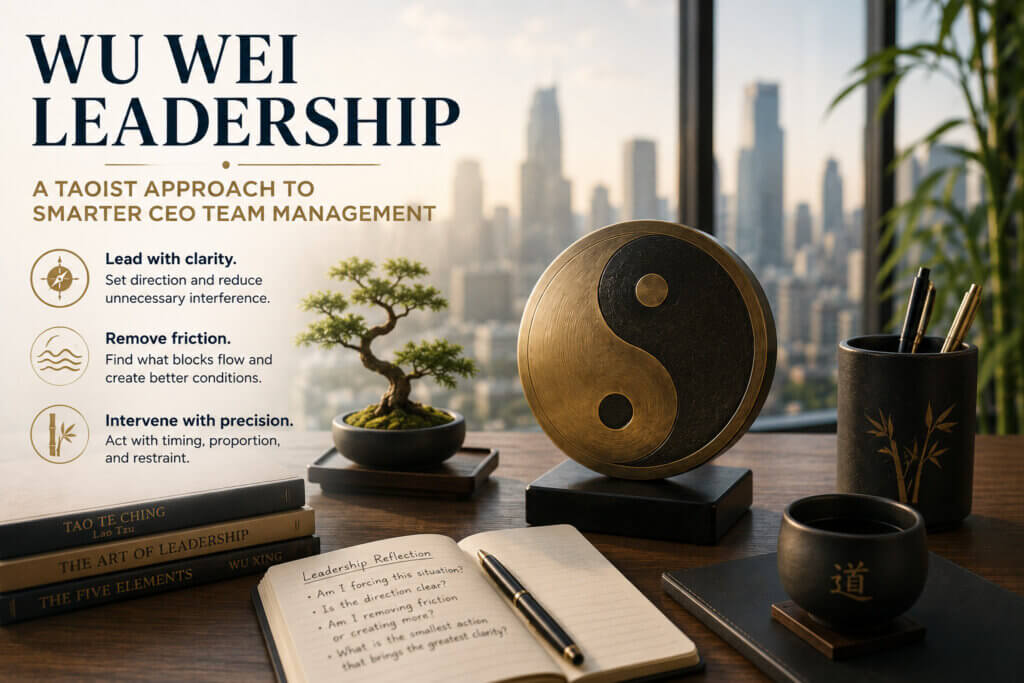
Wu Wei Leadership: A Taoist Approach to Smarter CEO Team Management
In modern business, many CEOs are taught to lead by pushing harder, monitoring more closely, and making every important decision themselves. At first, this may look like strength. A highly involved CEO can appear decisive, responsible, and deeply committed.
But over time, excessive control often creates a hidden problem.
The team becomes slower.
Managers stop making independent decisions.
Employees wait for approval.
The CEO becomes the center of every important movement.
When this happens, leadership no longer creates momentum. It creates dependency.
Wu Wei Leadership offers a different way to understand power, responsibility, and team management.
Rooted in Taoist philosophy, Wu Wei is often translated as “non-action,” but that phrase can easily be misunderstood. In leadership, Wu Wei is better understood as disciplined, well-timed action without unnecessary force. It is the ability to guide without over-controlling, to step back without disappearing, and to let capable people take real responsibility when the conditions are clear.
For CEOs, this is not an abstract spiritual idea. It is a practical leadership principle.
A CEO who understands Wu Wei does not abandon responsibility. Instead, they design better systems, choose better people, create clearer direction, and reduce unnecessary interference. The result is not passive management. It is calmer, sharper, and more sustainable leadership.
What Is Wu Wei Leadership?
Wu Wei Leadership is a management approach inspired by the Taoist idea of effortless action. It teaches leaders to stop confusing control with effectiveness.
In team management, Wu Wei means leading in a way that creates movement without excessive pressure.
It means:
- setting direction without controlling every step
- giving ownership instead of constant instructions
- removing obstacles instead of simply demanding speed
- observing before reacting
- acting at the right time, with the right amount of force
- allowing the team to develop judgment, rhythm, and responsibility
A CEO practicing Wu Wei remains highly aware of what is happening, but does not turn awareness into constant interference.
This distinction matters.
There is a difference between absence and restraint.
Absence means the leader has stopped paying attention.
Restraint means the leader understands that excessive intervention can weaken ownership, slow judgment, and make the team dependent.
Wu Wei Leadership is not softness. It is precision with self-control.
Why Wu Wei Leadership Matters for CEOs Today
Modern teams rarely fail because everyone is lazy. More often, they struggle because the organization itself creates friction.
Priorities are unclear.
Meetings are excessive.
Decision rights are vague.
Approvals take too long.
Managers are afraid to make mistakes.
The CEO keeps stepping in, so the team never fully grows.
Many CEOs want high-performing teams, but their own management habits can unintentionally prevent that performance from emerging.
Wu Wei Leadership helps CEOs shift from direct control to system design.
Instead of asking, “How do I make everyone do this?”
The CEO begins asking, “What structure, clarity, and authority would make the right work easier to do?”
That question changes the leader’s role from constant driver to thoughtful architect.
The Common CEO Trap: Becoming the Center of Everything
In early-stage businesses, the founder or CEO often solves everything personally. This can be necessary at the beginning. When the company is small, speed often depends on one person’s attention, taste, judgment, and urgency.
But as the business grows, the same habit becomes dangerous.
When every decision needs the CEO, three problems appear:
- The team stops thinking independently.
- The CEO becomes exhausted.
- The company cannot scale beyond one person’s attention.
At this stage, more control does not create more performance. It creates a ceiling.
Wu Wei Leadership helps CEOs move from:
“I must control every outcome.”
to:
“I must build a system where good decisions, clear ownership, and responsible action become easier.”
This is a subtle but powerful shift.
Less Control Does Not Mean Lower Standards
One common misunderstanding is that non-forcing means weakness, softness, or lack of ambition.
In Taoist thinking, Wu Wei is not weak. It is intelligent alignment.
A river does not force its way through stone by shouting at it. It follows the terrain, adapts to resistance, and over time becomes powerful. In leadership, this means the CEO does not need to fight every small issue directly. They need to understand the deeper pattern behind the problem.
If a team constantly misses deadlines, the answer may not be more pressure. The deeper issue may be:
- unclear ownership
- too many competing priorities
- weak project structure
- fear of speaking honestly
- lack of decision authority
- poor communication between departments
Wu Wei Leadership asks the CEO to address the operating pattern behind the symptom, rather than only reacting to what is visible on the surface.
This is why it can be highly practical in modern management.
The Taoist Meaning Behind Wu Wei
In Taoist philosophy, Wu Wei describes a way of acting that follows the natural order of things. It does not mean avoiding action. It means avoiding forced, excessive, ego-driven action.
For leadership, this idea is especially relevant because many leaders act from anxiety.
They interrupt because they fear mistakes.
They over-explain because they do not trust the team.
They rush decisions because silence feels uncomfortable.
They add rules because uncertainty makes them nervous.
They join every discussion because they fear losing control.
Wu Wei invites a different kind of leadership: one based on observation, timing, proportion, and trust.
This does not reduce the leader’s responsibility. It deepens the leader’s awareness of how every intervention affects judgment, confidence, and culture inside the team.
A CEO’s behavior does not happen in isolation. Every reaction teaches the team what kind of culture they are living in.
If the CEO reacts with panic, the team learns panic.
If the CEO punishes every mistake, the team learns fear.
If the CEO changes direction constantly, the team learns instability.
If the CEO gives clear direction and measured space, the team learns ownership.
Wu Wei is therefore not just a personal leadership style. It is a cultural force.
Wu Wei Is About Timing
A wise CEO does not act at every moment. They act at the right moment.
Sometimes the team needs direct guidance.
Sometimes they need space to test their judgment.
Sometimes a problem should be corrected immediately.
Sometimes it should be observed long enough to understand its true cause.
This is where Wu Wei becomes a leadership skill rather than a slogan.
The question is not simply:
“Should I act or not act?”
The better question is:
“What kind of action is truly needed here?”
A poorly timed action can create more confusion. A well-timed action can unlock the entire team.
Wu Wei Is About Proportion
Some leadership problems require strong action. Others require only a small adjustment.
A CEO who uses the same level of force for every issue creates stress inside the company. Minor mistakes become dramatic. Employees become afraid to make decisions. The team waits for approval instead of building confidence.
Wu Wei teaches proportion.
Not every problem needs a meeting.
Not every mistake needs a speech.
Not every disagreement needs executive intervention.
Not every delay means someone is careless.
Sometimes the most effective leadership move is to clarify one sentence, remove one obstacle, or ask one better question.
This kind of restraint is not laziness. It is maturity.
How CEOs Can Apply Wu Wei Leadership in Team Management
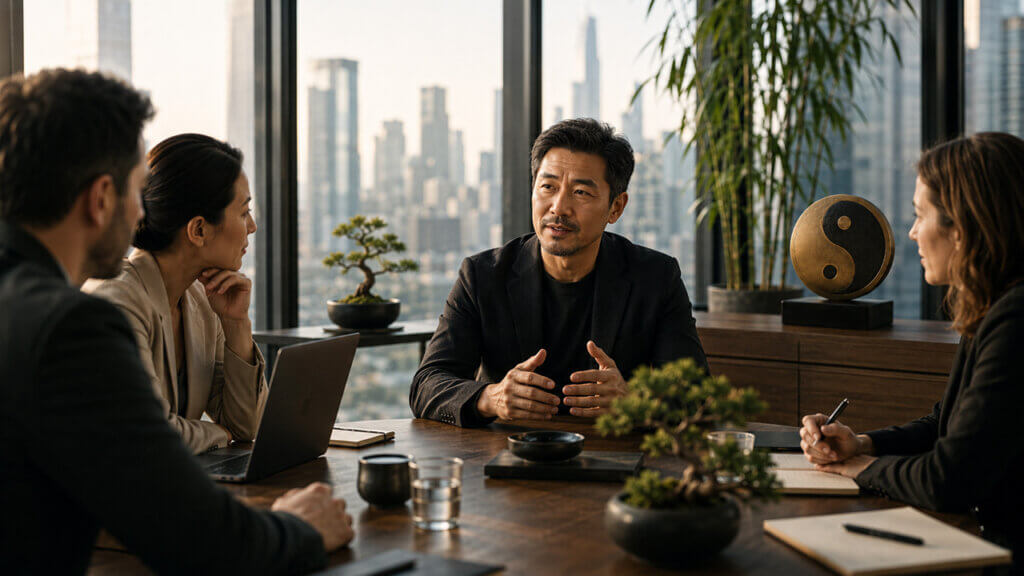
Wu Wei Leadership becomes valuable when it moves from philosophy into daily management.
Below are practical ways a CEO can apply this principle.
1、Set Direction, Then Stop Over-Managing the Path
A CEO’s role is not to walk every step for the team. The CEO’s role is to define the mountain.
In practical terms, this means the leader should make the destination clear:
- What are we trying to achieve?
- Why does it matter?
- What must not be compromised?
- What does success look like?
- Who owns the outcome?
- What decisions can the team make without asking again?
Once direction is clear, the team should have room to choose the path.
This is not a lack of leadership. It is a better use of leadership.
Practical CEO Example
Instead of saying:
“Do it exactly this way.”
A Wu Wei-style CEO might say:
“The goal is to improve customer retention by making the onboarding experience clearer. I want the first proposal by Friday. You own the process. Bring me the key trade-offs, not every small detail.”
This gives direction without suffocating execution.
It also signals trust. The team understands what matters, but they are not reduced to following instructions mechanically.
2、Replace Micromanagement with Clear Ownership
Micromanagement often appears when ownership is unclear.
If nobody truly owns the result, the CEO feels forced to step in. But stepping in repeatedly only teaches the team that responsibility ultimately belongs to the CEO.
Wu Wei Leadership solves this by making ownership explicit.
A strong ownership structure includes:
- one clear owner
- a defined outcome
- decision boundaries
- reporting rhythm
- visible accountability
- freedom within agreed limits
The CEO does not need to chase every detail when ownership is designed properly.
Better Management Question
Better Management Question
Instead of asking:
“Why didn’t you ask me before doing this?”Ask:
“What decision rights were unclear, and how can we define them better next time?”
This question improves the system instead of simply blaming the person.
A Wu Wei-style CEO does not only ask, “Who made the mistake?”
They also ask, “What condition allowed this mistake to become likely?”
That second question is where better management begins.
3、Create Fewer, Better Meetings
Many companies use meetings as a substitute for trust.
When leaders feel uncertain, they add more check-ins. But too many meetings can fragment attention and make deep work almost impossible.
Wu Wei Leadership encourages CEOs to reduce unnecessary noise.
Good meetings should exist for one of four reasons:
- to make a decision
- to solve a real blockage
- to align on direction
- to review meaningful results
If a meeting does none of these, it may be organizational clutter.
Wu Wei Meeting Rule
Wu Wei Meeting Rule
Before adding a meeting, ask:
“Will this meeting remove friction, or will it create more?”
This single question can improve team rhythm immediately.
A meeting should create clarity. If it only creates reporting pressure, it may be weakening the system.
4、Observe Before Intervening
A CEO often sees problems quickly. But seeing a problem is not the same as understanding it.
Wu Wei Leadership values observation before action.
For example, if a team member is underperforming, the obvious response may be pressure. But the deeper cause could be:
- unclear expectations
- poor role fit
- lack of training
- too many competing priorities
- personal burnout
- weak communication between teams
- unrealistic deadlines
A CEO who reacts too fast may treat the wrong problem.
Observation does not mean ignoring the issue. It means gathering enough understanding to act accurately.
Leadership Reflection Question
Before stepping in, ask:
“Am I solving the real problem, or am I reacting to the discomfort this problem creates in me?”
This is one of the most important questions a CEO can ask.
Many leadership mistakes happen because the leader acts to reduce their own anxiety, not to improve the system.
5、Remove Friction Instead of Adding Force
One of the most useful ways to understand Wu Wei Leadership is this:
Do not push harder until you understand what is blocking flow.
If a team is slow, the answer is not always “work faster.” The answer may be to remove friction.
Common sources of friction include:
- unclear priorities
- too many approval layers
- vague roles
- outdated tools
- conflicting instructions
- fear of making mistakes
- too much reporting
- too little decision authority
A CEO who removes these obstacles can improve speed without creating unnecessary pressure.
This reflects a practical side of Taoist thinking: progress often comes not from forcing more effort, but from understanding where energy is being blocked.
Practical Friction Audit
Friction Audit for CEOs
Ask your team:
“What slows you down that does not actually improve quality?”Then listen carefully.
The answer may reveal more about your company than another performance review.
This kind of question creates both operational insight and cultural trust.
6、Let Capable People Become Capable
A team cannot become mature if the CEO constantly rescues it.
This is difficult for many founders. They may know the business better than anyone. They may see mistakes coming earlier than others. But if they solve every issue too quickly, the team never develops judgment.
Wu Wei Leadership requires patience.
Not passive patience, but developmental patience.
A CEO should allow team members to experience responsibility, learn from controlled mistakes, and build decision-making strength.
When Should a CEO Step In?
The CEO should step in when:
- the mistake may seriously damage customers
- the decision affects brand trust
- legal, financial, or ethical risk is involved
- the team is clearly misaligned with company direction
- repeated behavior shows that ownership is not working
The CEO should step back when:
- the team can learn safely
- the issue is reversible
- the owner has enough context
- the cost of intervention is greater than the cost of learning
- the decision is within the agreed ownership boundary
This balance is where Wu Wei becomes practical management wisdom.
Wu Wei Leadership vs Passive Leadership
Wu Wei is often misunderstood, so it is important to separate it from passive leadership.
| Passive Leadership | Wu Wei Leadership |
| Avoids responsibility | Holds responsibility clearly |
| Ignores problems | Observes before acting |
| Gives vague direction | Gives clear direction |
| Lets confusion continue | Removes friction |
| Avoids hard conversations | Chooses the right timing |
| Has no standards | Maintains standards without excessive force |
| Disappears from the team | Stays present without micromanaging |
| Allows weak performance to continue | Addresses root causes with proportion |
Wu Wei is not “leave everyone alone.”
It is “intervene with precision.”
That is why it can be especially useful for CEOs. A CEO’s attention is expensive. The more carefully it is used, the more powerful it becomes.
How Wu Wei Leadership Builds a Healthier Company Culture
Company culture is not created by slogans. It is created by repeated behavior.
If a CEO constantly interrupts, the culture becomes reactive.
If a CEO punishes every mistake, the culture becomes fearful.
If a CEO changes direction every week, the culture becomes unstable.
If a CEO never trusts anyone, the culture becomes dependent.
Wu Wei Leadership creates a different atmosphere.
It teaches the organization that clarity matters more than noise.
It teaches managers that ownership is real.
It teaches employees that responsibility is not only demanded, but trusted.
It teaches the CEO that leadership is not measured by how often they intervene.
It Encourages Calm Execution
Teams perform better when they understand what matters and are not constantly pulled in different directions.
A Wu Wei-style CEO reduces unnecessary urgency. This does not mean moving slowly. It means not turning every issue into an emergency.
Calm execution is often faster than chaotic urgency.
Urgency can be useful in a crisis. But when everything becomes urgent, nothing is truly prioritized.
Wu Wei Leadership protects the team from false urgency.
It Builds Trust
Trust is not built by motivational speeches. It is built when people are allowed to own meaningful work.
When a CEO gives clear direction and then allows responsible space, the team feels respected. Over time, this creates stronger commitment.
Trust does not mean there are no standards.
Trust means the team knows the standards and has enough room to meet them with intelligence.
It Improves Decision Quality
When employees are trained only to ask for permission, decision-making stays weak. When they are given clear principles and real ownership, their judgment improves.
Wu Wei Leadership helps decision-making move closer to the work itself.
That is essential for growing companies.
A CEO cannot be close to every customer, every project, every detail, and every daily trade-off. A strong company needs distributed judgment.
Wu Wei helps that judgment develop.
A Practical Wu Wei Framework for CEOs
Here is a simple framework CEOs can use before stepping into a team issue.
Step 1: Observe the Pattern
Ask:
- Is this a one-time mistake or a repeated pattern?
- Is the issue caused by the person, the system, or unclear direction?
- Am I reacting from urgency, ego, or genuine necessity?
- What would I notice if I waited long enough to understand the pattern?
Step 2: Identify the Real Blockage
Ask:
- What is preventing the team from moving naturally?
- Is there confusion, fear, overload, or lack of authority?
- What obstacle can I remove?
- Is the current process helping quality or only creating control?
Step 3: Choose the Lightest Effective Action
Ask:
- Can this be solved with one clarification?
- Does it need a private conversation?
- Does it require a system change?
- Am I about to add more force than the situation needs?
The goal is not to avoid action. The goal is to avoid excessive action.
Step 4: Return Ownership to the Team
Ask:
- Who should own the next step?
- What decision rights do they need?
- How will we review progress without micromanaging?
- What should I stop doing so the owner can truly own the work?
This framework turns Wu Wei into a practical CEO decision tool.
When Wu Wei Leadership Does Not Work
For transparency, Wu Wei Leadership is not suitable for every situation.
There are moments when a CEO must act firmly and directly.
Wu Wei should not be used as an excuse to avoid:
- ethical problems
- financial risk
- legal responsibility
- repeated underperformance
- toxic behavior
- unclear company direction
- urgent customer damage
- serious brand risk
- broken trust inside the team
In these situations, “non-forcing” does not mean delay. It means the CEO should act clearly, proportionally, and without emotional excess.
Strong action can still be Wu Wei if it is necessary, timely, and aligned with the real nature of the problem.
This is an important point.
Wu Wei is not always gentle. Sometimes the most aligned action is a direct decision, a difficult conversation, or a firm boundary.
The difference is that the action comes from clarity, not panic.
The Commercial Value of Wu Wei Leadership
For a business audience, Wu Wei Leadership is not only philosophical. It can create measurable commercial value.
A CEO who practices this approach may improve:
- team speed
- decision ownership
- employee retention
- leadership focus
- operational clarity
- customer experience
- brand consistency
- long-term resilience
This matters because companies do not grow only through strategy. They grow through the quality of daily execution.
When the CEO is no longer the default checkpoint for every decision, the organization gains speed.
When teams receive clearer authority, responsibility becomes part of daily execution rather than a slogan.
When leadership becomes calmer and more consistent, culture becomes easier to trust.
In this sense, Wu Wei Leadership is not about doing less because the work is unimportant. It is about reducing the actions that weaken the system, so the actions that truly matter can become stronger.
How Daoist Objects Can Support Leadership Reflection

At Daoism Light, we do not present Daoist-inspired objects as magical guarantees. A symbol does not replace strategy, communication, hiring, training, or leadership skill.
However, symbolic objects can support reflection when they are used with the right understanding.
For a CEO, founder, manager, or creative leader, a Daoist-inspired piece on a desk, shelf, or workspace can become a quiet point of return. It can remind the leader to pause before reacting, notice the larger pattern, and return to steadier judgment when pressure rises.
This is where cultural objects become relevant to modern leadership.
They are not shortcuts.
They are not promises.
They are visual anchors for intention, rhythm, and self-awareness.
A Taiji symbol, Bagua-inspired form, Wu Xing motif, or refined brass ornament can hold meaning not because it controls outcomes, but because it helps the person remember how they want to lead.
In a modern office, this kind of object can bring cultural depth and quiet focus into a space that is often dominated by screens, speed, and constant decision pressure.
How to Bring Wu Wei Leadership Into Your Workspace
A workspace influences attention.
For CEOs and founders, the desk is not only a place of work. It is a place of decision-making. It is where difficult emails are written, hiring choices are considered, strategy is reviewed, and moments of pressure are processed.
A Daoist-inspired object can support this environment when it becomes part of a reflective routine rather than simple decoration.
Before reacting to a difficult decision, it may prompt a leader to ask:
- Am I forcing this situation?
- Have I made the direction clear?
- Am I removing friction or creating more?
- Does this issue need my control, or does it need better ownership?
- What is the smallest action that would create the greatest clarity?
This is the practical value of symbolic design.
It does not promise success.
It does not replace leadership.
It supports reflection.
For Daoism Light, this is the most respectful way to connect Daoist philosophy, modern life, and meaningful objects.
Final Thoughts: The CEO as a Designer of Conditions
The deepest lesson of Wu Wei Leadership is that a CEO should not try to control every movement inside the company.
A better CEO designs the conditions where good movement becomes natural.
That means choosing the right people, setting clear direction, removing friction, protecting focus, and intervening only when intervention truly improves the system.
Wu Wei is not passive.
It is not vague.
It is not anti-ambition.
It is disciplined restraint.
For modern CEOs, this may be one of the most valuable leadership skills of all: knowing when to act, when to wait, and how to lead without turning the whole company into a reflection of personal anxiety.
In a world that rewards noise, Wu Wei Leadership offers something rare.
Quiet strength.
Clear direction.
Trust in capable people.
And the wisdom to know that some problems are solved through better structure, calmer timing, and more mature trust.
FAQ
What is Wu Wei Leadership?
Wu Wei Leadership is a leadership approach inspired by Taoist philosophy. It means leading through clarity, timing, trust, and minimal unnecessary force. It does not mean doing nothing. It means acting only in ways that truly improve the system.
How can CEOs use Wu Wei Leadership?
CEOs can use Wu Wei Leadership by setting clear direction, giving teams real ownership, reducing unnecessary meetings, observing before reacting, and removing obstacles instead of constantly increasing pressure.
Is Wu Wei Leadership the same as passive leadership?
No. Passive leadership avoids responsibility. Wu Wei Leadership holds responsibility clearly but avoids unnecessary interference. It is about precise, timely, and proportionate action.
Can Wu Wei Leadership work in modern business?
Yes. Wu Wei Leadership can be useful in modern business because many teams suffer from over-control, unclear ownership, decision bottlenecks, and excessive meetings. The principle helps leaders build healthier systems and stronger team autonomy.
Does Wu Wei mean a CEO should never intervene?
No. A CEO should intervene when there is serious risk, ethical concern, customer harm, repeated underperformance, or clear misalignment. Wu Wei means the CEO should intervene wisely, not excessively.
How is Wu Wei different from micromanagement?
Micromanagement tries to control the process in detail. Wu Wei Leadership focuses on setting direction, defining ownership, removing friction, and allowing capable people to execute with judgment.
How is Wu Wei connected to Daoism Light products?
Daoism Light products are inspired by Daoist symbolism and Eastern aesthetics. They are not presented as magical guarantees. Instead, they can serve as cultural and contemplative reminders of balance, clarity, and intentional living.
Create a workspace that reminds you to lead with clarity, patience, and balance.
Browse Daoism Light’s symbolic decor collection and find pieces inspired by Taiji, Bagua, Wu Xing, and traditional Daoist aesthetics.
Author Note
Written by the Daoism Light editorial team, this article was created for readers who want to explore Daoist philosophy, leadership, and symbolic culture in a clear, modern, and culturally respectful way.
At Daoism Light, we approach Daoist-inspired objects through their symbolic depth, historical background, and thoughtful role in everyday life. We do not present these pieces as magical guarantees or exaggerated spiritual shortcuts. Instead, we see them as cultural, aesthetic, and contemplative anchors — meaningful accents that bring a sense of intention, balance, and quiet beauty into modern spaces.
Related Articles
- How Daoism Philosophy Influences Feng Shui
- Bagua vs Yin Yang: Understanding Two Core Symbols in Daoist Culture
- The Meaning of Wu Xing