Daoist Symbols
What Is the Meaning of Taiji? The Authentic Daoist Guide
Discover the authentic meaning of Taiji in Daoism. Learn about Taijitu, Yin-Yang balance, and how Taiji philosophy relates to change and daily life.

Table of Contents
What Is the Meaning of Taiji? A Clear Guide to Taiji in Daoist and Chinese Philosophy
The Taiji meaning is often reduced to one familiar image: a circle divided into flowing dark and light forms.
But Taiji is much more than a symbol of “balance.”
In Chinese philosophy, Taiji (太极) describes an underlying unity in which contrasting tendencies such as Yin and Yang become distinguishable, interact, and continually change.
Taiji does not simply ask us to keep two sides equal. It is not a universal diagram of good versus evil, and it is not merely another name for the familiar Yin-Yang symbol.
A more useful way to understand Taiji is as a philosophical framework for thinking about unity and difference, movement and stillness, activity and rest, continuity and change, timing and response.
Taiji is not simply about keeping opposites in balance. It is about understanding how differences emerge, relate, and change within a larger whole.
This distinction also helps explain why Taiji, Yin-Yang, Bagua, and Wu Xing are connected without being interchangeable.
What Does Taiji Literally Mean?
The Chinese term Taiji (太极) combines two characters.
Tai 太
Tai (太) can suggest something great, very great, supreme, or reaching an extreme degree.
Ji 极
Ji (极) can refer to an extreme, limit, pole, or ultimate point.
Historically, the character also carried associations with a structural ridgepole or central axis, which later made it useful in philosophical discussions involving limits, orientation, and ultimate structure.
Together, Taiji has commonly been translated as:
- Great Ultimate
- Supreme Ultimate
- Supreme Polarity
No single English translation captures everything.
“Great Ultimate” can sound as though Taiji were a supreme object or divine being.
“Supreme Polarity” is philosophically useful, but can feel abstract without explanation.
A practical definition is:
Taiji is the larger unity within which polarity and change become possible.
This is more accurate than simply saying:
“Taiji means balance.”
From Wuji to Taiji: How Does Differentiation Begin?
Taiji becomes clearer when placed beside another important Chinese philosophical term:
Wuji (无极).
A simplified conceptual sequence used in later Chinese cosmological thought is:
Wuji → Taiji → Yin and Yang → increasingly differentiated patterns
Or:
Wuji — undifferentiated condition
↓
Taiji — unity capable of differentiation
↓
Yin and Yang — relational polarity
↓
More complex patterns of change
This should not be read as a scientific timeline describing the physical creation of the universe.
It is better understood as a philosophical model showing how difference can emerge from unity.
What Is Wuji?
Wuji can be understood as a condition in which clearly defined poles or distinctions have not yet appeared.
The emphasis is on the absence of fixed differentiation.
What Changes With Taiji?
With Taiji, unity remains, but distinction becomes possible.
Yin and Yang can now be discussed as recognizable yet interdependent tendencies.
Wuji emphasizes the undifferentiated. Taiji describes unity beginning to express polarity.
This distinction makes the relationship between Taiji and Yin-Yang much easier to understand.
Is Taiji the Same as the Yin-Yang Symbol?
Not exactly.
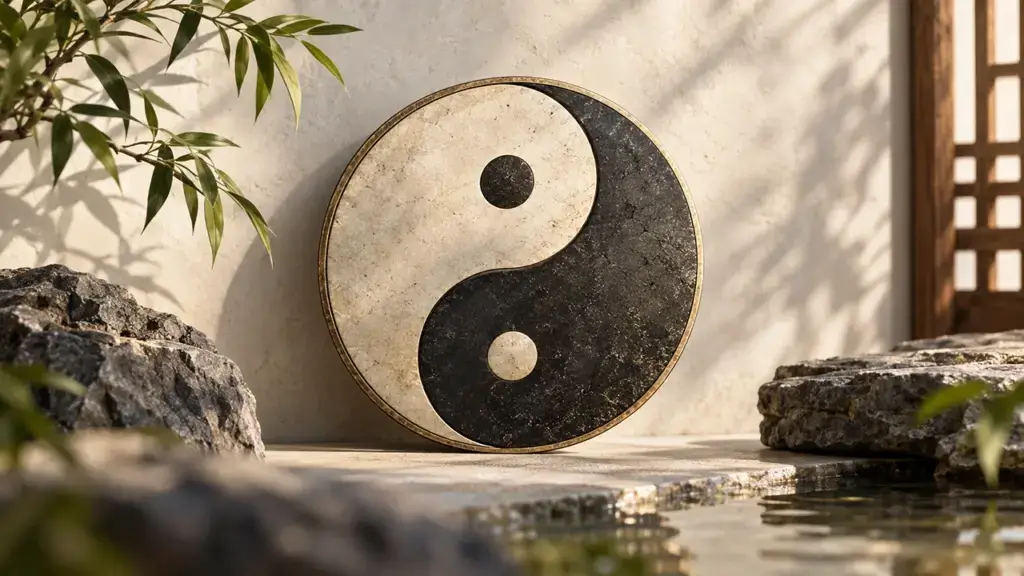
The familiar circular image is commonly called the Yin-Yang symbol in English.
A more precise term is:
Taijitu (太极图) — literally, a diagram of Taiji.
Three related ideas should be separated.
| Term | Basic Meaning | What It Describes |
|---|---|---|
| Taiji 太极 | Great Ultimate / Supreme Polarity | The philosophical framework of unity and differentiation |
| Yin-Yang 阴阳 | Complementary relational tendencies | How polarity operates through change |
| Taijitu 太极图 | Diagram of Taiji | A visual representation of those relationships |
Taiji is the concept. Yin and Yang describe the polarity. Taijitu visualizes the relationship.
For a deeper comparison, read Bagua vs Yin Yang: What Is the Difference?.
How to Read the Taijitu Symbol
The Taijitu looks simple, but several visual elements work together.
| Taijitu Element | Useful Interpretation |
|---|---|
| Outer circle | The larger whole within which difference appears |
| Dark and light regions | Contrasting but interdependent Yin and Yang tendencies |
| Curved dividing line | Movement, transition, and changing proportion |
| Contrasting dots | The presence or possibility of one tendency within the other |
These elements are best read together rather than treated as a rigid code.
The central visual idea of the Taijitu is that difference does not require complete separation.
The Outer Circle
Both Yin and Yang remain within the same form.
Neither exists outside the whole.
This makes the outer circle a useful visual expression of unity containing difference.
Day and night are different, yet both belong to one daily cycle.
Movement and stillness are different, yet both belong to one rhythm.
Beginning and completion are different, yet both can belong to the same process.
The Curved Boundary
A straight line would divide the circle into two fixed blocks.
The curved boundary creates movement.
It suggests expansion, contraction, transition, and changing proportion.
One region appears to widen while the other narrows.
Then the relationship gradually reverses.
Taiji is better understood as a changing process than as a permanently fixed state.
The Contrasting Dots
The dots are often summarized through the expression:
Yin within Yang, Yang within Yin.
The idea is not that everything contains an exact mathematical amount of its opposite.
Instead, it suggests that conditions are rarely absolute.
Within a period of intense activity, the need for rest may already be developing.
Within a quiet phase, the conditions for future action may already be forming.
At noon, daylight remains dominant, yet the cycle is already moving toward evening.
At midnight, darkness dominates, but the cycle is already moving toward morning.
A dominant condition can already contain the beginning of change.
Taiji Is Not a Diagram of Good and Evil
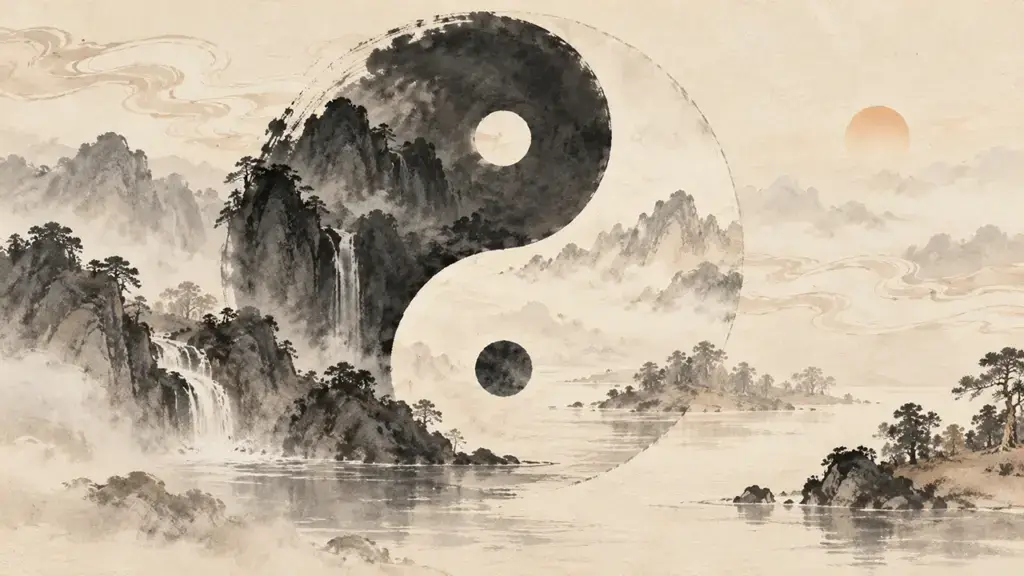
Because the Taijitu uses strong visual contrast, it is sometimes interpreted as a division between positive and negative, good and bad, or desirable and undesirable forces.
That does not accurately describe traditional Yin-Yang thinking.
Yin and Yang are better understood as relational tendencies.
Common Yin Associations
Yin is traditionally associated with:
- stillness
- inward movement
- receptivity
- shade
- coolness
- night
- contraction
Common Yang Associations
Yang is traditionally associated with:
- activity
- outward movement
- brightness
- warmth
- daytime
- expansion
Neither category automatically means good or bad.
Activity can be useful, but constant activity can become exhausting.
Stillness can be restorative, but endless inactivity may become stagnation.
The question is not which side is better, but what relationship exists between the two conditions.
Yin and Yang Are Relational, Not Permanent Labels
A common misunderstanding is to treat objects as permanently Yin or permanently Yang.
But Yin-Yang categories depend heavily on comparison.
A quiet room may appear relatively Yin compared with a crowded street.
The same room may appear relatively Yang compared with a completely dark, unused building late at night.
Moving water may express more active qualities than a still pool, even though water is commonly associated with Yin in other contexts.
Yin and Yang gain meaning through context, comparison, and relationship.
They are not fixed labels permanently attached to objects.
Does Taiji Really Mean Balance?
“Balance” is one of the most common words used to explain Taiji.
It can be helpful, but it can also oversimplify the idea.
The word often suggests equal work and rest, equal activity and stillness, equal Yin and Yang, or permanent stability.
Real processes are rarely that symmetrical.
Summer does not have to resemble winter.
Noon does not need to resemble midnight.
A deadline may require concentrated activity.
A period after completion may call for less activity and more recovery.
So rather than defining Taiji as permanent equality, it is more useful to think in terms of:
responsive proportion within changing conditions.
Taiji is less about making everything equal and more about understanding what a changing situation calls for.
Taiji and the Importance of Timing
Taiji becomes especially useful when life is understood as a sequence of changing phases rather than fixed states.
A project may move through:
- exploration
- planning
- concentrated work
- completion
- review
- rest
- another beginning
A relationship can move through conversation, silence, closeness, distance, cooperation, disagreement, and adjustment.
A home can shift between activity and quiet depending on the time of day.
Taiji reminds us that one phase does not necessarily need to last forever.
A Useful Taiji Question
Instead of asking:
“What state should I always stay in?”
try asking:
“What phase am I in now?”
This shifts attention away from fixed identity and toward process.
A Simple Example: Work and Rest
Work and rest are often treated as opposites competing for time.
Taiji suggests another way to see the relationship.
Rest can prepare the conditions for later activity.
Activity eventually creates the need for rest.
Neither one permanently replaces the other.
A beginning may require exploration.
A deadline may require concentrated effort.
Completion may create a natural point for review and recovery.
The useful question is not “work or rest?” but “what does this phase call for?”
Another Example: Speaking and Listening
Conversation offers another clear example.
One person speaks.
Another listens.
Then the roles change.
If everyone insists on speaking continuously, communication becomes difficult.
Yet this does not mean speaking is wrong and listening is always right.
At one moment, expression may be appropriate.
At another, listening may matter more.
Sometimes a pause is useful.
A Taiji-inspired question is: “What response fits the present relationship?”
What Is the Difference Between Taiji and Dao?
Taiji and Dao (道) are related but should not be treated as synonyms.
Dao is commonly translated as “Way,” “Path,” or simply Dao.
In classical Daoist philosophy, Dao refers broadly to the way reality arises, unfolds, and operates.
Taiji is more specifically useful for thinking about the emergence of distinction within unity.
| Concept | Useful Starting Point |
|---|---|
| Dao | The Way or unfolding process of reality |
| Wuji | An undifferentiated or non-polar condition |
| Taiji | Unity capable of expressing polarity |
| Yin-Yang | Complementary relational tendencies |
| Bagua | Eight symbolic configurations of change |
| Wu Xing | Five phases used to understand recurring patterns |
These concepts are connected, but they are not interchangeable names for the same idea.
Is Taiji Specifically a Daoist Concept?
Taiji is deeply connected with Daoist philosophy and symbolism.
However, it is not exclusive to Daoism.
The concept appears in the Yijing tradition and later became important in several Chinese philosophical systems.
During the Song dynasty, Zhou Dunyi developed an influential cosmological discussion around Taiji.
Later thinkers such as Zhu Xi incorporated Taiji, Yin-Yang, and the Five Phases into broader philosophical systems.
Daoist traditions likewise developed extensive frameworks involving Yin and Yang, qi, cosmological cycles, celestial patterns, directions, transformation, and symbolic correspondences.
Taiji belongs to a broad Chinese philosophical and cosmological vocabulary rather than to one single tradition alone.
For related background, read How Daoism Influences Feng Shui.
How Does Taiji Relate to Bagua?
Bagua (八卦) develops Yin-Yang relationships into a more detailed symbolic system.
The trigrams are built from two kinds of lines:
- an unbroken Yang line
- a broken Yin line
Three lines combine to form one trigram.
The eight trigrams are:
- Qian ☰
- Dui ☱
- Li ☲
- Zhen ☳
- Xun ☴
- Kan ☵
- Gen ☶
- Kun ☷
A simplified conceptual progression is:
Taiji
↓
Yin and Yang
↓
Yin-Yang line combinations
↓
Bagua
↓
More complex patterns of change
Taiji describes the broader framework of polarity; Bagua develops that polarity into eight symbolic configurations.
For deeper reading, see Bagua vs Yin Yang: What Is the Difference? and Bagua vs Feng Shui: What Is the Difference?.
How Does Taiji Relate to Wu Xing?
Wu Xing (五行) is often translated as the Five Elements, although “Five Phases” better reflects many philosophical uses.
The five are:
- Wood
- Fire
- Earth
- Metal
- Water
They should not be understood only as physical substances.
They can also describe recurring tendencies and stages such as growth, expansion, transformation, consolidation, storage, and transition.
Taiji and Yin-Yang provide one framework for understanding polarity and transformation.
Wu Xing offers another framework for understanding changing stages and relationships.
Taiji, Yin-Yang, and Wu Xing are related frameworks, but they organize change in different ways.
For deeper reading, see Wood Element Meaning in Wu Xing Philosophy and Earth Element Meaning in Wu Xing Philosophy.
Taiji vs Tai Chi vs Taijiquan
English terminology creates another common source of confusion.
Taiji is the modern Pinyin spelling of 太极.
Tai Chi is an older English rendering that became widely established.
The martial art is more fully written in Pinyin as:
Taijiquan (太极拳)
So:
Taiji = the philosophical concept
Taijiquan = the martial art
Taijiquan draws on ideas associated with changing relationships, yielding, timing, movement, and response.
The philosophy of Taiji is broader than the martial art of Taijiquan.
Taiji as a Personal Symbol
Some people wear or display Taiji imagery because the design carries cultural, philosophical, or personal meaning.
It may be associated with change, timing, adaptability, complementary differences, movement and stillness, or perspective.
Different people can interpret the same symbol differently.
One person may appreciate the philosophy.
Another may be interested in Chinese visual culture.
Someone else may simply value the geometry and craftsmanship.
A symbol can carry personal or cultural meaning without promising a specific result.
Why Does the Taiji Symbol Work So Well in Design?
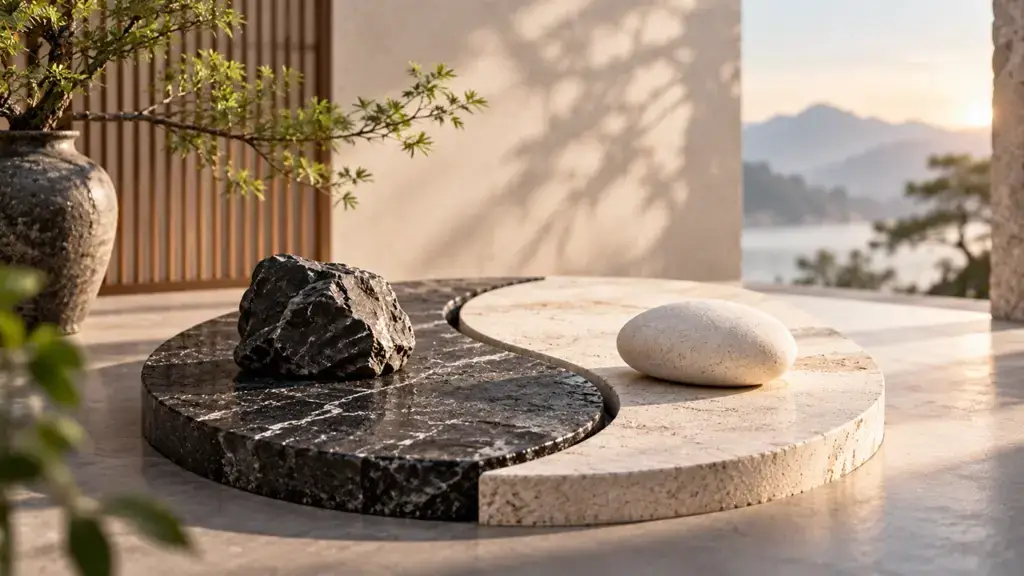
The Taijitu remains immediately recognizable because it combines strong contrast, simple geometry, continuous movement, and symmetry without rigidity.
It works particularly well in circular compositions, engraved metalwork, pendants, textiles, hanging designs, and graphic art.
The curved division keeps the design visually active, while the outer circle gives it a clear and compact silhouette.
The Taijitu is visually simple, but the philosophy behind it is layered.
Taiji in One Sentence
If you want the shortest useful definition:
Taiji is a Chinese philosophical concept describing an underlying unity in which complementary polarities such as Yin and Yang emerge, interact, and continually transform.
That is more accurate than simply saying:
“Taiji means balance.”
It also creates a stronger foundation for understanding Wuji, Yin and Yang, Bagua, Wu Xing, and wider Chinese ideas about change.
FAQ
Is Taiji the same thing as the Yin-Yang symbol?
Not exactly. Taiji is the philosophical concept. The familiar circular design is generally called the Taijitu, while Yin and Yang describe the relational tendencies represented within it.
Why do people call Taiji “Tai Chi”?
“Tai Chi” is an older English romanization of 太极. Modern Pinyin uses “Taiji.” In everyday English, “Tai Chi” is now especially associated with the martial art Taijiquan.
Why are Taiji symbols usually black and white?
Black and white create strong visual contrast between Yin and Yang. Historical and modern Taiji designs can also use other colors, so the philosophical meaning does not depend on the symbol being strictly black and white.
Which side of the Taiji symbol is Yin?
The darker section is generally used to represent Yin, while the lighter section represents Yang.
Why is there a light dot in the dark side and a dark dot in the light side?
The dots are commonly interpreted as showing that Yin and Yang are not completely isolated. A dominant condition may already contain the presence or beginning of its counterpart.
Is Wu Xing part of Taiji?
Wu Xing and Taiji belong to related areas of traditional Chinese cosmological thought, but they are separate frameworks. Wu Xing focuses on five phases—Wood, Fire, Earth, Metal, and Water—and their relationships.
Does the Taiji symbol have to face a particular direction?
Taijitu designs can appear in different orientations depending on artistic, historical, or design context. There is no single universal orientation required for every ordinary decorative or jewelry use.
How can I tell whether a Taiji design includes Bagua?
Look around the central Taiji symbol. If you see eight groups of three broken or unbroken lines arranged around it, those are the Bagua trigrams.
Related Articles
- Bagua vs Yin Yang: What Is the Difference?
- Bagua vs Feng Shui: What Is the Difference?
- How Daoism Influences Feng Shui
- Wood Element Meaning in Wu Xing Philosophy
- Earth Element Meaning in Wu Xing Philosophy
Author Note
Written by the Daoism Light editorial team, this article was created for readers who want to explore Daoist symbols in a clear, modern, and culturally respectful way.
Here, we approach Daoist-inspired objects through their symbolic depth, historical background, and thoughtful role in everyday life. We do not present these pieces as magical guarantees or exaggerated spiritual shortcuts. Instead, we see them as cultural, aesthetic, and contemplative anchors — meaningful accents that bring a sense of intention, balance, and quiet beauty into modern spaces.