Daoism
Bagua vs Feng Shui: Real Differences, Meaning, and Modern Use
Bagua vs Feng Shui explained through Daoist symbolism, spatial meaning, and real-life use. Learn the true difference and how to read each correctly.
Bagua vs Feng Shui: Understanding Their Real Difference in a Daoist Context
Many people first encountering Chinese traditional culture assume that Bagua vs Feng Shui refers to the same thing.
It does not.
Bagua and Feng Shui are related, but they are not interchangeable.
Bagua is a symbolic framework.
Feng Shui is a broader practice of spatial harmony.
Without that distinction, Bagua is often reduced to a decorative pattern, while Feng Shui is often reduced to a few placement tips.
Bagua vs Feng Shui: The Core Difference
Feng Shui concerns the relationship between people and space, including orientation, layout, movement, balance, and environmental harmony.
Bagua, by contrast, is a symbolic system built from the Eight Trigrams.
It organizes meaning through direction, polarity, relationship, and change.
| Aspect | Bagua | Feng Shui |
|---|---|---|
| Nature | Symbolic system | Spatial harmony practice |
| Core basis | Eight Trigrams and the I Ching | Orientation, layout, flow, and environmental relationship |
| Main focus | Meaning, direction, relationship, and symbolic order | Balance, placement, spatial support, and harmony within lived environments |
| Typical use | Interpreting symbolic structure | Applying principles within a space |
| Common forms | Trigram diagrams, pendants, plaques, mirrors, symbolic motifs | Room arrangement, entrance placement, desk positioning, environmental adjustment |
| In modern reading | Often understood as a symbolic or cultural framework | Often understood as a practical method for organizing space |
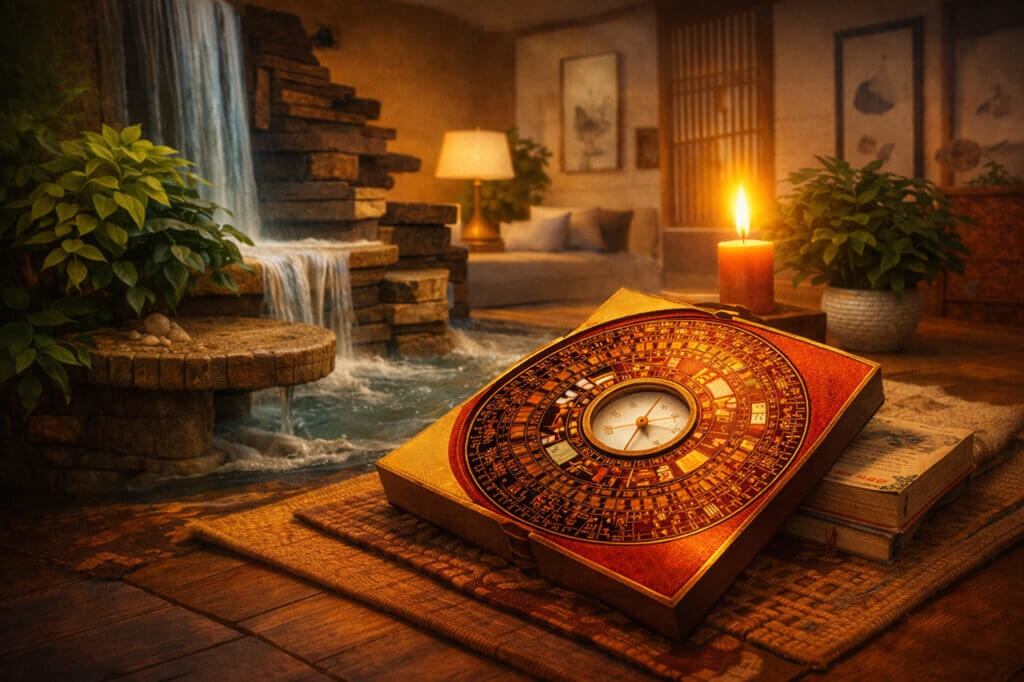
| In traditional context | Connected with Daoist cosmology and patterned meaning | Connected with spatial orientation, environmental coherence, and tools such as the Luo Pan |
A Basic Analogy
Feng Shui harmonizes space.
Bagua helps interpret symbolic order within that space.
- Feng Shui works with space
- Bagua works with symbolic structure
Bagua can be used within Feng Shui, but Feng Shui is not limited to Bagua alone.
Bagua is not the whole of Feng Shui. It is one symbolic system within a much wider way of understanding space, relationship, and order.
For readers who want a deeper foundation before going further, learn the deeper meaning of Bagua in Daoist tradition.
What Is Bagua in Daoist Thought?
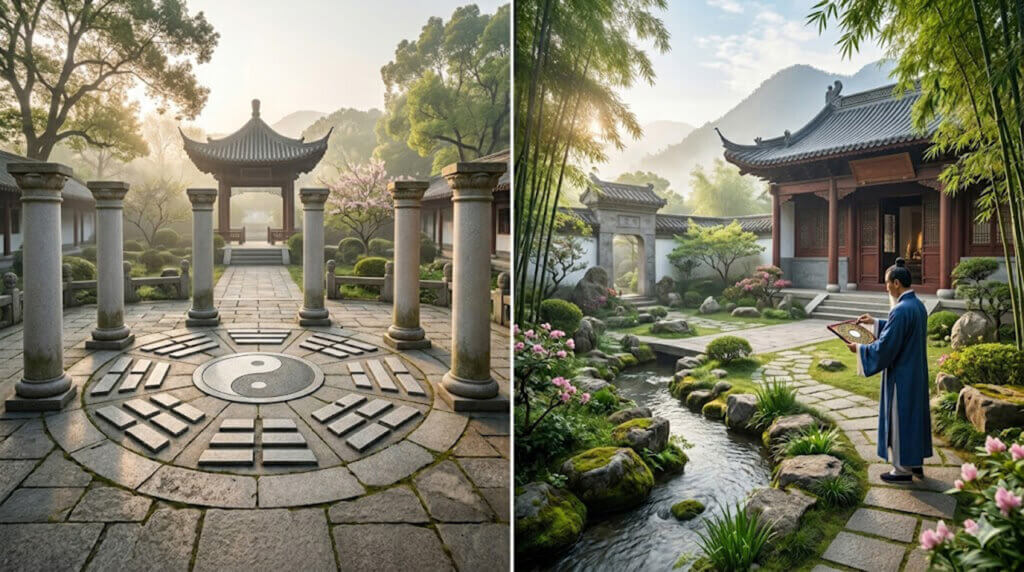
Bagua refers to the Eight Trigrams, one of the foundational symbolic systems in classical Chinese thought, the I Ching, and Daoist cosmology.
It is more than a decorative sign.
It is a visual language of pattern.
Each trigram is formed from broken and unbroken lines, expressing different relational structures and energetic states.
The Basic Symbolism of the Eight Trigrams
Traditionally, Bagua corresponds to:
- Heaven
- Earth
- Thunder
- Wind
- Water
- Fire
- Mountain
- Lake
These are not simply names for natural objects.
They also express states such as emergence, receptivity, activation, penetration, flow, illumination, stillness, and transformation.
In traditional associations, directions are also linked with trigram qualities, such as Water in the north and Fire in the south.
Why Bagua Still Matters
Bagua is still commonly used to think about:
- direction
- balance
- timing
- relationship
- symbolic order
- spiritual orientation
For that reason, Bagua appears not only in classical texts, but also in pendants, plaques, mirrors, protective motifs, and Daoist-inspired objects.
To understand how its symbolic structure developed in different forms, explore the difference between Early Heaven and Later Heaven Bagua.

What Is Feng Shui?
Feng Shui is a practice of environmental harmony.
It asks whether a space supports life.
That includes layout, movement, orientation, entrance relationships, visual balance, and the relationship between symbolic objects and the surrounding environment.
The Focus of Feng Shui
Feng Shui is concerned with:
- the relationship between people and space
- the relationship between movement and stillness
- the relationship between openness and containment
- the relationship between intention and environment
In more traditional systems, directional reading may also involve tools such as the Luo Pan.
A Feng Shui object is meaningful not only because it looks traditional, but because its symbolism, placement, and context can work together.
Common Misreadings of Bagua vs Feng Shui
Misreading 1: Bagua is just a room map
Bagua is often reduced to a flat chart for dividing a room into life areas.
That use exists, but it does not exhaust the meaning of Bagua.
In a broader Daoist context, Bagua also belongs to a symbolic system of direction, order, polarity, and cosmological pattern.
Misreading 2: Feng Shui is just decor placement
Feng Shui is often simplified into “put this object here for this result.”
That compresses a much larger practice of spatial relationship and environmental coherence.
Misreading 3: All protective symbols mean the same thing
Bagua, Yin Yang, talismanic motifs, trigrams, mirrors, and other traditional symbols are often grouped together as generic “good luck” imagery.
They are related in some contexts, but they are not identical.
Each carries a different symbolic role, visual history, and cultural meaning.
Bagua in Western Contexts
In Western contexts, Bagua is often treated as a graphic tool within Feng Shui, or simplified into a fixed symbol related to home layout.
That understanding is incomplete.
In a Daoist cultural context, Bagua is not only an auxiliary diagram for dividing space, but is also connected with direction, relationship, change, order, and cosmological expression.
Feng Shui places greater emphasis on layout, orientation, and environmental harmony within space, while Bagua is more closely tied to symbolic structure itself.
Because of this, the common Western idea that “Bagua = Feng Shui map” is better understood as a simplified applied interpretation, rather than the full meaning of Bagua in traditional thought.
Bagua in Practice and Use
Symbolic use
A pendant, plaque, mirror, or hanging charm featuring a Bagua pattern first presents symbolic meaning.
These objects usually carry the following symbolic emphasis:
- balance
- protection
- a sense of direction
- order
- spiritual steadiness
- a connection to Daoist tradition
Spatial use
Questions about where an object should be placed within an entrance, on a desk, or in a room belong to the applied side of Feng Shui.
When an object is read mainly through placement, orientation, and environmental relationship, it is functioning more within a Feng Shui context.
Bagua in Jewelry vs Bagua in Home Objects
Bagua in jewelry
When Bagua appears in pendants, bracelets, charms, or wearable pieces, it is usually read first as symbolic form.
In that setting, the emphasis is often on:
- personal symbolism
- protection themes
- spiritual identity
- cultural meaning
- visual connection to Daoist tradition
Bagua in home objects
When Bagua appears in plaques, mirrors, wall pieces, entrance objects, or room decor, it is more often read through spatial context.
In that setting, the emphasis is often on:
- placement
- orientation
- relationship to the room
- relationship to entry points
- symbolic support within the environment
The same symbol can therefore carry different practical emphasis depending on its use context.
For readers interested in how these meanings appear in real products, discover Daoist symbols used in jewelry and home decor.
If your focus is on personal symbolism in wearable form, read our guide to Bagua pendant meaning.
Conclusion: The Real Answer to Bagua vs Feng Shui
Bagua is not the whole of Feng Shui.
It is a symbolic framework within a broader tradition of spatial understanding.
Feng Shui works through environment, placement, orientation, and relationship.
Bagua works through symbolic structure, trigram logic, direction, and meaning.
When the two are treated as identical, both become flatter than they really are.
When they are understood in context, symbols become clearer, objects become easier to interpret, and Daoist culture becomes easier to approach with more depth and less confusion.
FAQ
Is Bagua the same as Feng Shui?
No. Bagua is a symbolic system based on the Eight Trigrams, while Feng Shui is a broader practice of spatial harmony.
Can Bagua be used in a small apartment?
Can Bagua be used in a small apartment?
Is Bagua only about protection?
No. Bagua can also symbolize order, balance, direction, change, and connection to Daoist cosmology.
Can Bagua be meaningful without formal Feng Shui practice?
Yes. Many people engage with Bagua through jewelry, symbolic decor, visual culture, or Daoist-inspired objects without treating it as formal Feng Shui application.
Why is Bagua often misunderstood in the West?
Because it is frequently introduced only as a Feng Shui room map or layout tool, while its broader symbolic and cosmological meaning is left unexplained.
Is Bagua religious, symbolic, or both?
Bagua is often encountered as a symbol, but its meaning is rooted in a wider tradition of classical Chinese thought and Daoist cosmology. In modern use, it may appear as a cultural, symbolic, spiritual, or design element depending on context.
Author Note:This article is written for readers exploring Daoist culture through clear, modern, and culturally respectful interpretation.