
Daoism
Where to Place a Five Emperor Ruler at Home
Where to place a Five Emperor Ruler at home, with practical ideas for entryways, studies, shelves, doors, orientation, and everyday display.
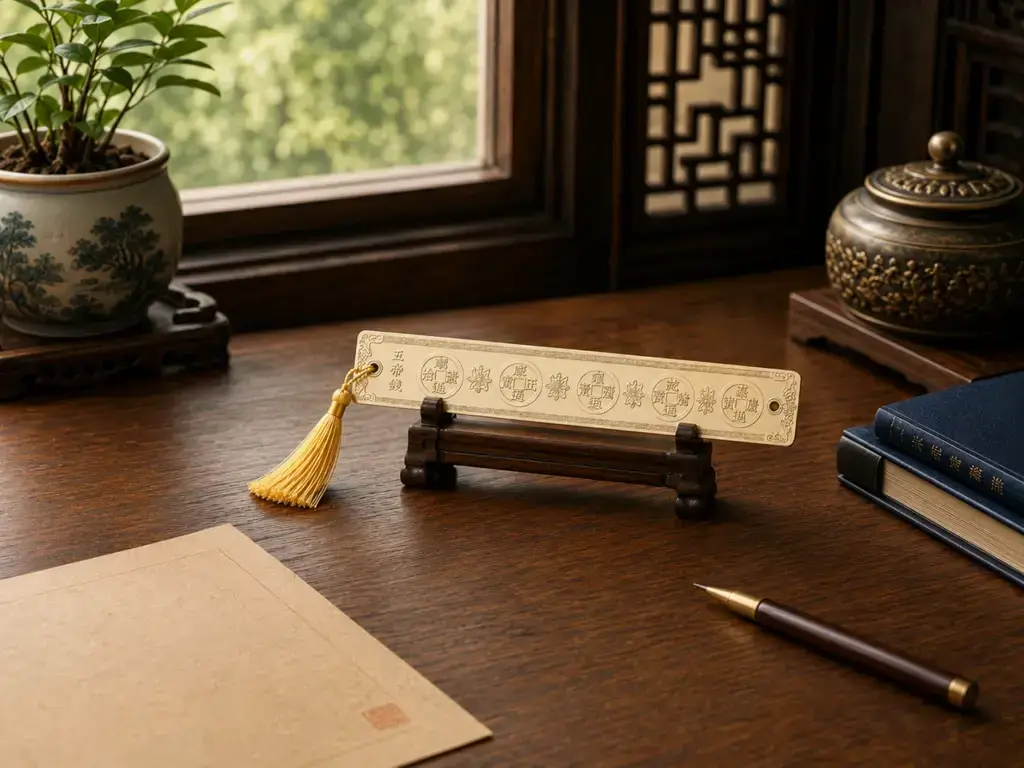
Where to Place a Five Emperor Ruler at Home: A Practical Guide
If you are wondering where to place a Five Emperor Ruler at home, you will probably find several different answers.
Some placement guides focus on compass directions. Others recommend the front door, hallways, windows, workspaces, or particular areas of the home.
For someone encountering the Five Emperor Ruler for the first time, that can turn a relatively straightforward question into a complicated set of rules.
A more useful starting point is to look at the object itself.
Consider:
what is engraved on the ruler, how its elongated shape relates to the room, and where its details can actually be seen.
For many homes, this naturally leads to the entryway, study, bookshelf, interior doorway, or display cabinet.
This guide looks at both the cultural background of the Five Emperor Ruler and the practical realities of displaying a detailed copper object at home.
Quick Answer: Where Should You Place a Five Emperor Ruler?
For most homes, these are the easiest places to consider first:
| Placement | Why It Works |
|---|---|
| Inside the entryway | Naturally connects with arrival and the transition into the home |
| Beside the front door | The elongated shape works well with a door frame |
| Above an entryway console | Keeps the ruler visible without interfering with the door |
| Study or home office | Makes detailed inscriptions easier to view |
| Living-room bookshelf | Works naturally among books and collected objects |
| Interior doorway or hallway | Fits narrow transitional wall spaces |
| Display cabinet | Especially practical for a double-sided ruler |
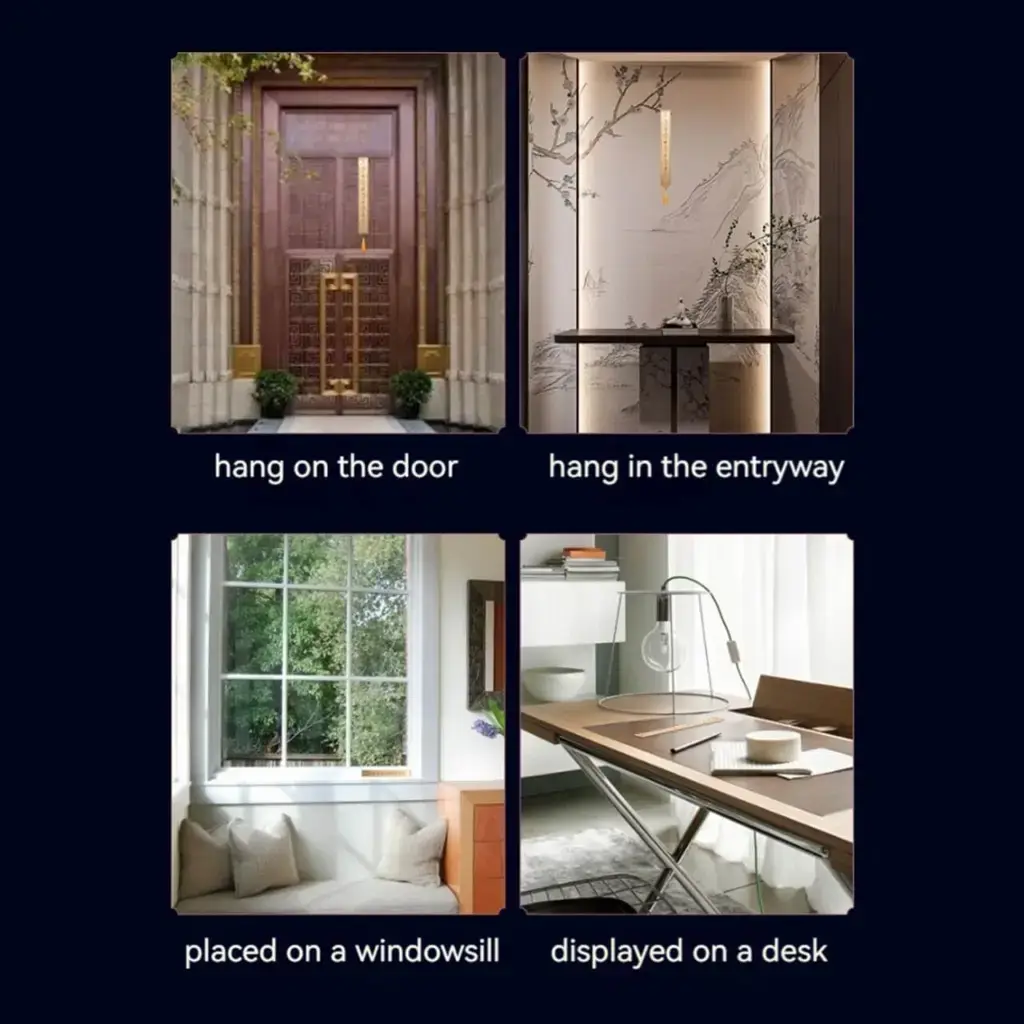
The simplest rule is often the most useful:
choose a clean, secure, visible location where the ruler looks connected to the surrounding space.
What Is a Five Emperor Ruler?
A Five Emperor Ruler is commonly called Wu Di Chi (五帝尺) in Chinese.
Modern versions usually use a long ruler-shaped format and incorporate imagery associated with the Five Emperor Coins.
The commonly recognized Five Emperor Coins correspond to the reign periods of:
- Shunzhi
- Kangxi
- Yongzheng
- Qianlong
- Jiaqing
These coin designs belong to the broader history of Qing dynasty cash coinage.
A modern Five Emperor Ruler, however, should not automatically be described as an antique Qing object.
Contemporary rulers usually combine older coin imagery with other traditional Chinese motifs in a newly made decorative format.
Depending on the design, these may include:
- Five Emperor Coin motifs;
- bats holding coin motifs;
- traditional inscriptions;
- Eight Immortals-related imagery;
- cloud patterns;
- Daoist-inspired diagrams;
- Wu Yue Zhen Xing Tu.
Knowing what is actually engraved on the ruler makes it easier to choose a placement that suits the object rather than simply following a generic rule.
Why Does the Ruler Shape Matter?
Five individual round coin motifs and one long ruler create very different visual effects.
Separate coins emphasize repetition.
The ruler creates a continuous linear composition.
Its shape naturally suggests:
- order;
- measurement;
- direction;
- continuity;
- boundary.
From a design perspective, this makes the ruler especially compatible with the straight lines already present in a room.
It can relate naturally to:
- door frames;
- shelves;
- consoles;
- desks;
- cabinets;
- narrow wall sections.
This is one reason the Five Emperor Ruler can work comfortably in a contemporary interior without requiring the entire room to follow a traditional Chinese decorating style.
How to Choose the Right Location
Before deciding on a room, compare the ruler with the space around it.
A good position should allow you to answer yes to most of these questions:
- Can the full ruler be seen clearly?
- Is the engraving close enough to appreciate?
- Is there enough open space around it?
- Will doors or drawers clear the piece?
- Is the location reasonably dry?
- Does its horizontal or vertical form suit nearby furniture or architecture?
These practical considerations can narrow down the best location very quickly.
1、The Entryway and Front Door
For many homes, the entryway is the most natural place to begin.
An entrance already has a clear spatial role: it marks the transition from outside to inside and creates the first impression of the interior.
Chinese decorative traditions have also long given attention to entrances through inscriptions, imagery, couplets, and other visual elements, although specific customs vary by period and region.
The Five Emperor Ruler fits comfortably here because its long form relates well to the straight geometry of a doorway.
Good Entryway Positions
Consider:
- beside the front door;
- above an entryway console;
- between the door and a cabinet;
- on an interior-facing wall near the entrance;
- resting securely on a console or display shelf.
For brass or purple copper pieces, indoor placement also keeps routine maintenance simpler than long-term exposure to rain and changing outdoor conditions.
Above the Door or Beside It?
Both can work.
Above-door placement follows the horizontal line of the upper frame and can look particularly neat when there is enough open space.
Before installing it there, check:
- ceiling clearance;
- mounting security;
- visibility of the engraving;
- exposure to moisture;
- whether the proportions feel crowded.
If the space above the frame is tight, the wall beside the door will often give the ruler more room to breathe.
There is no advantage in forcing it into a location that does not suit the architecture.
What If the Door Faces an Elevator or Long Hallway?
Many apartment entrances open toward:
- an elevator;
- another apartment door;
- a stairwell;
- a long shared corridor.
Traditional Feng Shui discussions may interpret these layouts through concepts of movement and spatial flow.
From a daily interior perspective, the entrance may simply feel open, busy, or visually unfinished.
A Five Emperor Ruler can be placed on the interior wall beside the entrance as one part of a more complete entryway arrangement.
It can sit alongside:
- a narrow console;
- a small lamp;
- an everyday tray;
- a framed piece;
- a well-positioned mirror.
The aim is not to claim that the ruler changes the elevator or hallway itself.
Instead, it gives the interior side of the entrance a clearer focal point and a more intentional visual structure.
2、In a Study or Home Office
A study is especially suitable for a ruler with detailed engraving.
At this distance, it is easier to appreciate:
- coin inscriptions;
- traditional characters;
- small decorative motifs;
- reverse-side imagery;
- differences in metal texture.
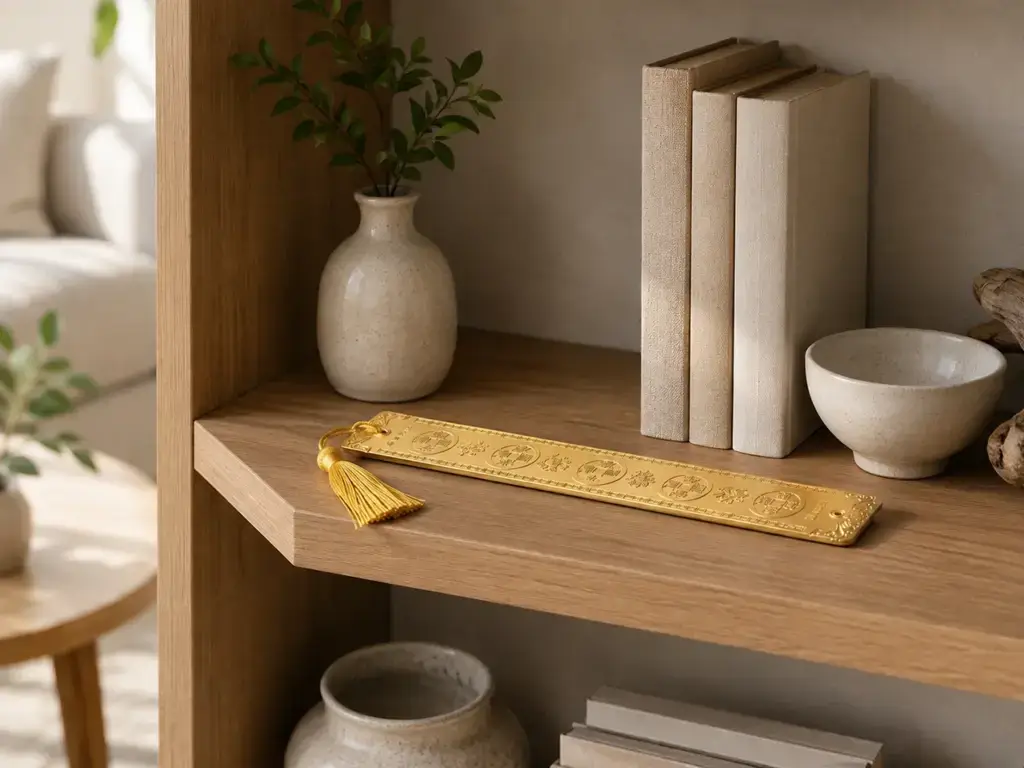
Good locations include:
- above a writing desk;
- beside a bookcase;
- on an open shelf;
- near books on Chinese history, philosophy, art, or culture;
- beside other small metal objects.
In a study, the ruler can be appreciated primarily through its craftsmanship, symbolism, and visual detail.
What If the Desk Faces a Door?
A desk facing an active doorway can sometimes be distracting.
Before adding any symbolic object, address the functional layout first.
Useful changes may include:
- adjusting the desk angle;
- improving task lighting;
- reducing visible clutter;
- creating a calmer background;
- minimizing interruptions where possible.
The Five Emperor Ruler can then be displayed nearby as part of the study rather than treated as a substitute for practical workspace design.
3、On a Living-Room Shelf
A Five Emperor Ruler does not need to become a major wall feature.
A bookshelf or display shelf often works particularly well.
It can sit alongside:
- books;
- ceramics;
- small sculptures;
- framed photographs;
- other collected objects.
Because the ruler already contains detailed engraving, avoid surrounding it with too many small objects.
A little negative space helps the metalwork and motifs stand out.
4、Beside an Interior Doorway or Along a Hallway
The front entrance is not the only doorway that can work.
Other useful locations include:
- beside the entrance to a study;
- along a hallway leading into the living room;
- between dining and sitting areas;
- near a staircase landing;
- on a narrow wall between rooms.
These spaces are particularly useful when the main entryway has very little free wall area.
The ruler’s narrow proportions allow it to occupy spaces where wider artwork might feel crowded.
5、Near a Window
A Five Emperor Ruler can be placed near a window if the surface is stable and the environment is suitable.
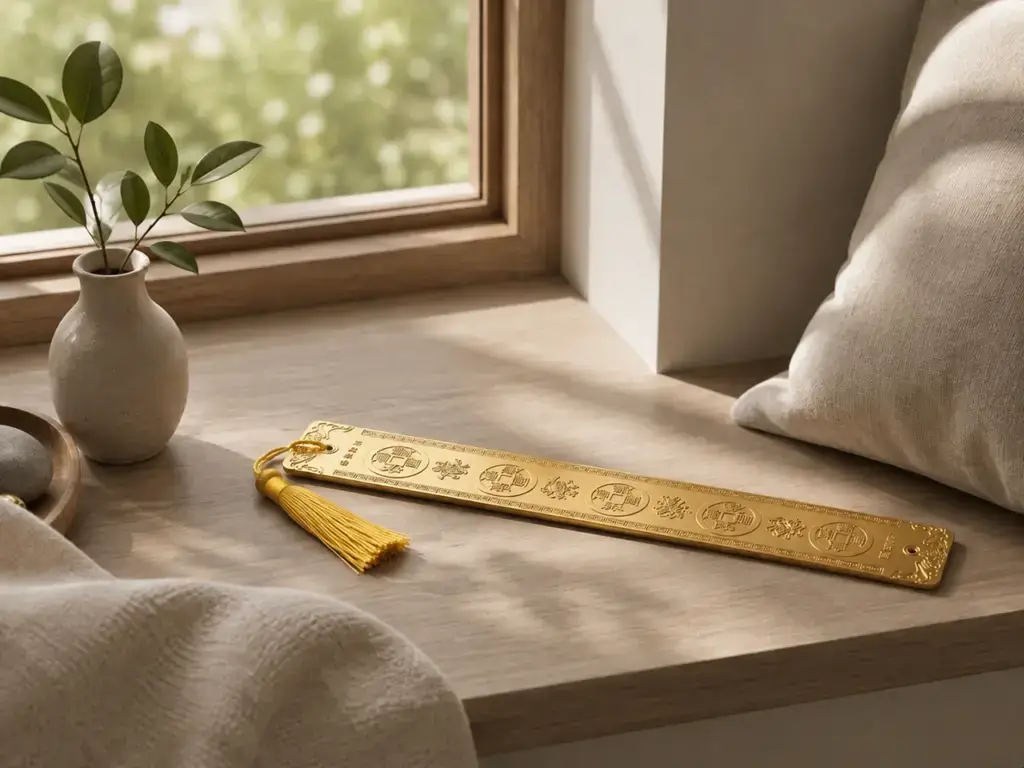
Before using a windowsill or nearby shelf, check for:
- condensation;
- frequent moisture;
- prolonged direct sunlight;
- the risk of the piece being knocked over.
Copper-based materials naturally change with handling and exposure over time, so the actual condition of the location matters more than a generalized rule about what the window faces.
What About an Exposed Beam?
Exposed beams are frequently mentioned in traditional Feng Shui discussions.
They are also strong architectural features from a purely visual perspective.
A large beam directly over a bed, desk, or sofa can sometimes make an area feel heavier or more enclosed.
A Five Emperor Ruler does not physically alter the beam.
If the layout feels uncomfortable, first consider:
- repositioning furniture;
- improving lighting;
- adjusting the seating or desk location;
- reducing visual weight near the ceiling.
If you still want the ruler to relate visually to the beam, an adjacent wall is usually a more practical display location.
For safety, avoid casually suspending a heavy metal object directly above a bed or frequently used seat.
Wall Display or Shelf Display?
Both have advantages.
Wall Display
Wall mounting works well when:
the wall has enough empty space.
the ruler has a clear front-facing composition;
you want it to relate to a door frame or architectural line;
Shelf or Cabinet Display
Freestanding display may be better when:
- you rent your home;
- you do not want to drill the wall;
- the ruler is double-sided;
- you like to rearrange your decor;
- you want to inspect the engraving closely.
For a double-sided ruler, a shelf or cabinet also makes it much easier to turn the piece around occasionally.
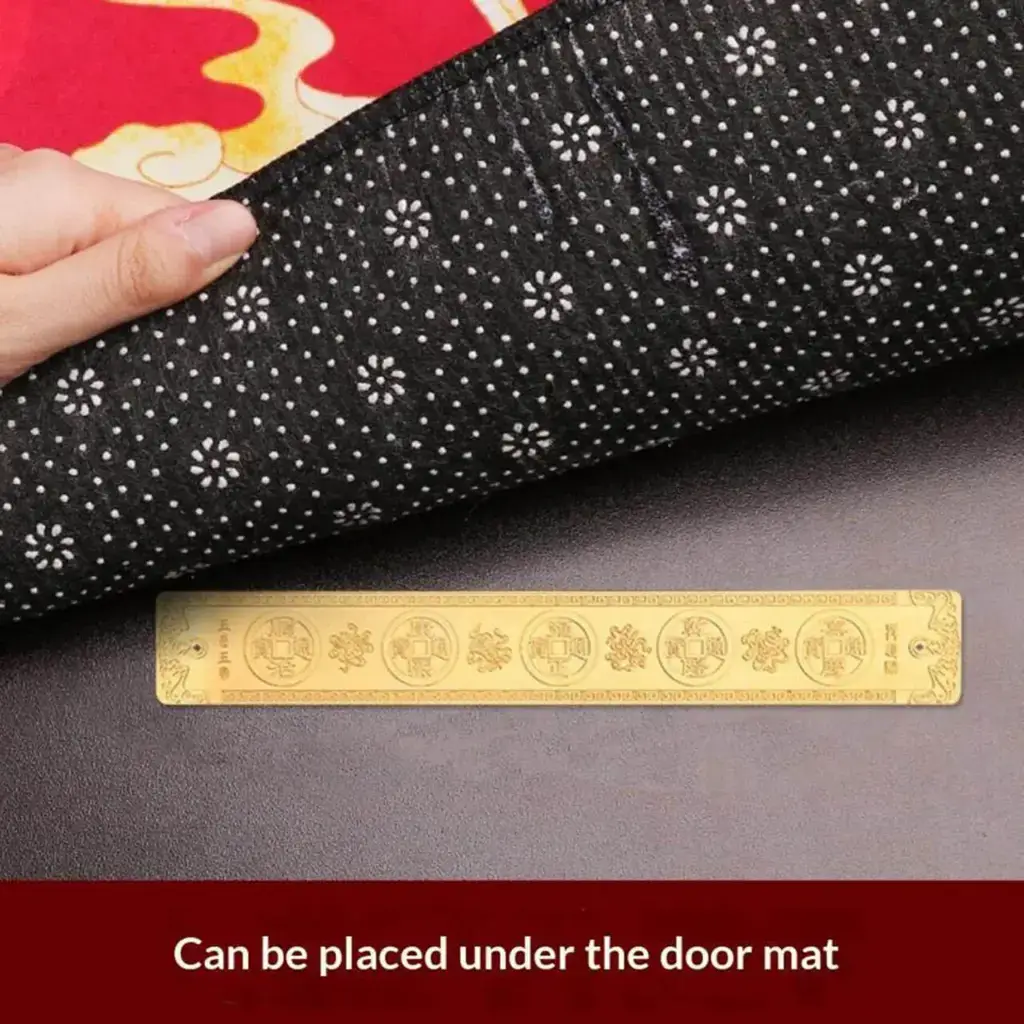
Should You Put a Five Emperor Ruler Under a Door Mat?
Some traditional placement discussions mention positioning Five Emperor-related objects near or beneath thresholds.
For a solid copper ruler with detailed engraving, however, placing it under a door mat is usually less practical.
The entrance floor can expose it to:
- repeated pressure;
- dust;
- moisture;
- grit from shoes;
- surface abrasion.
The engraving also becomes completely hidden.
If you have chosen a detailed ruler because you appreciate its material and design, visible placement beside the entrance usually allows the object to be appreciated more fully.
Which Side Should Face Outward?
This is one of the most practical questions about a double-sided Five Emperor Ruler.
Some designs feature Five Emperor Coin imagery on one side and Wu Yue Zhen Xing Tu on the reverse.
For normal home display, there is no universal requirement that the same side must always face outward.
Choose according to:
- which composition you prefer;
- which side suits the room;
- which imagery interests you most;
- which face is easiest to see from the main viewing direction.
If the ruler rests on a shelf or inside a cabinet, you can simply turn it around whenever you want to see the other design.
Does a Five Emperor Ruler Need to Face a Specific Direction?
Not necessarily.
Specific compass recommendations usually depend on the particular traditional Feng Shui method being followed.
Different approaches may consider:
- building orientation;
- surrounding landscape;
- room function;
- architectural form;
- time;
- compass calculations.
For that reason, a single statement such as “every Five Emperor Ruler must face one particular direction” removes much of the context behind those traditional methods.
For cultural home display, it is usually more useful to focus on:
- correct orientation of the engraving;
- visibility;
- proportion;
- room function;
- secure installation.
Can You Put a Five Emperor Ruler in a Bedroom?
Yes.
A bedroom does not automatically exclude traditional cultural objects.
However, because a Five Emperor Ruler often combines strong geometry with detailed engraving, it may feel more natural in an entryway, study, hallway, or living room.
If you prefer it in the bedroom, consider:
- a bookshelf;
- a dresser;
- a reading corner;
- a side wall.
From a practical safety perspective, avoid casually mounting a relatively heavy metal piece directly above the bed.
Horizontal or Vertical?
Both can work.
Horizontal Placement
Usually works well:
- above a console;
- above a shelf;
- above a desk;
- above a doorway.
Vertical Placement
Often works well:
- beside a door frame;
- beside a bookcase;
- on a narrow section of wall;
- between two pieces of furniture.
The design itself should guide the final decision.
If the characters or motifs clearly have an upright orientation, preserve that direction first.
How High Should You Hang It?
There is no universal height that every home needs to follow.
Instead, relate the ruler to nearby architecture and normal viewing distance.
For example:
- above a console, leave enough open space between the furniture and ruler;
- beside a door, align it naturally with the frame;
- in a study, keep detailed engraving within a comfortable viewing range.
A good display should make the ruler feel connected to the room rather than isolated on the wall.
Before You Place It: Three Practical Checks
There is no need to make the setup complicated.
1、Clean the Display Area
Dust the wall, shelf, console, or cabinet first.
Detailed metalwork looks more intentional in a clean setting.
2、Check Clearance and Conditions
Make sure:
- the door will not strike it;
- drawers and cabinets can open normally;
- the area is not regularly damp;
- the shelf is stable;
- cooking steam or grease will not reach it.
3、Align the Ruler Carefully
Long rectangular objects make uneven placement easy to notice.
Keep a horizontal ruler visibly level.
For vertical placement, use the nearby door frame, cabinet, or bookcase as a visual reference.
Five Emperor Coins vs. a Five Emperor Ruler
The two use related imagery, but their visual structure is different.
Five Emperor Coins
A Five Emperor Coin arrangement emphasizes individual circular forms.
The coins may be:
- connected;
- strung together;
- incorporated into hanging decor;
- reproduced as engraved motifs.
Five Emperor Ruler
A Five Emperor Ruler organizes related imagery into a fixed elongated composition.
Its shape works particularly well with:
- door frames;
- shelves;
- narrow walls;
- furniture edges.
The useful difference is not that one format is “stronger” than another.
They simply interact with a room in different ways.
Where We Would Avoid Placing One
Some locations are harder on the material or make the engraving difficult to appreciate.
Damp Bathrooms
Frequent humidity can accelerate changes in brass and copper surfaces.
Directly Beside a Stove
Grease, steam, and repeated cleaning are not ideal for detailed metalwork.
Directly on the Floor
The ruler is harder to see and more likely to be kicked, scratched, or stepped on.
Where a Door Repeatedly Hits It
Repeated impact can mark both the ruler and the surrounding surface.
Behind Large Furniture
If the design is mostly hidden, the value of the engraving is lost.
In an Overcrowded Display
Fine details are easier to appreciate when the surrounding area has some open space.
A Five Emperor Ruler Should Complement the Room, Not Replace Good Design
A symbolic object can add cultural interest and visual character, but it should not be expected to fix practical problems with a room.
If a space feels uncomfortable because it is:
- too dark;
- cluttered;
- poorly ventilated;
- awkward to move through;
- badly lit;
- poorly arranged;
address those conditions directly.
Lighting, airflow, furniture placement, storage, and daily maintenance have an immediate effect on how a home functions.
The Five Emperor Ruler can then become a thoughtful layer within an already comfortable space.
That gives the object a clearer and more realistic role in everyday living.
Making a Five Emperor Ruler Work in a Contemporary Interior
A Five Emperor Ruler does not require a traditionally styled room.
Its narrow, geometric form can work naturally with many kinds of interiors.
In a compact entryway, the ruler can use the narrow wall beside the door without taking up floor space.
In an open living area, it can sit quietly among books and collected objects.
In a rental, a shelf or display cabinet avoids permanent wall mounting.
In a simple study, brass or purple copper can introduce a warm material contrast against wood, books, stone, or neutral walls.
The goal is not to recreate a historical setting.
It is to give the ruler enough space for its form, engraving, and material character to be seen clearly.
What to Look for When Choosing a Five Emperor Ruler
The right product is easier to place because it already suits the intended space.
Material
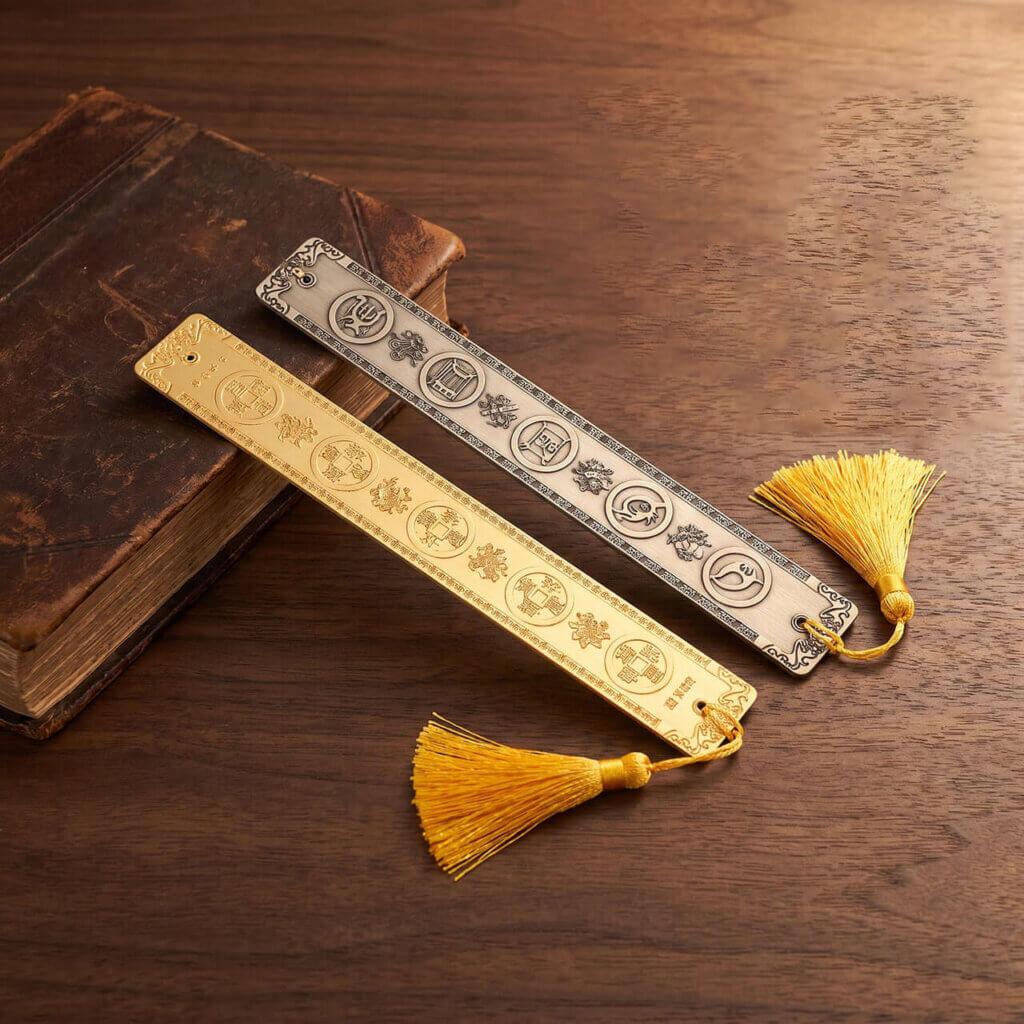
Brass offers a warmer golden tone and combines easily with wood and neutral interiors.
Purple copper shows a stronger natural copper character and usually creates a more noticeable material accent.
Both can gradually develop natural surface variation through air, moisture, and handling.
Double-Sided Design
If the ruler has two fully developed sides, consider how you plan to display it before buying.
A shelf or cabinet may be more satisfying than permanent flat wall mounting if you want to view both compositions.
Engraving
Check exactly what appears on the piece.
A clear product description should identify:
- the Five Emperor Coin arrangement;
- additional traditional motifs;
- the reverse-side composition;
- the correct orientation of inscriptions.
Dimensions
Measure the intended location first.
Check:
- wall width;
- available height;
- door clearance;
- console width;
- shelf depth.
The right proportions usually matter more to the finished display than simply choosing the largest piece available.
A Closer Look at the Daoism Light Five Emperor Ruler
The Daoism Light Five Emperor Ruler with Wu Yue Zhen Xing uses two different engraved compositions across one copper piece.
One side centers on Five Emperor Coin motifs, arranged along the length of the ruler together with additional traditional imagery.
The reverse presents Wu Yue Zhen Xing Tu, creating a clearly different visual experience when the ruler is turned over.
It is available in:
- Brass
- Purple Copper
The two materials give the same engraved structure distinct surface character.
Because both sides contain complete compositions, the ruler works particularly well in places where it can be viewed at close range, such as:
- an entryway console;
- a study;
- a bookshelf;
- a display cabinet;
- a personal collection.
Final Thoughts
The best answer to where to place a Five Emperor Ruler at home is not one universal compass direction.
For most homes, good places to begin include:
the entryway, beside the front door, a study, a bookshelf, an interior doorway, or a display cabinet.
The ruler’s elongated shape works especially well with the straight lines already found around doors, shelves, desks, and furniture.
Choose a location where the piece can be seen clearly and displayed safely.
It is also worth understanding what you are displaying.
The Five Emperor Coin imagery draws from historical Qing dynasty coin culture, while the contemporary Five Emperor Ruler brings those older motifs into a modern decorative format.
Seen this way, placement becomes less about searching for one secret rule and more about creating a thoughtful relationship between traditional symbolism, craftsmanship, and the space you live in.
FAQ
Do I have to hang a Five Emperor Ruler above the front door?
No. Above the door is only one option. If the space above the frame is narrow, placing it beside the door or above an entryway console often gives the ruler more room and makes the engraving easier to see.
My entryway is very small. Where can I put it?
A narrow wall beside the door, a small entryway console, or a shelf can work well. The elongated shape of a Five Emperor Ruler usually requires less wall width than larger decorative pieces.
I rent my home and cannot drill into the wall. Can I still display it?
Yes. You can place it securely on a bookshelf, console, or inside a display cabinet. This is especially convenient for a double-sided ruler because it can be turned easily.
Which side of a double-sided Five Emperor Ruler should face outward?
There is no universal requirement. If one side shows Five Emperor Coin motifs and the other shows Wu Yue Zhen Xing Tu, choose the composition you prefer or the one that fits the surrounding room better.
You can also switch sides occasionally if the ruler is not permanently mounted flat against the wall.
Should a Five Emperor Ruler be horizontal or vertical?
Either can work.
Horizontal placement suits consoles, shelves, desks, and doorways, while vertical placement works especially well beside door frames, bookcases, and narrow walls.
The correct orientation of the engraved characters should come first.
Does a Five Emperor Ruler need to face a particular compass direction?
Not if you are using it primarily as cultural home decor.
Specific directional recommendations generally belong to particular Feng Shui methods rather than a single rule that applies to every home.
Can I put a Five Emperor Ruler in the bedroom?
Yes.
A bookshelf, dresser, reading corner, or side wall can all work.
For practical safety, avoid casually mounting a relatively heavy copper piece directly above the bed.
Can I put it on a bookshelf instead of hanging it?
Yes. A bookshelf or display cabinet is one of the easiest ways to display a double-sided ruler.
It keeps the engraving within comfortable viewing distance and makes it easy to turn the ruler around to see the reverse.
Should I put a Five Emperor Ruler under the door mat?
For a solid engraved copper ruler, visible display is usually more practical.
Under a door mat, the ruler is exposed to repeated pressure, dirt, moisture, and abrasion while the engraving is completely hidden.
Which is better for home decor, brass or purple copper?
It depends on the look you prefer.
Brass has a warmer golden tone and combines easily with wood and neutral interiors.
Purple copper shows a stronger natural copper character and creates a more distinctive material accent.
Neither is inherently better; the choice is mainly about appearance and how the material works with the room.
Will brass or purple copper change color, and how should I clean it?
Yes. Copper-based materials can gradually deepen in tone or develop natural surface variation through exposure to air, moisture, and handling.
For routine care, use a soft dry cloth. Avoid aggressive abrasives and strong chemical cleaners, particularly around engraved or filled areas.
Are the Five Emperor Coins on a modern ruler genuine Qing dynasty coins?
Not necessarily.
Many contemporary Five Emperor Rulers use engraved representations of Five Emperor Coin designs rather than five original antique coins.
Always check the individual product description if the presence of historical coins matters to you.
Author Note
Written by the Daoism Light editorial team, this article was created for readers who want to explore Daoist symbols in a clear, modern, and culturally respectful way.
Here, we approach Daoist-inspired objects through their symbolic depth, historical background, and thoughtful role in everyday life. We do not present these pieces as magical guarantees or exaggerated spiritual shortcuts. Instead, we see them as cultural, aesthetic, and contemplative anchors — meaningful accents that bring a sense of intention, balance, and quiet beauty into modern spaces.
RELATED ARTICLES
- Five Emperor Coins Meaning: History, Symbols, and Modern Interpretation
- discover the meaning of Wu Yue Zhen Xing Tu
- understand the difference between Bagua and Feng Shui