Daoist Symbols
Li Trigram Meaning Explained: Fire, Clarity, and Awareness in Daoism
Li Trigram Meaning Explained for readers exploring Daoist symbolism. Learn how the Fire Trigram relates to clarity, perception, awareness, and conscious insight in Daoist thought and modern life.
Understanding the Li Trigram in Daoism: Fire, Insight, and Clear Perception
Why the Li Trigram Still Matters
Many people today do not struggle because they lack information. They struggle because too much information makes clear judgment harder.
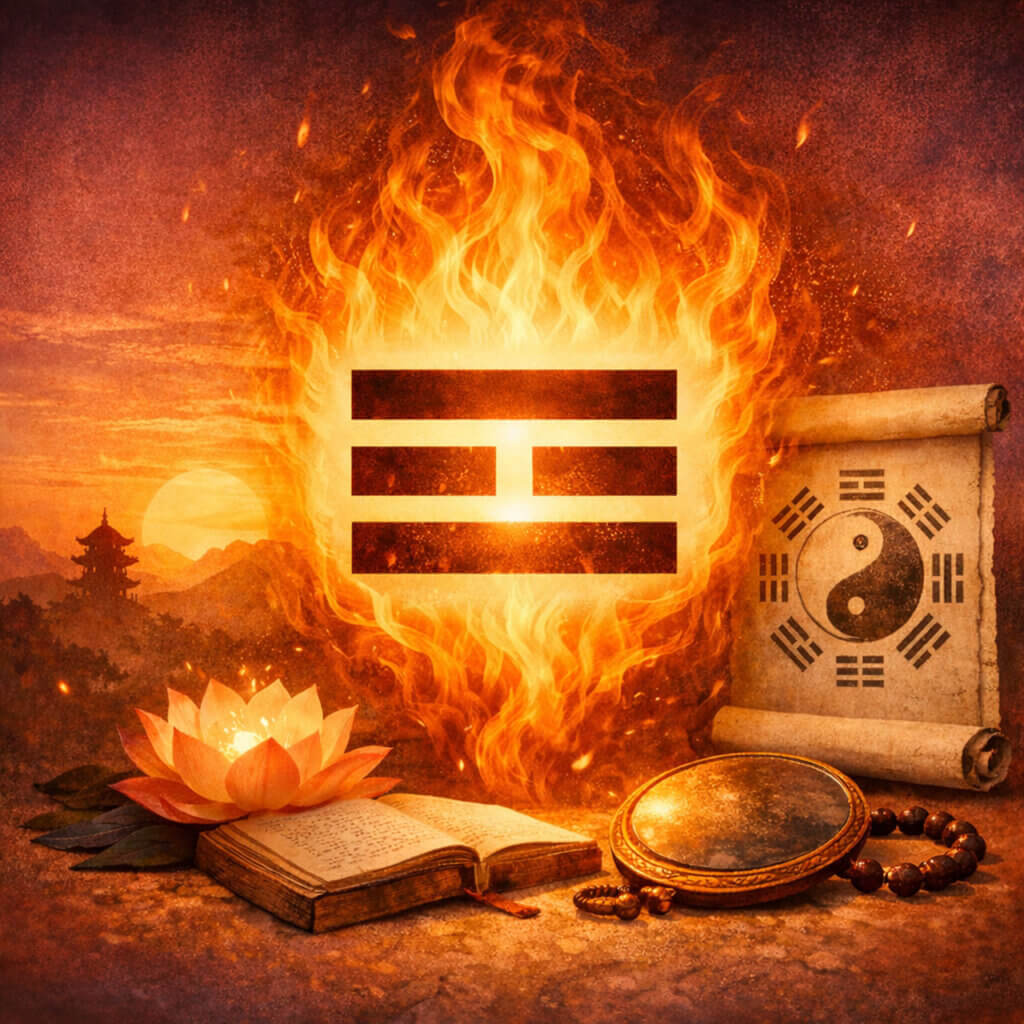
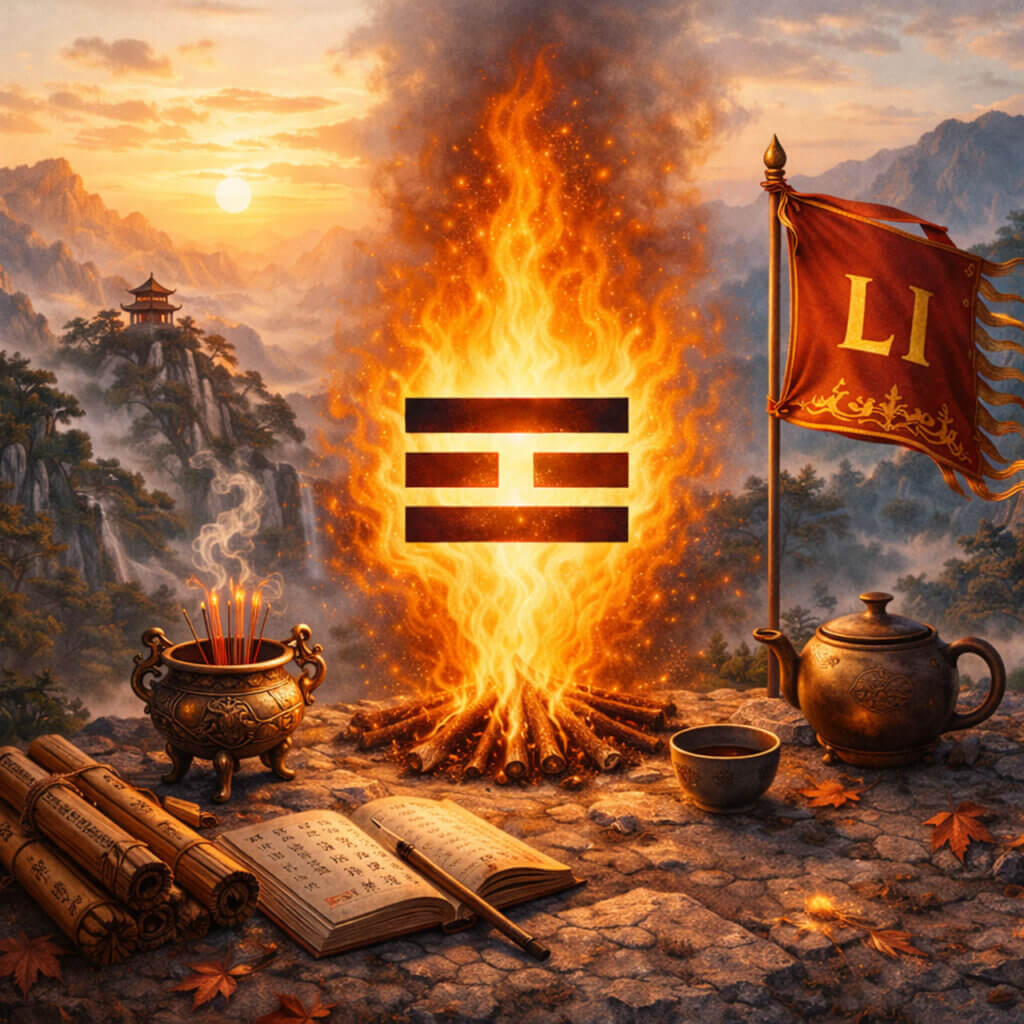
This is one reason the Li Trigram Meaning Explained still matters. In Daoist thought, Li (離 / ☲) is associated with fire, light, and the south, but its meaning goes far beyond heat or outward brightness. Li points to visibility, recognition, and the kind of perception that allows a person to see more clearly instead of merely reacting more quickly.
That makes Li surprisingly relevant to modern life. We live in a world of constant stimulation, endless interpretation, and high visibility. More things compete for attention, yet fewer things are understood well. In that environment, Li raises a practical question: are you actually seeing clearly, or simply reacting to what appears brightest?
Daoist wisdom suggests that clarity is not intensity. It is discernment. Li points not to dramatic force, but to conscious awareness. Not louder thinking, but cleaner seeing.
Li Trigram at a Glance
| Dimension | Li Trigram Details | Modern Significance |
|---|---|---|
| Element | Fire | Energy, visibility, and transformation |
| Direction | South | Peak radiance, recognition, and public presence |
| Structure | Yang–Yin–Yang (☲) | Inner clarity within outward expression |
| Anatomy | Eyes and Heart | Perception, awareness, and conscious response |
| Season | Summer | Full expression, maturity, and outward illumination |
What Is the Li Trigram in Daoism?
The Li Trigram is one of the eight foundational trigrams of the Bagua and one of the most recognizable symbolic forms in Daoist thought.
The Basic Symbolism of Li
Li is commonly associated with fire, the south, brightness, and manifestation. But in Daoist thought, what matters most is not simply that it is “bright,” but that it reveals. Li makes what was once vague become clear. It helps people distinguish appearance from reality and shifts perception from passive reaction toward more conscious understanding.
To better understand where Li belongs within the wider Daoist symbolic system, you can also explore the full meaning of the Bagua
Why Is Li Associated with Fire?
Li is associated with fire because fire gives light, and light makes form visible. In Daoist interpretation, that matters because illumination is not only physical. It also symbolizes understanding.
The deeper point is this: Li is not just about fire itself, but about what illumination does. Fire is visible, but Li concerns the way visibility creates distinction. It allows patterns to emerge, boundaries to sharpen, and confusion to give way to recognition.
Fire as Illumination
Fire reveals shape, pattern, and difference. What is blurred in darkness becomes clear in light. This is why Li is tied to discernment rather than mere brightness.
Fire as Dependence
A flame depends on fuel. Symbolically, this suggests that clarity depends on what it is attached to. Attention, intention, and steadiness shape what becomes illuminated.
Fire as Presence
Li can also relate to visibility, expression, and public presence. But Daoist thought makes an important distinction: being visible is not the same as being deep. Something can attract attention and still lack real insight.
This is why Li should not be reduced to charisma, image, or surface brilliance. Its deeper significance lies in how light reveals truth, not in how brightness captures attention.
Li Is Not Passion — It Is Awareness
One of the most common misunderstandings is to interpret Li as emotion, excitement, charisma, or dramatic fire energy.
That reading is too shallow.
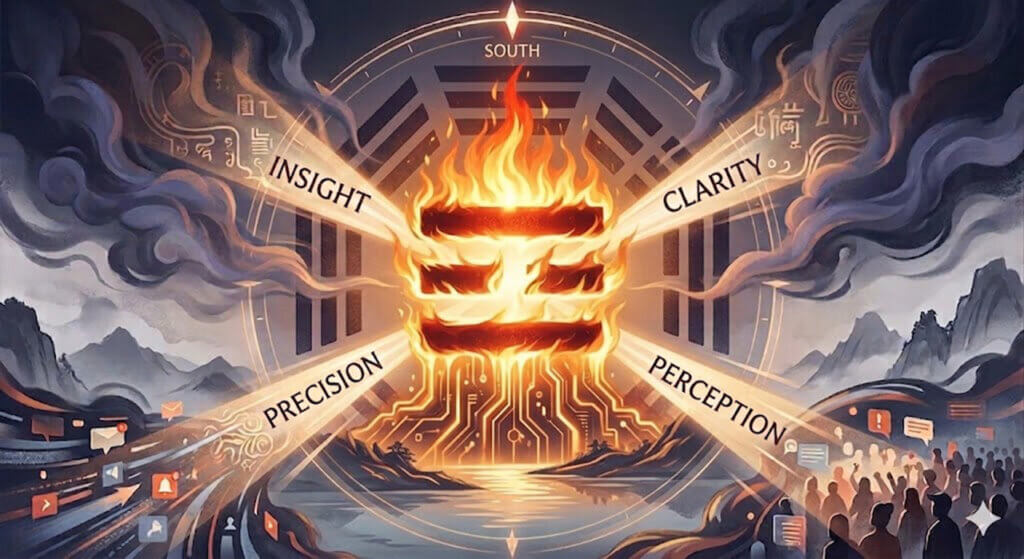
Li does not primarily symbolize passion. It symbolizes awareness. It does not create truth through force. It reveals what is already there.
This is why Li is better understood as a trigram of conscious attention, clear perception, ethical discernment, and intelligent illumination.
When Li becomes distorted, a person may appear bright, expressive, or certain while lacking depth. When Li is balanced, insight becomes calm, precise, and trustworthy.
Why intensity is not the same as insight
Many people confuse stimulation with understanding. A strong reaction is not the same as clear perception. Li reminds us that intensity alone does not produce wisdom.
Li as a Dynamic State, Not a Fixed Personality
A useful way to understand Li is this: Li does not define who you are. It describes how clearly you are seeing.
Rather than treating it as a rigid personality label, Daoist interpretation allows Li to be understood as a changing condition of awareness.
Like fire, clarity requires:
- fuel — attention
- structure — boundaries
- balance — neither too harsh nor too dim
Too much brightness blinds. Too little light confuses. Forced clarity often becomes distortion.
True clarity is steady. It does not need to overpower a situation in order to understand it.
For this reason, Li can be read less as an identity and more as a condition: a way of seeing that can strengthen, weaken, sharpen, or become clouded depending on context.
What the Li Trigram Does Not Mean
A stronger understanding of Li comes not only from defining what it is, but also from clarifying what it is not.
Li Does Not Mean Aggression
Although fire can be intense, Li is not mainly about pressure, domination, or force. Its central function is illumination.
Li Does Not Mean Constant Stimulation
Brightness is not the same as wisdom. Too much exposure and too much reaction can weaken judgment instead of refining it. Overstimulation often creates confusion disguised as activity.
Li Does Not Mean Superficial Positivity
Li is not a symbol of polished optimism. Illumination can reveal discomfort, contradiction, and the need for change.
This is part of what gives Li depth. It is not simply a bright symbol. It is a symbol of truthful visibility.
Li in the Bagua: Why Context Matters
Li becomes more meaningful when understood as part of the Bagua rather than as an isolated symbol.
Each trigram expresses a different pattern of energy and relationship. Li contributes visibility, recognition, and refined perception. But illumination alone is not enough. It must work with grounding, timing, receptivity, depth, and action.
No single trigram explains everything. Li helps make things visible, while other trigrams help support, contain, initiate, or deepen what Li reveals.
Li vs Kan
Kan relates to depth, uncertainty, inward movement, and what is hidden. Li, by contrast, reveals, clarifies, and makes understanding possible.
Li vs Qian
Qian initiates. Li clarifies. Qian moves forward; Li helps a person see the path.
Li with Kun
Kun provides support, receptivity, and stability. When Li is supported by Kun, clarity becomes more grounded and sustainable.
To expand this section naturally, you can compare Li and Kan in Daoist symbolism, learn how Early Heaven and Later Heaven Bagua differ, and understand the deeper meaning of Kun in Daoist thought.
How the Li Trigram Applies to Modern Life
If translated into modern life, Li can be understood as the principle of clear seeing.
1、Decision-Making and Mental Clarity
In high-pressure situations, people often act before they truly understand. Li teaches the opposite:
- clarify perception before accelerating action
- separate insight from emotional urgency
- question what feels loud but shallow
True clarity feels steady, not frantic.
A person may have constant feedback, constant meetings, and constant visibility, yet still lack real clarity about what matters most. Li reminds us that seeing more is not always the same as seeing better.
2、Leadership, Visibility, and Public Roles
Li naturally connects with leadership, teaching, speaking, public presence, and creative expression.
Yet Daoist thought warns that visibility without grounding becomes fragile. Recognition alone is unstable. When Li stands alone, it can burn out. When supported by depth or steadiness, it becomes more sustainable.
This makes Li especially relevant for people who are often seen, heard, or relied upon. The quality of their presence depends not only on expression, but on the clarity behind it.
3、Emotional Awareness Without Overexposure
Li does not teach emotional suppression, but neither does it celebrate emotional dramatization. It supports:
- feeling without performing
- observing emotion without denying it
- allowing insight to mature before reacting
Li refines emotion into understanding. It does not ask a person to become cold. It asks them to become clear.
4、Personal Growth and Self-Reflection
For personal growth, Li can be understood as the gradual refinement of perception. It is less about becoming louder and more about becoming clearer.
A person guided by Li learns to notice what is true, what is distracting, and what deserves sustained attention.
Li in Balance and Imbalance
| Energy State | Signs and Behaviors | Impact on Life |
|---|---|---|
| Balanced Li | Clear perception, calm insight, selective focus | Wise decisions, steady reputation, healthy boundaries |
| Excessive Li | Hyper-reactivity, seeking validation, burnout | Anxiety, performative living, emotional fatigue |
| Deficient Li | Confusion, lack of vision, indecisiveness | Stagnation, withdrawal, mental fog |
Practical Guidance Inspired by Li
When Li feels especially relevant—or when clarity is needed—these principles are useful:
- clarify motives before acting
- reduce noise and unnecessary input
- avoid performative decisions
- seek truth rather than validation
- let insight mature before expression
A simple way to reflect on Li in daily life
Ask yourself: what am I reacting to, and what am I actually seeing? That question alone often reveals whether your attention is being guided by clarity or by stimulation.
Li is not louder thinking.
It is cleaner seeing.
FAQ
What does the Li Trigram mean in Daoism?
The Li Trigram in Daoism commonly represents fire, clarity, illumination, awareness, and perception. Its deeper meaning is connected to discernment and conscious seeing.
Is the Li Trigram only about fire?
No. Fire is its primary symbol, but Li also refers to visibility, insight, recognition, and mental clarity.
Does Li represent passion or emotion?
Not primarily. Li is better understood as awareness rather than emotional intensity.
Can Li become unbalanced?
Yes. Distorted Li may appear as overexposure, burnout, arrogance, superficial confidence, or excessive mental stimulation.
Is the Li Trigram a positive symbol in Daoism?
It is often understood positively because it relates to clarity, illumination, and awareness. However, Daoist thought does not treat it as simply positive. Like any trigram, its value depends on balance, context, and how its qualities are expressed.
Why does Li matter in modern life?
Because modern life often confuses visibility with understanding. Li reminds us that clear perception is more valuable than constant reaction.
If you feel drawn to symbols of clarity, awareness, and conscious direction, you may also enjoy exploring our Daoist-inspired pieces for everyday reflection.
Final Reflection: Fire That Illuminates, Not Burns
To understand the Li Trigram Meaning Explained fully, it helps to move beyond the simple phrase “Li means fire.”
In Daoist thought, Li represents the power of illumination: the kind of clarity that reveals truth, sharpens perception, and supports more conscious action. It is not about dramatic intensity for its own sake. It is about seeing well enough that action no longer needs to be forced.
Li remains meaningful because it reminds us that seeing clearly is a discipline, not an accident. In a world that rewards reaction, Li points back to perception.
Author Note: This article is written for readers exploring Daoist culture through clear, modern, and culturally respectful interpretation.