Five Elements
Earth Element Meaning in Wu Xing Philosophy
Explore Earth Element Meaning in Wu Xing, including its role in cultivation, transition, balance, and the Five Phases cycle.
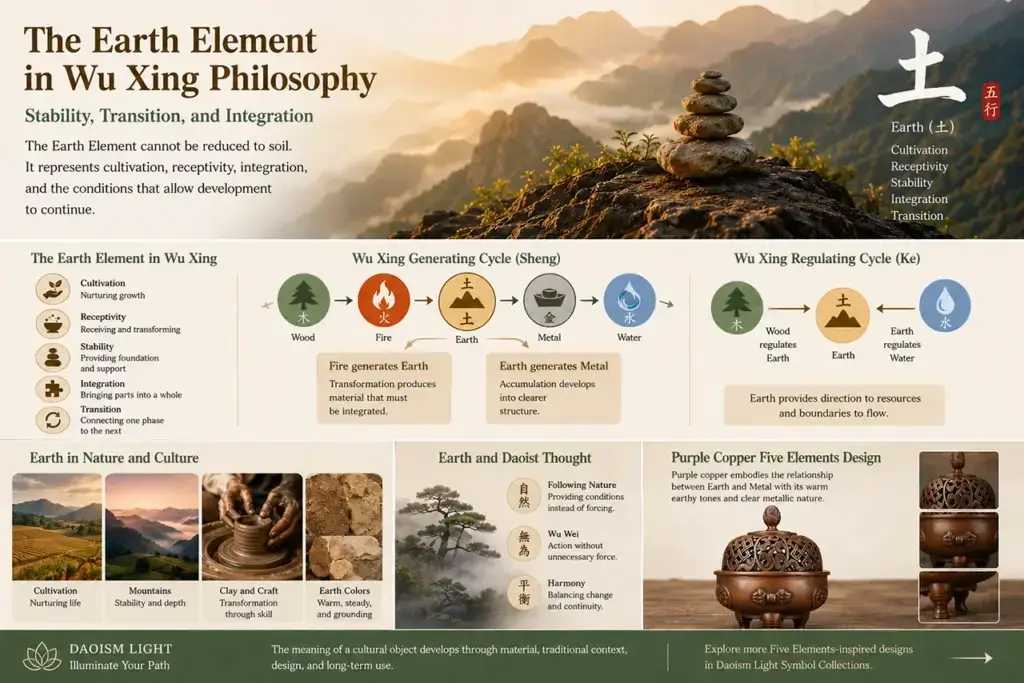
The Earth Element in Wu Xing: Stability, Transition, and Integration
The Earth Element Meaning in Wu Xing Philosophy cannot be reduced to soil, physical ground, or simply the idea of feeling “grounded.”
In Wu Xing (五行), often translated as the Five Elements or Five Phases, Wood, Fire, Earth, Metal, and Water are not understood as isolated substances. Instead, they describe dynamic patterns of transformation, interaction, and relationship.
Among these five phases, Earth represents a stage connected with cultivation, receptivity, integration, stability, and transition.
Earth receives what has already developed, provides conditions for growth, and prepares the foundation from which the next transformation can emerge.
Unlike a static object, Earth represents an ongoing process.
It is the moment when experience becomes understanding, potential becomes structure, and change becomes something that can continue.
Quick Answer: What Does the Earth Element Mean in Wu Xing?
The Core Meaning of Earth in Wu Xing
The Earth Element in Wu Xing represents:
- cultivation
- stability
- receptivity
- nourishment
- integration
- transition
- continuity
In early Chinese explanations of the Five Phases, Earth is often connected with receiving seeds and producing crops.
This image is important because it shows that Earth is not passive.
A field does not simply exist. It receives, transforms, supports, and creates conditions for future growth.
From this perspective, Earth symbolizes the ability to:
- absorb experience
- organize knowledge
- support development
- maintain continuity
- create conditions for transformation
Earth is not the beginning of movement like Wood or Fire.
It is the stage where movement becomes established.
What Is Wu Xing?
Wu Xing Describes Five Phases of Change
Wu Xing (五行) is commonly translated as the Five Elements, although “Five Phases” or “Five Processes” often better reflects its philosophical meaning.
The word xing (行) suggests movement, activity, and changing conditions.
Rather than describing five fixed materials, Wu Xing describes relationships between different patterns of change.
The five phases are:
The Five Phases and Their Core Patterns
| Phase | Chinese | Core Pattern |
|---|---|---|
| Wood | 木 | Growth, expansion, renewal |
| Fire | 火 | Expression, intensity, transformation |
| Earth | 土 | Receiving, cultivation, integration |
| Metal | 金 | Structure, refinement, definition |
| Water | 水 | Flow, adaptation, storage |
The Five Phases influence each other through generating and regulating relationships.
The generating cycle is commonly described as:
Wood → Fire → Earth → Metal → Water → Wood
The regulating cycle is commonly described as:
Wood → Earth → Water → Fire → Metal → Wood
These relationships show that no single phase exists independently.
Each phase gains meaning through its connection with the others.
What Does Earth Do Within a Process?
Soil is the clearest natural image behind Earth, but the philosophical meaning extends beyond physical land.
Earth receives, supports, transforms, and organizes.
It allows one stage of development to become the foundation for another.
For example:
A thought becomes a plan.
A plan becomes action.
Action becomes experience.
Experience becomes understanding.
This movement reflects the quality of Earth:
taking what already exists and helping it become something more complete.
The Historical Meaning of Earth
Earth Receives and Produces
Early Chinese explanations of the Five Phases often described each phase through its natural function.
Water moistens and descends.
Fire rises and transforms.
Wood grows and expands.
Metal forms structure.
Earth receives seeds and produces crops.
This agricultural image reveals an important idea:
Earth represents the relationship between potential and development.
A seed contains possibility, but possibility requires:
- suitable conditions
- time
- nourishment
- protection
- continued care
Earth is therefore not simply a symbol of stability.
It is stability that allows transformation to happen.
The Core Meanings of the Earth Element
Earth as Foundation
Earth provides a base from which development can begin and continue.
Symbolically, Earth is associated with:
- reliability
- patience
- preparation
- continuity
- long-term growth
A foundation does not prevent movement.
Instead, it allows movement to become sustainable.
Many important structures in life remain invisible:
The habits behind expertise.
The preparation behind achievement.
The care behind relationships.
The patience behind craftsmanship.
Earth represents these supporting conditions.
Earth as Cultivation
Growth rarely happens instantly.
A seed becomes a plant through repeated interaction between material, environment, and time.
In human life, cultivation may describe:
- learning
- creative practice
- personal development
- craftsmanship
- building relationships
- developing knowledge
Earth represents the repeated care that allows something valuable to mature.
It is not the excitement of beginning.
It is the patience that allows beginnings to become lasting results.
Earth as Receptivity
Earth receives rain, seeds, minerals, and the remains of previous growth.
Through this process, it transforms what it receives into new possibilities.
Symbolically, Earth can represent:
- listening before responding
- understanding context
- gathering experience
- allowing ideas to settle
- creating space for development
Receptivity does not mean accepting everything without judgment.
It means having the ability to work with what is already present.
Earth as Integration
Earth represents the stage where different experiences become connected.
It can describe:
- information becoming understanding
- experience becoming wisdom
- inspiration becoming form
- change becoming continuity
- separate parts becoming a whole
This is why Earth is often associated with maturity.
It is the process of bringing different pieces together.
Earth as Stability Without Rigidity
Stability is one of the most recognizable qualities associated with Earth.
However, stability in Wu Xing does not mean remaining unchanged forever.
A mountain remains present through different seasons.
Soil continues supporting life while constantly transforming.
Earth represents a type of stability that allows change to happen without losing structure.
Healthy Earth qualities include:
- consistency
- patience
- reliability
- responsibility
- adaptability within structure
When Earth-like qualities become excessive, they may appear as:
- resistance to change
- over-attachment to familiar routines
- endless preparation without action
- difficulty making decisions
- carrying too much responsibility for others
A balanced Earth does not refuse movement.
It provides a stable condition where movement can develop naturally.
Why Is Earth Associated With the Center?
The Center Creates Orientation
In many later correspondence systems of Wu Xing, Earth is associated with the center.
The center does not mean that Earth is more important than the other phases.
Instead, its role is orientation.
It creates a reference point where different movements can remain connected within one system.
Wood expands.
Fire rises.
Metal contracts.
Water descends.
Earth provides the place where these movements can be understood as part of a larger pattern.
The center represents connection rather than superiority.
Earth and Transitional Periods
Earth is often connected with transition.
A transition is the moment when one phase has completed its movement and another begins to form.
For example:
A period of learning eventually becomes understanding.
A period of creativity eventually becomes a finished work.
A period of change eventually becomes a new structure.
Earth represents the process of allowing transformation to settle.
Some later systems associate Earth with late summer, harvest, and the transitional periods between seasons.
However, specific correspondences vary among different texts and traditions.
The broader idea remains consistent:
Earth helps one movement become the foundation for the next.
Earth in the Wu Xing Generating Cycle
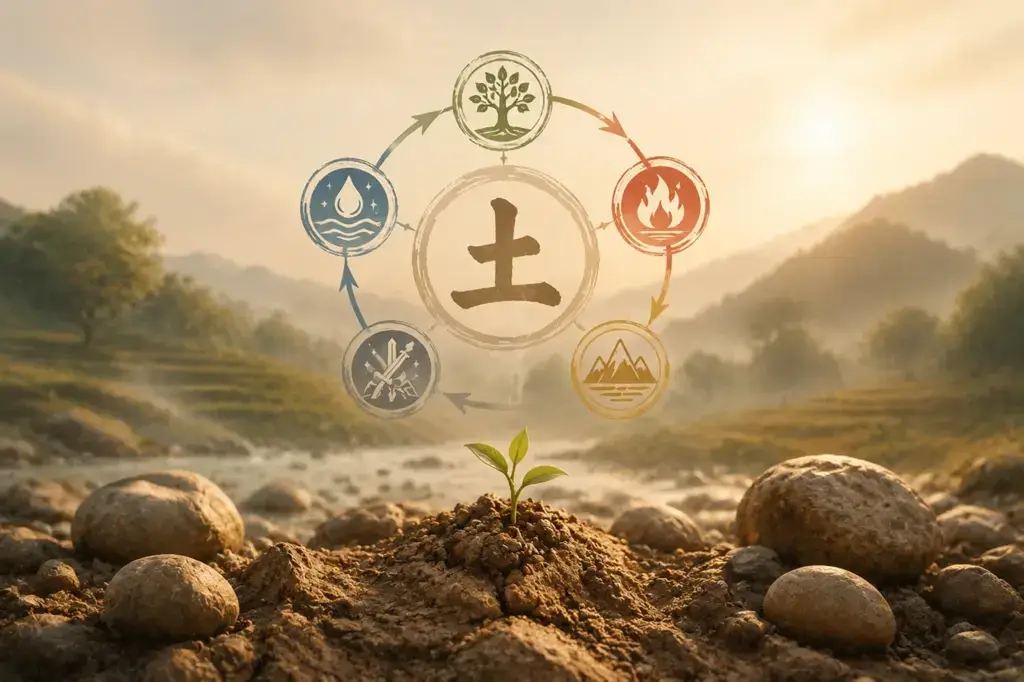
The generating cycle is commonly expressed as:
Wood → Fire → Earth → Metal → Water → Wood
Each phase creates conditions that support the following phase.
Within this cycle:
- Fire generates Earth.
- Earth generates Metal.
To understand the phases leading into Earth, explore:
Wood Element Meaning in Wu Xing Philosophy
Fire Element Meaning in Wu Xing Philosophy
Fire Generates Earth
The traditional image of Fire generating Earth comes from the idea that burned material returns to the ground as ash.
Symbolically:
Fire represents intensity, expression, and transformation.
Earth represents the stage where transformation becomes integrated.
The movement from Fire to Earth can describe:
- activity becoming experience
- inspiration becoming form
- expression becoming understanding
- transformation becoming something usable
A new idea may begin with passion and excitement.
However, without structure, it may remain incomplete.
Earth provides the conditions that allow energy to become something lasting.
Fire Element Meaning in Wu Xing Philosophy
Earth Generates Metal
Metal comes from mineral-bearing ground.
In the generating cycle, Earth creates the conditions from which Metal emerges.
Symbolically:
Earth gathers.
Metal refines.
This relationship can describe:
- experience becoming knowledge
- preparation becoming structure
- resources becoming organization
- accumulated ideas becoming clearer decisions
The Earth-Metal relationship also provides an interesting connection with material design.
Purple copper has a distinct metallic character while carrying a naturally warm reddish-brown appearance.
Within a Five Elements-inspired design, purple copper can visually connect:
- the grounded warmth associated with Earth
- the structured quality associated with Metal
- traditional craftsmanship
- material presence and texture
This is a cultural and design interpretation rather than a claim that the material produces a guaranteed effect.
Earth in the Wu Xing Regulating Cycle
The regulating cycle is commonly expressed as:
Wood → Earth → Water → Fire → Metal → Wood
This cycle describes how different phases limit, guide, and balance one another.
A phase is not considered permanently positive or negative.
Its meaning depends on relationship, timing, and proportion.
Wood Regulates Earth
Roots enter the soil, spread through it, and draw resources from it.
Wood represents growth and direction.
Earth provides support, but Wood introduces movement and purpose.
This relationship asks:
What is this foundation helping to grow?
Preparation is valuable, but preparation without direction can become stagnation.
Wood reminds Earth that stability should support development.
Wood Element Meaning in Wu Xing Philosophy
Earth Regulates Water
arth regulates Water through structure and boundaries.
Landforms, riverbanks, and channels guide the movement of water.
Earth does not eliminate flow.
It gives flow a form.
Symbolically, this relationship can represent:
- organizing emotions
- creating healthy boundaries
- giving ideas structure
- allowing change to move in a meaningful direction
Water provides flexibility.
Earth provides containment.
Together they demonstrate balance between movement and structure.
Earth’s Relationship With the Other Phases
| Relationship | Cycle | Symbolic Meaning |
|---|---|---|
| Fire generates Earth | Generating | Transformation becomes integrated experience |
| Earth generates Metal | Generating | Accumulation develops into structure |
| Wood regulates Earth | Regulating | Growth gives direction to stability |
| Earth regulates Water | Regulating | Structure allows movement to remain coherent |
No phase exists alone.
The meaning of Earth becomes clearer through its relationships with Wood, Fire, Metal, and Water.
Earth Symbolism and Human Qualities
Traditional Earth-Associated Qualities
Modern interpretations sometimes connect Earth with human qualities.
Earth is commonly associated with:
- patience
- reliability
- practicality
- attentiveness
- support
- responsibility
These qualities can be useful as reflective ideas.
However, they should not be treated as fixed personality diagnoses.
A person is not limited to one element.
Human experiences change according to environment, time, relationships, and circumstances.
When Earth-Like Qualities Become Excessive
Every quality can become limiting when separated from balance.
For example:
Patience may become hesitation.
Stability may become resistance.
Support may become over-responsibility.
Preparation may replace action.
Familiarity may prevent exploration.
A balanced Earth works together with the other phases:
- Wood provides direction.
- Fire provides movement.
- Metal provides clarity.
- Water provides adaptability.
Earth is strongest when it remains connected to change.
Earth Symbolism in Traditional Chinese Culture
Agriculture and Cultivation
Agriculture provides one of the clearest cultural images of Earth.
A productive field depends on:
- preparation
- timing
- natural conditions
- continued care
The relationship between land and cultivation created a powerful metaphor throughout Chinese culture.
Earth can therefore symbolize:
- education
- craftsmanship
- personal development
- relationships
- creative practice
- long-term growth
Cultivation is not only about producing a result.
It is about creating the conditions where development can continue.
Mountains and Enduring Presence
Mountains are not identical to the Earth phase, but they express many qualities often associated with Earth symbolism:
- stability
- depth
- continuity
- accumulated time
- visible form supported by unseen foundations
In traditional Chinese landscape aesthetics, mountains and water are often presented together.
The mountain provides structure.
Water provides movement.
Their relationship demonstrates that harmony does not require everything to be the same.
Material and Transformation
Materials provide another way to understand Earth symbolism.
Clay is one of the clearest examples.
It begins as a flexible natural material and becomes a lasting form through:
- water
- heat
- time
- craftsmanship
This transformation reflects an important idea within Wu Xing:
A final form is not created by one element alone.
Instead, it emerges through relationships between different conditions.
For example:
- Earth provides material.
- Water creates flexibility.
- Fire completes transformation.
- Tools refine the shape.
- Human craftsmanship gives cultural meaning.
A finished object carries traces of many processes.
This reflects the deeper meaning of Earth:
receiving different conditions and allowing them to become something coherent.
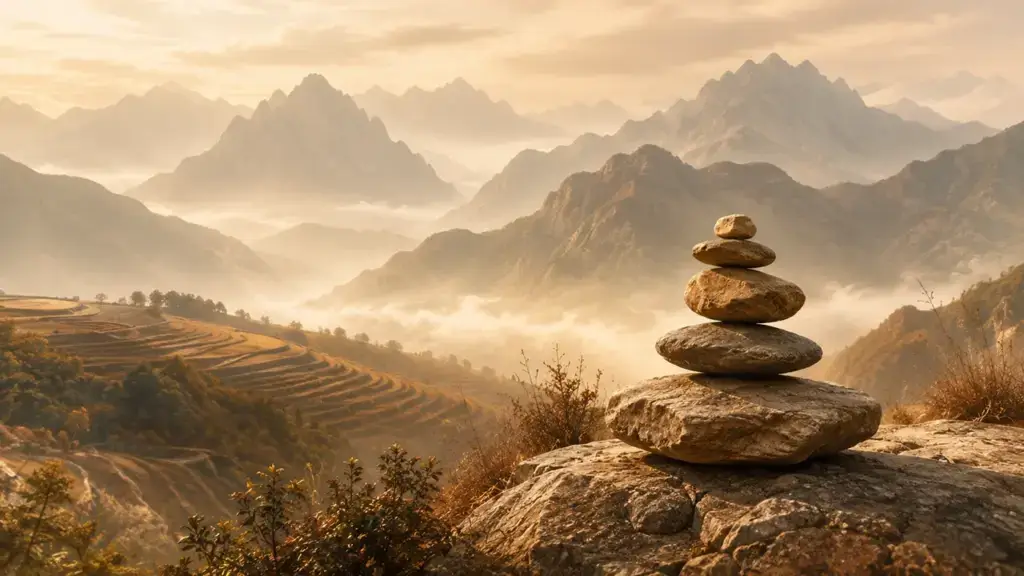
Earth Colors and Visual Language
Earth-inspired colors are often connected with natural landscapes and material textures.
Common visual expressions include:
- yellow
- ochre
- sand tones
- clay red
- warm beige
- natural brown
- muted earth colors
These colors are not universal fixed rules across all Chinese traditions.
Their meaning depends on:
- historical period
- cultural context
- artistic composition
- personal interpretation
In modern design, Earth-inspired colors are often used to create a sense of warmth, natural connection, and visual stability.
Earth Element and Daoist Thought
Wu Xing developed across many areas of traditional Chinese thought.
Although Daoist traditions made extensive use of Five Phase concepts, Wu Xing is not exclusive to Daoism.
It has also appeared in:
- Chinese philosophy
- medicine
- cosmology
- ritual traditions
- political thought
- artistic practices
Understanding Earth therefore requires looking at it as part of a broader cultural framework.
Earth and Naturalness
Daoist thought often emphasizes responding to actual conditions rather than forcing unnecessary control.
Earth provides a useful image for this approach.
Soil does not force a plant to grow faster.
Instead, it provides conditions where growth can happen naturally.
This does not mean complete passivity.
Successful cultivation still requires:
- preparation
- observation
- adjustment
- patience
The difference is that action works with the process rather than against it.
Earth and Wu Wei
Wu wei (无为) is often misunderstood as doing nothing.
A more accurate interpretation is action without unnecessary force.
Earth-like action may involve:
- preparing the right conditions
- understanding limitations
- creating support
- allowing time to participate
- avoiding excessive pressure
A farmer cannot force a seed to become a tree overnight.
Growth requires cooperation between effort and natural conditions.
This reflects an important Daoist idea:
effective action often comes from understanding the rhythm of change.
Earth and the Human Relationship With Nature
Food, shelter, materials, craftsmanship, and communities all depend on relationships with land and environment.
Earth symbolism encourages attention toward:
- resources
- materials
- surroundings
- seasons
- conditions that support daily life
It reminds us that human development does not happen separately from nature.
Is Wu Xing the Same as Feng Shui?
Understanding the Difference Between Wu Xing and Feng Shui
Wu Xing and Feng Shui are related but different concepts.
Wu Xing is a broad framework describing patterns of transformation and interaction.
Feng Shui applies related ideas to relationships among:
- people
- buildings
- landscapes
- orientation
- environmental conditions
The Five Phases may appear in Feng Shui discussions, but understanding Wu Xing does not require treating every modern Feng Shui interpretation as part of the original philosophical framework.
A Daoism Light Perspective on Earth Symbolism
Earth as a Symbol of Continuity and Integration
In our exploration of Daoist-inspired objects, Earth often appears less visually dramatic than symbols associated with Fire, Water, or Yin-Yang.
Fire immediately suggests intensity.
Water suggests movement.
Wood suggests growth.
Metal suggests structure.
Earth may appear quieter.
However, its importance comes from what happens after the initial moment of inspiration.
Earth represents:
- deciding what deserves to remain
- transforming experience into understanding
- allowing knowledge to mature
- creating continuity after change
- connecting traditional symbolism with everyday life
The meaning of a cultural object develops through:
- material
- historical background
- craftsmanship
- visual design
- long-term appreciation
Within the Wu Xing generating cycle, Earth produces Metal.
Purple copper has a distinct metallic character together with a naturally warm reddish-brown tone.
Through material, color, texture, and craftsmanship, a purple copper Five Elements design can visually reflect the relationship between Earth and Metal.
This is a cultural and design interpretation rather than a claim that the material guarantees a specific outcome.
Readers interested in exploring how Wood, Fire, Earth, Metal, and Water appear in traditional symbolic design can explore the Five Elements-inspired designs within Daoism Light Symbol Collections.
Common Misunderstandings About the Earth Element
Earth Is Only Soil
Soil is the primary natural image connected with Earth.
However, the Earth phase also represents:
- cultivation
- receptivity
- integration
- transition
- continuity
Its meaning extends beyond physical material.
More Earth Is Always Better
Wu Xing does not suggest that one phase should always be increased.
Every phase has strengths and limitations.
Balance comes from relationships between different phases.
Everyone Has One Permanent Element
Some modern interpretations use Wu Xing to discuss personality tendencies.
However, people are not limited to one permanent element.
Human experiences change through:
- environment
- age
- relationships
- circumstances
Earth Symbols Guarantee Stability
Symbolic objects can carry:
- cultural meaning
- artistic value
- personal reflection
However, they cannot guarantee emotional, financial, professional, or personal outcomes.
Every Tradition Uses the Same Correspondences
Different texts and traditions may vary in:
- colors
- seasons
- directions
- symbolic relationships
Understanding these differences creates a more respectful approach to Chinese cultural concepts.
FAQ
What is the simple meaning of Earth in Wu Xing?
Earth represents cultivation, receptivity, stability, integration, and the conditions that allow development to continue.
Is Earth in Wu Xing the same as physical soil?
No.
Soil provides the main natural image, but Wu Xing describes dynamic relationships rather than five fixed substances.
Why is Earth associated with the center?
Earth is associated with the center because it provides orientation and helps different movements remain connected within one system.
What generates Earth in Wu Xing?
Fire generates Earth.
This represents transformation becoming something that can be received, organized, and integrated.
What colors represent Earth?
Common Earth-inspired colors include:
yellow
ochre
sand
clay red
beige
natural brown
Their meaning depends on cultural and artistic context.
Is Earth connected with one season?
Some later systems connect Earth with late summer, harvest, or transitional periods between seasons.
Specific interpretations vary.
How does Earth interact with Water?
Wood regulates Earth.
Growth and direction help prevent stability from becoming stagnation.
Is Wu Xing the same as Feng Shui?
No.
Wu Xing is a broader framework of transformation.
Feng Shui uses related concepts in environmental and spatial interpretation.
Are Earth personality traits traditional?
Some interpretations associate Earth with patience, reliability, and support.
However, these should not be treated as fixed personality diagnoses.
Conclusion
Understanding Earth as a Foundation for Transformation
The Earth Element Meaning in Wu Xing Philosophy describes the stage where change is received, organized, and made sustainable.
Earth helps explain:
- how experience becomes understanding
- how potential receives support
- how different movements remain connected within a larger cycle
Preparation, cultivation, integration, and renewal may not always be immediately visible.
However, they often determine whether development can continue.
A strong foundation allows transformation to become part of life.
Bringing Wood, Fire, Earth, Metal, and Water Into Modern Design
Explore how Wood, Fire, Earth, Metal, and Water are brought together through:
- traditional Chinese symbolism
- purple copper craftsmanship
- detailed engraving
- modern aesthetic design
Discover Daoism Light’s Purple Copper Five Elements Design, created as a cultural and aesthetic object for modern daily life.
Related Articles
- Yin and Yang meaning
- Wood Element Meaning in Wu Xing Philosophy
- Fire Element Meaning in Wu Xing Philosophy
- Wu Xing generation cycle
Author Note
Written by the Daoism Light editorial team, this article was created for readers who want to explore Daoist symbols in a clear, modern, and culturally respectful way.
Here, we approach Daoist-inspired objects through their symbolic depth, historical background, and thoughtful role in everyday life. We do not present these pieces as magical guarantees or exaggerated spiritual shortcuts. Instead, we see them as cultural, aesthetic, and contemplative anchors — meaningful accents that bring a sense of intention, balance, and quiet beauty into modern spaces.