Daoism
Bagua vs Yin Yang: Difference, Meaning & Taoist Balance Guide
Bagua vs Yin Yang explained through Taoist philosophy, Feng Shui, balance, space, and modern spiritual decor. Learn the real difference and how to choose the right symbol.
Bagua vs Yin Yang: The Real Difference Between Two Taoist Symbols
Why Bagua vs Yin Yang Matters
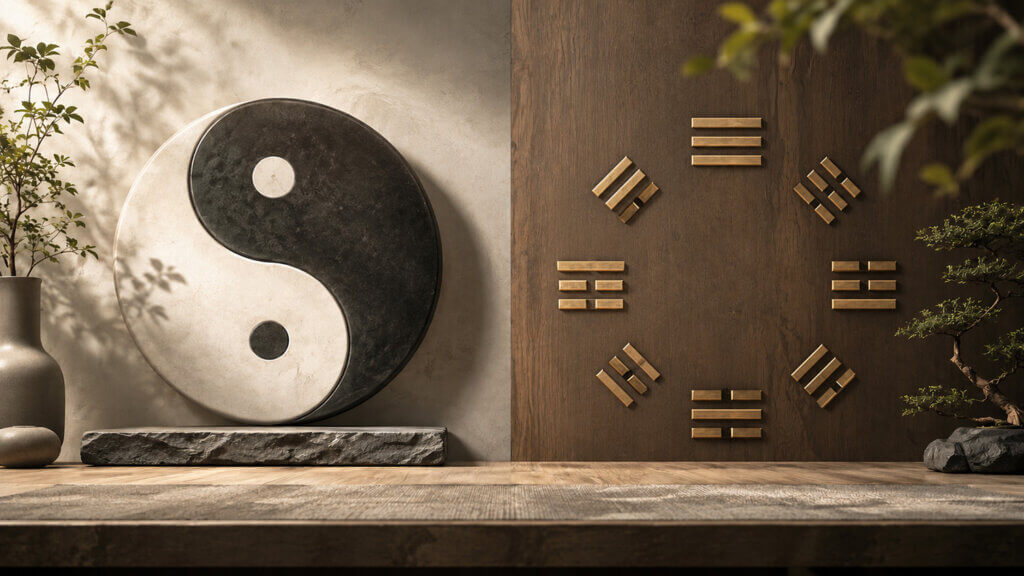
If you are exploring Taoist philosophy, Feng Shui, spiritual decor, martial arts, or Chinese symbolism, you have probably seen two famous images again and again: the black-and-white Yin Yang symbol and the octagonal Bagua symbol made of eight trigrams.
At first, they may seem like similar “Eastern symbols of balance.” But Bagua vs Yin Yang is not just a visual comparison. It is a deeper question about how Taoist thought understands life, space, change, and harmony.
The simplest way to understand the difference is this:
Yin Yang explains the basic rhythm of balance. Bagua shows how that rhythm becomes patterns, directions, situations, and spatial meaning.
In modern terms, Yin Yang is like the basic code of balance. Bagua is the symbolic operating system built from that code.
This article looks at Bagua and Yin Yang through Taoist symbolism, Feng Shui space, everyday aesthetics, and practical use. It helps explain what each symbol means, how they connect, and which one may better fit your personal intention, home, car, workspace, or daily carry.
What Is Yin Yang?
Yin Yang is one of the most important ideas in Taoist philosophy. It describes how life moves through complementary forces: dark and light, stillness and movement, softness and strength, receiving and acting, rest and activity.
A common mistake is to see Yin and Yang as “good versus bad.” That is not accurate. Yin is not negative, and Yang is not positive in a moral sense. They are two different qualities that depend on each other.
Yin gives depth, rest, softness, and receptivity.
Yang gives movement, brightness, action, and expression.
Life becomes unbalanced when one side becomes excessive, blocked, or disconnected from the other.
Yin Yang Is a Principle of Dynamic Balance
The classic Yin Yang symbol, also called the Taiji symbol, shows a dark half and a light half. Each side contains a small dot of the opposite color. This detail is essential.
It means nothing is absolute.
Day becomes night.
Rest prepares action.
Stillness can hold hidden movement.
Activity eventually needs recovery.
Yin Yang is not about freezing life into perfect symmetry. It is about recognizing the right rhythm for the right moment.
A Simple Way to Understand Yin Yang
Yin Yang asks:
“What kind of balance is needed here?”
In a room, it may be the balance between light and shadow.
In work, it may be the balance between ambition and rest.
In relationships, it may be the balance between speaking and listening.
In personal energy, it may be the balance between movement and stillness.
What Is Bagua?
Bagua means “Eight Trigrams.” Each trigram is made of three lines. A solid line represents Yang, and a broken line represents Yin.
This means Bagua is built from Yin and Yang, but it is not the same thing.
If Yin Yang is the basic principle of balance, Bagua is a symbolic map showing how Yin and Yang combine into eight different patterns. These patterns are traditionally connected with nature, direction, movement, space, family roles, body symbolism, and Feng Shui interpretation.
The Eight Trigrams of Bagua
The eight trigrams are not random marks. Each one represents a specific pattern of energy, movement, and meaning.
| Trigram | Symbol | Common Meaning | Practical Interpretation |
|---|---|---|---|
| Qian | ☰ | Heaven | Creative force, strength, leadership |
| Kun | ☷ | Earth | Receptivity, support, nourishment |
| Zhen | ☳ | Thunder | Awakening, movement, beginning |
| Xun | ☴ | Wind / Wood | Gentle influence, flexibility, gradual entry |
| Kan | ☵ | Water | Depth, risk, wisdom, hidden emotion |
| Li | ☲ | Fire | Clarity, visibility, illumination |
| Gen | ☶ | Mountain | Stillness, boundary, stability |
| Dui | ☱ | Lake | Joy, expression, reflection |
Bagua Is a Blueprint of Transformation
Bagua is not just decoration around the Yin Yang symbol. It is a symbolic language for reading how change appears in the world.
Zhen is not only “thunder.” It is the moment when something begins.
Gen is not only “mountain.” It is the wisdom of stopping before energy becomes scattered.
Kan is not only “water.” It is the depth and uncertainty that require awareness.
Li is not only “fire.” It is the clarity that reveals what was previously hidden.
This is why Bagua has strong value in Feng Shui and symbolic home decor. It helps people think about space, direction, boundary, movement, and intention.
Bagua vs Yin Yang: The Core Difference
The clearest way to compare Bagua vs Yin Yang is:
Yin Yang is the principle. Bagua is the map.
Yin Yang is the rhythm. Bagua is the structure.
Yin Yang explains balance. Bagua organizes change.
Yin Yang tells us that life moves between complementary forces.
Bagua shows how those forces become eight recognizable patterns.
Bagua vs Yin Yang Comparison Table
| Category | Yin Yang | Bagua |
|---|---|---|
| Core meaning | Dynamic balance | Eight patterns of change |
| Best understood as | Rhythm | Map |
| Structure | Two complementary forces | Eight trigrams made from Yin and Yang lines |
| Main question | What balance is needed? | What pattern is appearing? |
| Time or space | Strongly connected to cycles and rhythm | Strongly connected to direction and spatial order |
| Common use | Personal reflection, balance, harmony | Feng Shui, spatial analysis, symbolic protection, direction |
| Visual form | Taiji symbol | Eight trigrams, often around a center |
| Best for products | Pendants, bracelets, meditation decor | Hanging charms, home plaques, Feng Shui decor, Bagua pendants |
Time and Space: A Deeper Difference
One of the most useful ways to understand the difference between Yin Yang and Bagua is through time and space.
Yin Yang is strongly connected to cycles of time: day and night, rest and action, summer and winter, expansion and return. It helps us understand rhythm.
Bagua is strongly connected to space and direction. In Feng Shui, Bagua is used to understand how different parts of a space relate to movement, intention, and symbolic meaning.
This is why Yin Yang often feels more personal and internal, while Bagua often feels more spatial and environmental.
How Bagua and Yin Yang Work Together
Bagua and Yin Yang are different, but they are deeply connected.
Every Bagua trigram is made from Yin and Yang lines. This means Yin Yang gives Bagua its foundation, while Bagua gives Yin Yang more detail.
This is why many Bagua designs place the Yin Yang symbol in the center. The center represents the source of balance. The eight trigrams around it represent how balance unfolds into directions, conditions, and patterns.
A helpful modern analogy is this:
Yin Yang is the battery of balance. Bagua is the lens that directs that balance into different areas of life and space.
This does not mean the object automatically changes reality. A more respectful interpretation is that the combined symbol reminds people of balance, order, direction, and awareness.
Bagua vs Yin Yang in Feng Shui
In Feng Shui, Yin Yang and Bagua have different roles.
Yin Yang helps evaluate whether a space feels balanced. A room may feel too Yang if it is overly bright, noisy, sharp, or restless. A room may feel too Yin if it is too dark, unused, stagnant, or heavy.
Bagua helps interpret the structure of a space. It connects symbolic meaning with direction, placement, movement, and intention.
This is why Bagua symbols are often used in home plaques, entrance ornaments, Feng Shui mirrors, and hanging charms. The Bagua suggests order, boundary, direction, and symbolic presence.
Yin Yang, by contrast, suggests harmony, rhythm, and inner balance.
How to Choose Between Bagua and Yin Yang Symbols
Once you understand the difference between Bagua and Yin Yang, choosing the right symbol becomes much easier. The question is not which one is better, but which meaning fits your intention, space, or daily use.
One pattern we often notice at Daoism Light is that people are not only asking what Bagua or Yin Yang means. They are asking how to use these symbols without misunderstanding them. For example, a Bagua mirror is very different from a Bagua pendant or a decorative plaque. That distinction matters.
For this reason, we encourage readers not to choose Taoist symbols only by appearance. Many people are looking for something that expresses a personal intention: balance, direction, calmness, protection symbolism, or a clearer connection to traditional Taoist culture.
The right symbol is not simply the one that looks more powerful. It is the one whose meaning fits your space, your daily rhythm, and the feeling you want to carry.
Choose Yin Yang If You Want Inner Balance
Yin Yang symbolism works well for:
- Pendants
- Bracelets
- Meditation corners
- Desk decor
- Daily reminder objects
- Minimal spiritual jewelry
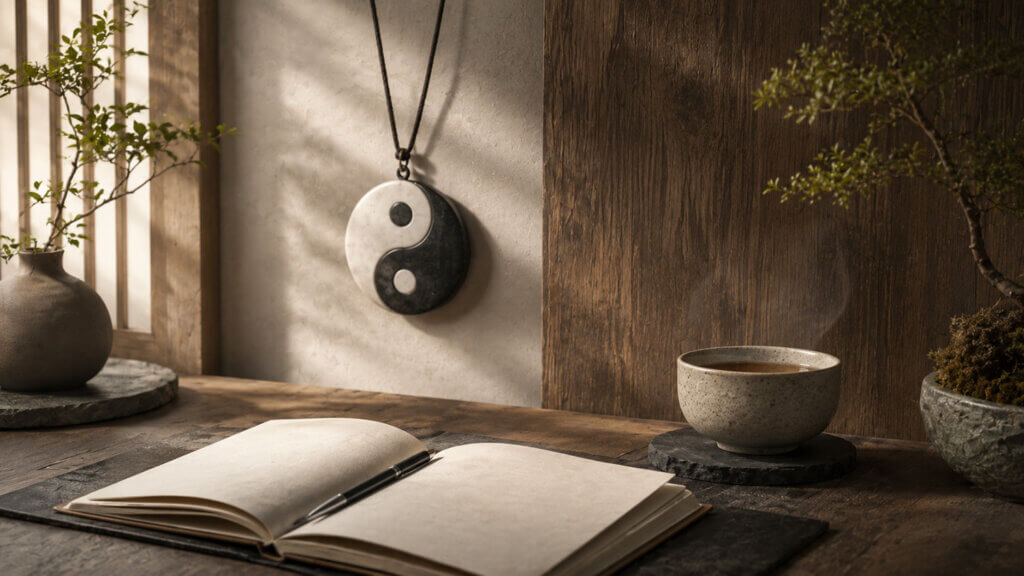
It is especially suitable for people who want a symbol of calmness, rhythm, emotional balance, and self-awareness.
Choose Bagua If You Want Direction and Structure
Bagua symbolism works well for:
- Entrance ornaments
- Car hanging charms
- Feng Shui wall decor
- Bagua pendants
- Home plaques
- Studio or shop decor
It is especially suitable for people who want a stronger symbol of direction, boundary, spatial order, Feng Shui meaning, and traditional structure.
What Not to Do With Bagua and Yin Yang Symbols
Understanding a symbol also means knowing how not to use it casually. Bagua and Yin Yang symbols can be beautiful, but they are not the same type of object in traditional use.
Do Not Treat a Bagua Mirror as Ordinary Indoor Decor
A Bagua mirror is traditionally used as an exterior Feng Shui object, often placed outside an entrance to symbolically address sharp corners, direct roads, or visually aggressive structures.
It is generally not treated as ordinary indoor decoration, especially if it is convex or concave. If you simply want a Taoist-inspired symbol for your room, a Bagua plaque, pendant, artwork, or non-mirror ornament is usually a better choice.
Do Not Use Yin Yang as a Random Aesthetic Pattern
The Yin Yang symbol is often printed on fashion items, tattoos, and decor, but its deeper meaning is balance, transformation, and interdependence. Using it with some awareness makes the symbol feel more respectful and meaningful.
Do Not Expect Symbols to Replace Real Action
A pendant, charm, or home ornament can support intention and atmosphere, but it should not replace real decisions, emotional work, practical planning, or professional help when needed. In Taoist thought, symbols are most meaningful when they remind us to live with awareness.
How to Cleanse and Care for Yin Yang or Bagua Pieces
Some readers like to treat Taoist-inspired objects with a simple moment of care before using them. This does not need to be complicated or dramatic.
You may gently wipe the piece with a soft cloth, place it in a clean space, or let it rest near natural morning light for a short time. If you enjoy incense, sandalwood incense can create a quiet atmosphere before placing the object in your home or carrying it with you.
For brass or copper pieces, avoid harsh chemicals and moisture. Over time, natural metal may develop a subtle patina, which is part of its character and daily-use beauty.
Common Misunderstandings About Bagua and Yin Yang
Misunderstanding 1: Bagua and Yin Yang Mean the Same Thing
They are connected, but they are not identical. Yin Yang is the basic principle of balance. Bagua is a structured symbolic system built from Yin and Yang.
Misunderstanding 2: Yin Yang Means Good and Evil
Yin and Yang are not moral opposites. Yin is not bad, and Yang is not good. Both are necessary. The issue is imbalance, not the existence of either side.
Misunderstanding 3: Bagua Is Only for Feng Shui Experts
Bagua has deep applications in Feng Shui, but beginners can still understand its basic meaning. You do not need to master every classical system to appreciate Bagua as a symbol of direction, change, and order.
Misunderstanding 4: Symbols Automatically Create Results
A careful modern explanation should avoid exaggerated promises. Bagua and Yin Yang are meaningful because they carry cultural memory, philosophical insight, and symbolic guidance. They can support intention, atmosphere, and reflection, but they should not be described as guaranteed supernatural solutions.
Explore Taoist Symbols in Modern Life
At Daoism Light, we approach Taoist-inspired objects as cultural and symbolic pieces, not exaggerated magical tools.
A pendant, bracelet, hanging charm, or home ornament becomes more meaningful when it is chosen with awareness. The right symbol can remind you of balance, direction, calmness, boundary, or personal intention.
If you are drawn to Yin Yang, you may be seeking inner balance and emotional harmony.
If you are drawn to Bagua, you may be seeking direction, spatial order, and a stronger connection to traditional Feng Shui culture.
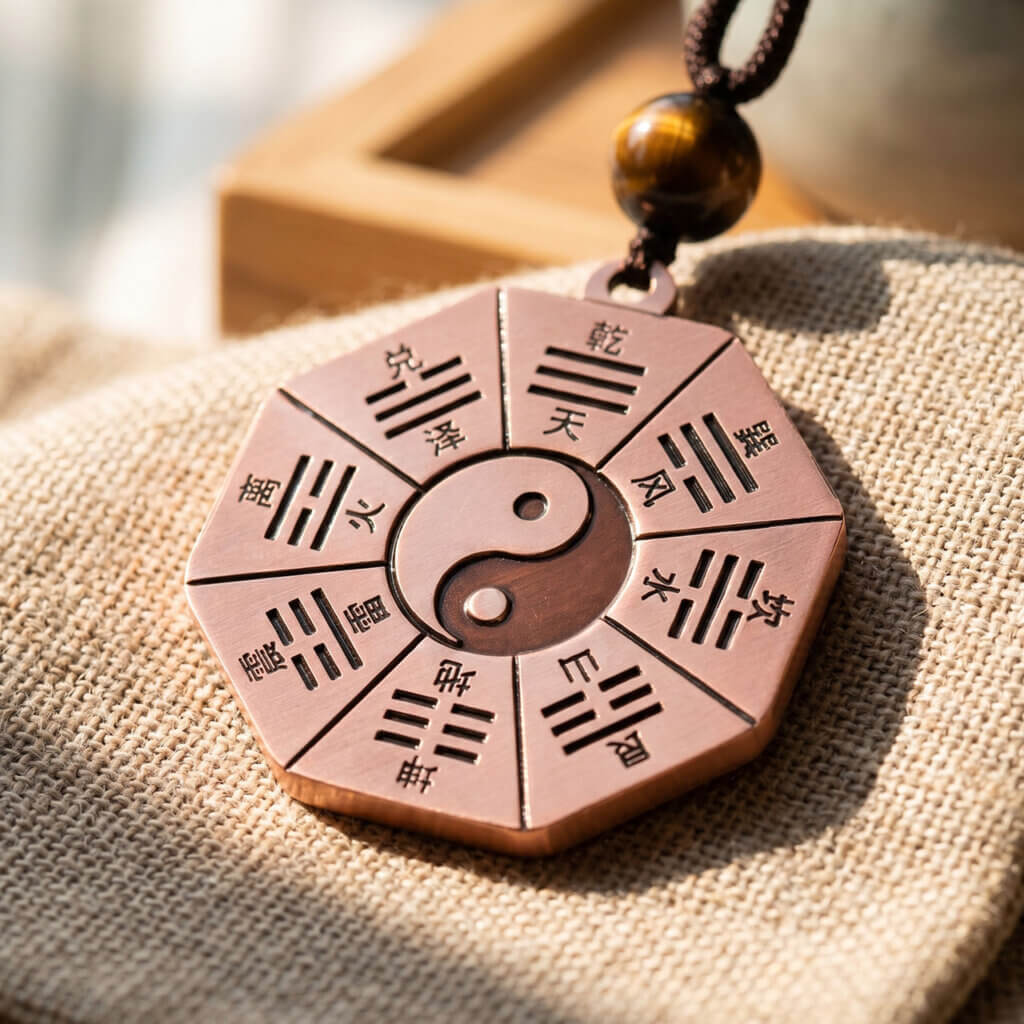
Both symbols can be beautiful. The best choice is the one whose meaning fits your life, space, and intention.
FAQ
What is the main difference between Bagua and Yin Yang?
Yin Yang represents dynamic balance, while Bagua represents eight symbolic patterns created from Yin and Yang lines. Yin Yang is the principle. Bagua is the map.
Is Bagua made from Yin Yang?
Yes. Each Bagua trigram is made from solid Yang lines and broken Yin lines, making Bagua a more detailed symbolic system built from Yin Yang.
Why does the Bagua often have Yin Yang in the center?
The Yin Yang center represents the source of balance. The eight trigrams around it show how balance unfolds into directions, patterns, and life situations.
Is Yin Yang used in Feng Shui?
Yes. Yin Yang is used in Feng Shui to understand whether a space feels balanced, too active, too heavy, too bright, too dark, restless, or stagnant.
Is Bagua only used in Feng Shui?
No. Bagua also appears in Taoist symbolism, the I Ching, martial arts, traditional diagrams, pendants, plaques, and spiritual decor.
Should I choose Bagua or Yin Yang jewelry?
Choose Yin Yang jewelry for balance, calmness, and self-awareness. Choose Bagua jewelry for direction, structure, traditional symbolism, and stronger Feng Shui meaning.
Can Bagua and Yin Yang be used together?
Yes. Together, they represent balance at the center and change in all directions.
Are Bagua and Yin Yang religious symbols?
They can appear in Taoist religious contexts, but they are also philosophical and cultural symbols appreciated for meaning, design, balance, space, and self-reflection.
Author Note
Written by the Daoism Light editorial team, this article is created for readers who want to understand Taoist symbols through clear, modern, and culturally respectful interpretation.
Our content focuses on symbolic meaning, traditional cultural context, and practical daily use. We avoid exaggerated spiritual promises and present Taoist-inspired objects as cultural, aesthetic, and reflective pieces.
Related Articles
- Deep Dive: Understanding the 8 Trigrams of the Bagua
- Early Heaven vs Later Heaven Bagua
- How Daoism Philosophy Influences Feng Shui
- Bagua vs Feng Shui