Feng Shui
How Daoism Philosophy Influences Feng Shui: An Authentic Guide to Balance and Space
Learn how Daoism philosophy influences Feng Shui through Yin and Yang, Qi, Bagua, and the Five Elements. A clear guide to harmony, space, and authentic Daoist insight.
How Daoism Philosophy Influences Feng Shui
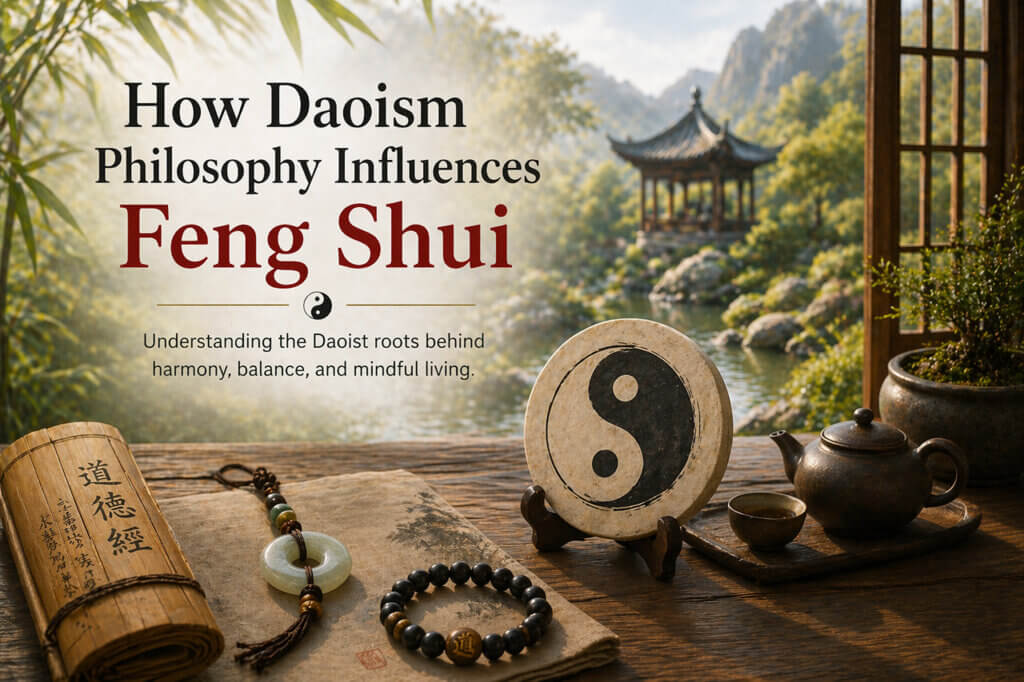
When people first explore Feng Shui, they often encounter it through simple advice about furniture placement, lucky symbols, or wealth corners. But understanding how Daoism philosophy influences Feng Shui goes much deeper than decoration. It begins with a different way of seeing life, space, movement, and harmony.
In Daoist thought, human beings do not stand outside nature. We live within patterns, rhythms, directions, and relationships. Feng Shui grows out of that same worldview. Rather than asking only where to place objects, it asks a more meaningful question: how can a living space support balance, clarity, and a better quality of daily life?
Seen this way, Feng Shui is not just a list of fixes. It is a way of arranging space so that it works with life rather than against it.
This article explains those roots in a clear and culturally respectful way. Instead of repeating trend-based advice, it looks at the Daoist ideas that give Feng Shui its structure, logic, and lasting value.
Why Daoism Matters in Feng Shui
Feng Shui becomes much easier to understand when placed back into its philosophical background. Without that context, it can look like a collection of rules. With Daoist thought behind it, it becomes a coherent way of understanding environmental alignment.
In Daoism, harmony does not come from forcing outcomes. It comes from recognizing patterns, reducing friction, and living in better relationship with what surrounds you. That is one of the central ideas behind Feng Shui.
Feng Shui Is About Relationship, Not Just Objects
A common misunderstanding is to treat Feng Shui as object-based: place one cure here, hang one charm there, add one symbolic item, and expect the whole space to change.
A more grounded interpretation is broader. Objects matter because they exist within a larger field of placement, direction, movement, proportion, and atmosphere. The space itself matters. The way it feels matters. The way it supports rest, focus, and daily rhythm matters.
This is why Feng Shui is not mainly about collecting symbolic items. It is about whether a space supports the kind of life unfolding inside it.
Authentic Daoist Feng Shui vs. Modern Pop Feng Shui
A useful distinction is the difference between authentic Daoist Feng Shui and modern pop Feng Shui. One treats space as part of a larger philosophy of harmony. The other often reduces Feng Shui to surface-level symbolic fixes.
| Authentic Daoist Feng Shui | Modern Pop Feng Shui |
|---|---|
| Focuses on alignment, proportion, and lived experience | Focuses heavily on quick symbolic fixes |
| Pays attention to airflow, movement, and emotional tone | Often prioritizes decorative cures |
| Uses symbols within a broader spatial logic | Often treats symbols as standalone solutions |
| Emphasizes balance rather than excess | Can encourage overuse of objects and remedies |
| Seeks harmony with natural rhythm | Often presents Feng Shui as instant optimization |
This distinction matters because Daoist philosophy gives Feng Shui a deeper foundation. It shifts the focus away from superstition and back toward relationship, rhythm, and balance.
The Core Daoist Ideas Behind Feng Shui
To understand how Daoism philosophy influences Feng Shui, it helps to begin with a few core ideas.
1、The Dao: The Larger Order Behind Life
The Dao is often translated as “the Way,” but in practice it points to the deeper order through which life unfolds.
Feng Shui reflects this by assuming that environments are not neutral. A space can support coherence, or it can create resistance. A well-arranged home does not manufacture luck out of nowhere. It reduces unnecessary friction and helps life feel more settled, clear, and sustainable.
2、Qi: The Flow of Vital Influence in a Space
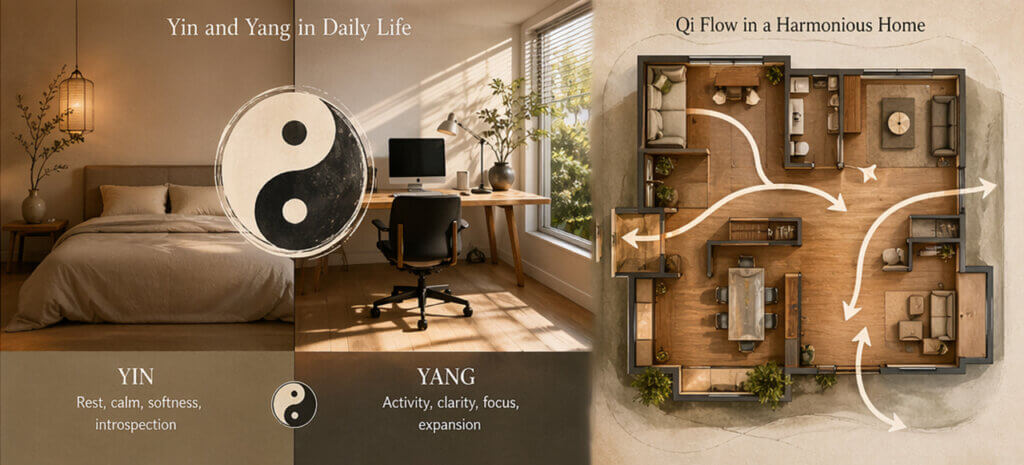
Qi is often translated as “energy,” but in Feng Shui it is more useful to think of it as the living quality of flow within a space. It helps describe why some places feel nourishing while others feel heavy, scattered, or draining.
What Can Disrupt the Sense of Qi Flow
- Cluttered Pathways: Interrupt movement and create mental friction.
- Narrow Transitions: Make movement feel tense or restricted.
- Harsh Alignments: Push energy out too quickly instead of letting it settle.
- Neglected Corners: Create visual dead zones and a sense of stagnation.
- Constant Visual Pressure: Overstimulates the mind and reduces ease.
From a Daoist perspective, these are not minor design details. They shape how the space is experienced every day.
3、Yin and Yang: Balancing Complementary Forces
One of the clearest ways Daoist philosophy shapes Feng Shui is through yin and yang.
Yin and yang are not simple opposites. They are complementary forces that define and support one another: rest and activity, quiet and stimulation, softness and structure, privacy and openness.
Bedroom vs. Workspace
| Space | Yin / Yang Tendency | Best Qualities |
|---|---|---|
| Bedroom | More Yin | Soft textures, calmer lighting, quieter visual rhythm, deeper rest |
| Workspace | More Yang | Clearer structure, stronger light, sharper focus, better support for action |
This illustrates a key Feng Shui principle: balance depends on purpose. Not every space should feel the same.
4、Wu Wei: Alignment Instead of Force
Wu Wei is often translated as “non-action,” but in practice it points to a way of acting without strain or unnecessary force.
This matters in Feng Shui because supportive spaces usually do not feel overworked. They feel breathable, proportionate, and natural. A room filled with too many symbolic intentions can still feel stressful. A simpler, better-aligned room often supports life more effectively.
5、The Five Elements: Wu Xing and Environmental Balance
In Daoist thought, Wood, Fire, Earth, Metal, and Water are not just materials. They are dynamic phases or patterns of change. Feng Shui uses this framework to notice how a space leans and what kind of adjustment might restore balance.
| Element | When Excessive, a Space May Feel |
|---|---|
| Wood | Overly expansive or difficult to contain |
| Fire | Overstimulating, agitating, or too intense |
| Earth | Heavy, static, or overly slow |
| Metal | Rigid, cold, or emotionally distant |
| Water | Withdrawn, heavy, or lacking activation |
The point is not to over-label every object. It is to understand the overall character of a space and bring it back into proportion.
The Bagua Map and the Daoist View of Space
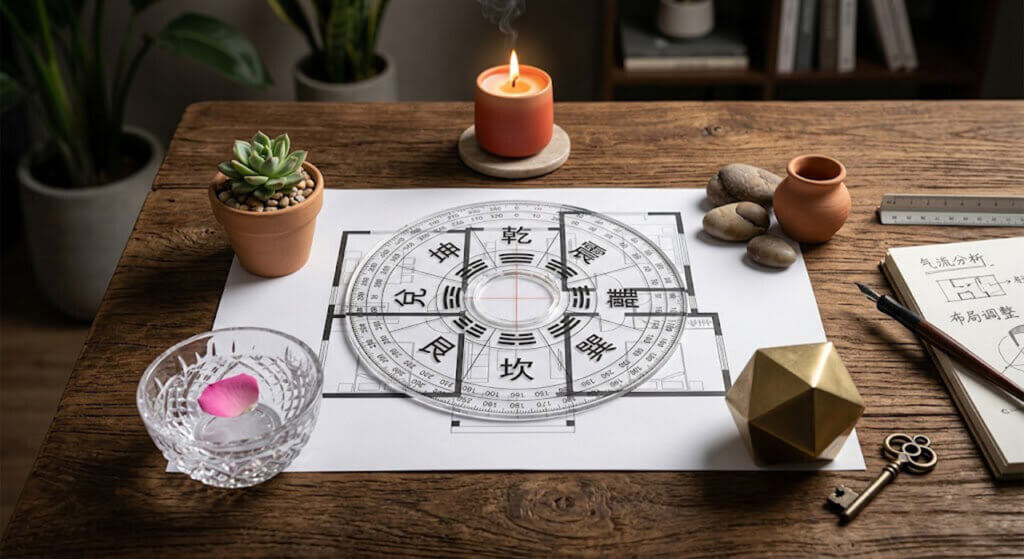
The Bagua is one of the clearest examples of how Daoist cosmology shapes Feng Shui.
In traditional understanding, the Bagua is not just a decorative symbol. It is a way of reading relationships between direction, pattern, change, and lived experience. Each trigram represents a quality of nature, and those natural qualities also connect with dimensions of human life.
Why Bagua Matters
The Bagua is valuable because it shifts Feng Shui away from random placement and toward structured interpretation. It helps people see the home not as a neutral container, but as a space in relationship with rhythm, orientation, and daily life.
How Daoism Shapes the Way Feng Shui Understands a Home
Daoism sees human life as part of a larger network of correspondences. Feng Shui inherits that worldview.
A doorway is not just an opening. It affects movement and reception.
A center is not only empty middle space. It can stabilize the whole environment.
A window is not just glass. It changes openness, exchange, light, and attention.
This is why placement matters in Feng Shui. Space is not passive. It participates in experience.
Living Well Means Living in Better Alignment
From a Daoist perspective, a good life is not measured only by accumulation. It is also measured by rhythm, clarity, health, ease, and relationship.
That is why Feng Shui is not only about wealth symbolism. It also concerns:
- sleep quality
- emotional atmosphere
- focus and attention
- family tone
- the feeling of being supported by the home
This broader view brings Feng Shui back to lived experience rather than superstition.
Common Misunderstandings About Daoism and Feng Shui
Misunderstanding 1: Feng Shui Is Just Superstition
This usually happens when Feng Shui is separated from its philosophical roots. In a Daoist framework, it is better understood as a traditional system of environmental harmony and symbolic order.
Misunderstanding 2: Feng Shui Is Only About Wealth
Wealth is only one part of the story. Traditional Feng Shui is also concerned with peace, health, rhythm, stability, and the emotional quality of life.
Misunderstanding 3: More Symbols Mean Better Results
Not necessarily. Too many symbolic fixes can create visual and emotional overload. Meaningful placement matters more than symbolic excess.
How to Apply This Understanding in Daily Life
A useful takeaway is this: Daoism does not ask you to chase a perfect space. It asks you to pay attention to relationship.
You can begin by:
- noticing whether your home feels scattered or settled
- observing where movement feels blocked
- reducing unnecessary visual stress
- distinguishing restful rooms from active rooms
- choosing symbolic objects with more intention and less accumulation
Seen this way, Feng Shui becomes less about anxious rule-following and more about improving the relationship between space and daily life.
How Symbolic Objects Fit into This Philosophy
Once Feng Shui is understood through Daoist thought, symbolic objects make more sense. Their value does not come only from appearance or belief. It comes from how they participate in atmosphere, intention, and meaning.
A Bagua symbol, a Five Elements bracelet, or a Daoist pendant can serve as a reminder of protection, grounding, clarity, or balance. When these objects are connected to understanding, they carry more lasting value than impulse-driven decoration.
Final Thoughts
To understand how Daoism philosophy influences Feng Shui, the most important shift is this: stop seeing Feng Shui as a collection of tricks, and start seeing it as a practical expression of Daoist harmony.
Its deeper purpose is not control. It is alignment.
Its deeper method is not excess. It is balance.
Its deeper value is not spectacle. It is support.
When understood this way, Feng Shui becomes more than a design trend. It becomes a culturally rooted way of thinking about how space shapes life.
FAQ
Is Feng Shui part of Daoism?
Feng Shui is not identical to Daoism, but it is deeply influenced by the Daoist worldview, especially ideas about harmony, yin-yang balance, qi, direction, and alignment between humans and nature.
Do I need to be a Daoist to practice Feng Shui?
No. Many of its practical insights can be appreciated as ways of improving balance, clarity, and comfort in a living space.
What is the easiest Feng Shui principle to start with?
Start with balance: reduce clutter, improve flow, and make sure rest spaces feel restful while active spaces feel clear and supportive.
Why can a home feel tiring in Feng Shui terms?
A space may feel tiring when movement is blocked, visual pressure is too strong, or the environment feels stagnant, overly yin, or overly yang.
Why does Daoist philosophy matter in Feng Shui?
Because it gives Feng Shui its deeper logic. Without that context, it can look like random advice. With it, the practice becomes more coherent and meaningful.
Author Note
This article is written for readers exploring Daoist culture through clear, modern, and culturally respectful interpretation. It aims to explain Feng Shui through its philosophical roots rather than through exaggerated claims or superstition-driven shortcuts.
It is part of our broader effort to present Daoist symbolism, philosophy, and related cultural objects in a way that is accessible, thoughtful, and grounded in meaning rather than hype.
Related Articles:
What Is Daoism? A Beginner-Friendly Introduction
Bagua Symbols and Their Meanings
Bagua vs Feng Shui: What’s the Difference?
Early Heaven vs Later Heaven Bagua Explained
How to Choose a Five Elements Bracelet