
Daoism
Daoism vs Buddhism: Key Differences in Practice, Belief, and Life
Explore the key differences between Daoism and Buddhism through suffering, daily practice, body, consciousness, destiny, and life direction in a clear modern guide.
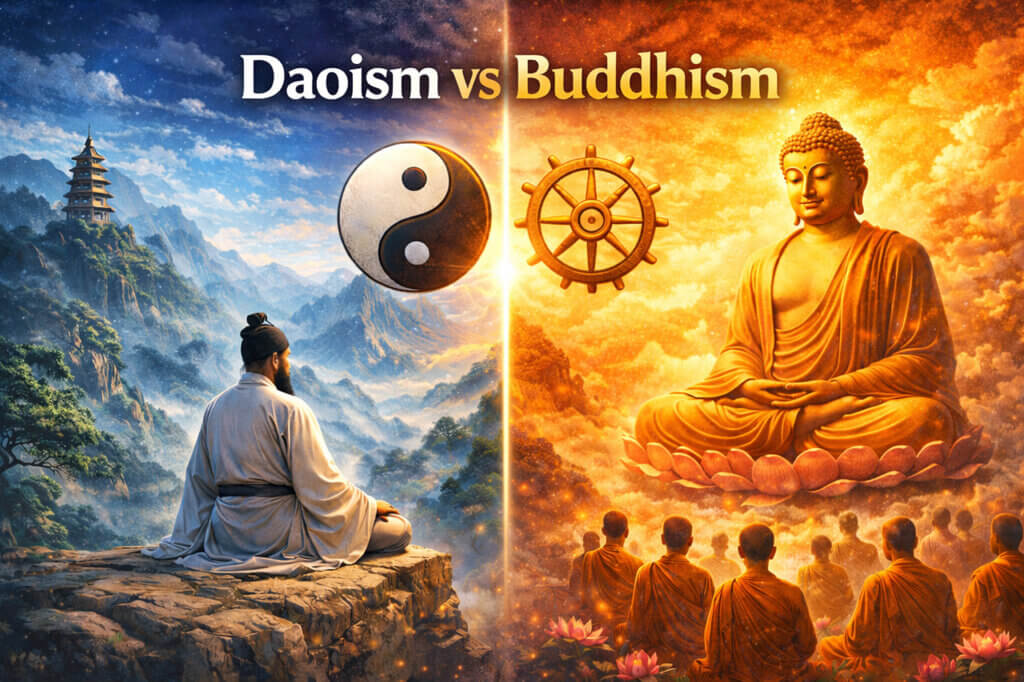
Daoism vs Buddhism Key Differences Explained
Why Understanding the Difference Matters
When people begin exploring Eastern wisdom more seriously, they often run into the same question: Daoism and Buddhism both seem to speak about inner cultivation, spiritual depth, and a way of life that goes beyond material pursuit. But once you look more closely, it becomes clear that they are not concerned with the same core questions.
In today’s reading context, this is not just a religious comparison. It is also a practical one. Many people are not only asking how to feel calmer. They are also asking how to live more smoothly, how to reduce inner friction, and how to understand direction and timing more clearly. On these questions, Daoism and Buddhism offer two different languages.
This article explains the key differences between Daoism and Buddhism through worldview, suffering and desire, daily practice, destiny, and life direction. For readers who are less familiar with Eastern philosophical traditions, starting with a broader introduction to what Daoism means can make the comparison much easier to understand.
Part of the confusion also comes from history. In East Asia, Chan Buddhism—known more widely today as Zen—developed through a long process of contact between Buddhist thought and Daoist language, sensibility, and ways of expression. That historical meeting helps explain why some modern readers initially feel that Daoism and Buddhism “look similar,” even though their deeper aims, methods, and starting points are not the same.
The Core Difference: Liberation and Alignment
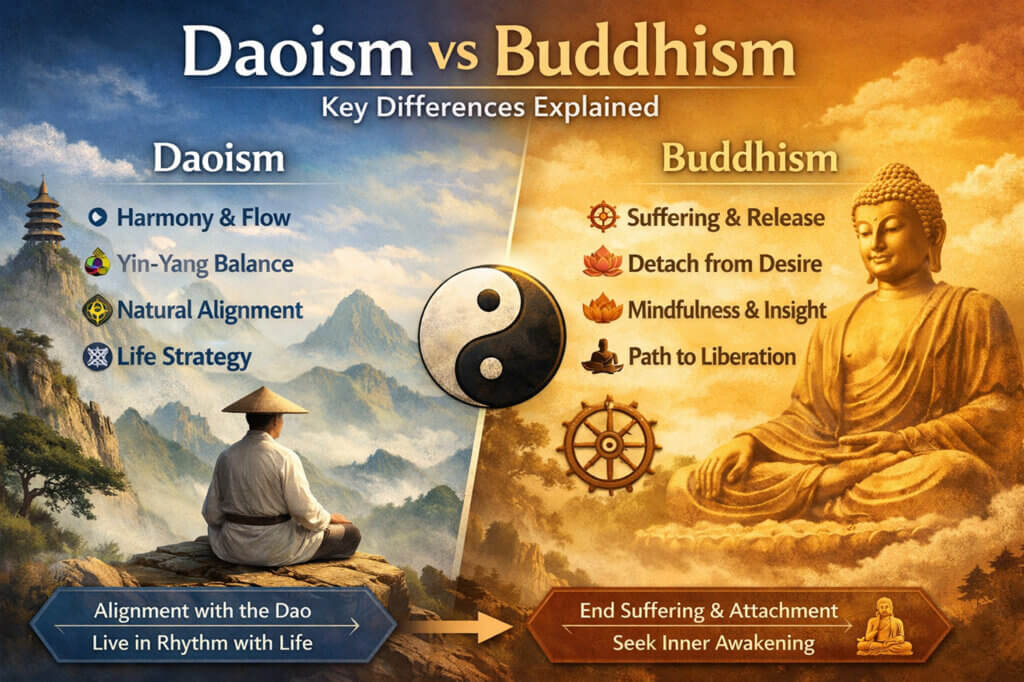
Buddhism begins with suffering and release
Buddhism begins more directly with suffering. Its concern is not simply how to make life feel a little smoother, but why suffering repeats, why attachment leads to anxiety and inner struggle, and how awakening and release become possible.
For this reason, Buddhism often feels psychologically precise. It is closer to a path of observation, discipline, practice, and letting go. It does not place its main emphasis on improving every condition of worldly life. Instead, it guides people to see how suffering is formed and how attachment keeps it going.
Daoism begins with harmony and alignment
Daoism starts from a different place. It does not first ask how to leave the world, but how to remain in right relationship with it. Daoism asks how a person can live in tune with the deeper rhythm of life rather than constantly struggling against reality. It values alignment with the Dao, responsiveness to timing, proportion, balance, and non-forcing action.
Because of this, Daoism feels more like a path of harmony. It points back toward a way of living that is more natural, more intelligent, and more in step with the flow of things. This is also why the Daoist idea of Wu Wei, or effortless action, is often so important in beginner explanations.
An easy way to remember the difference
Buddhism often asks: how does suffering arise, and how can it be released?
Daoism often asks: how can a person live with less friction and more harmony?
Suffering and Desire: Two Different Diagnoses
How Buddhism understands desire
In Buddhism, desire and attachment are deeply connected to suffering. The issue is not only what a person wants, but the grasping, clinging, and refusal to let go that can grow around wanting. That is what gives rise to anxiety, fear, disappointment, and repeated dissatisfaction. This is why Buddhist practice so often emphasizes awareness, observation, and gradually loosening identification with craving and thought.
Buddhism does not simply say that life is painful in a vague way. It asks more carefully: why does this suffering return again and again, and how does the mind participate in creating that cycle?
How Daoism understands desire
Daoism usually frames desire differently. Desire itself is part of life, but excess, imbalance, and striving against natural rhythm create trouble. In other words, Daoism is often less concerned with desire itself than with whether a person has lost proportion, begun living against the grain of life, or pushed beyond what the moment can truly sustain.
Because of this, Daoism has a different emotional tone. It does not necessarily begin with uprooting desire.More often, it begins with restoring balance, reducing friction, and returning to a more natural rhythm. Readers who want more background on balance may also find it useful to explore the meaning of Yin and Yang in daily life.
Why this difference matters in real life
If someone is more trapped in repeated attachment, obsessive thought, and emotional suffering, Buddhism may feel more direct.
If someone is more trapped in exhaustion, depletion, imbalance, and disconnection from body, environment, and pace of life, Daoism may feel more restorative.
Differences in Daily Practice
The Buddhist way: discipline and awareness
Buddhist practice often has a stronger sense of structure. It commonly emphasizes meditation, mindfulness, ethical discipline, and steady observation of the inner life. For people seeking greater clarity, deeper psychological insight, and a more defined path of practice, Buddhism can feel especially powerful.
In daily life, this often means learning to pause and see thoughts and emotions more clearly rather than being immediately carried away by them. The practical center of gravity is often consciousness itself: how the mind reacts, how attachment forms, and how awareness can gradually transform one’s relationship to suffering.
The Daoist way: flexibility, vitality, and embodied living
Daoist practice often feels more fluid and embodied. It pays attention to rhythm, breath, the movement of qi, health, cultivation, symbolic order, and the relationship between inner state and outer environment. For many readers, Daoism feels less like a tightly structured psychological training and more like a way of re-entering life with steadiness and vitality.
One of the most important differences is that Daoism places unusually strong emphasis on the body. In Daoist cultivation, the body is not treated as secondary to spiritual life. It is part of the path itself. This is why Daoist practice so often includes attention to rest, daily routine, nourishment, breath, energy preservation, and long-term vitality. The aim is not only insight, but also balance, resilience, physical well-being, and in many traditional contexts, the preservation of life and the cultivation of longevity.
In daily life, this often means learning how to act in step with timing, preserve energy, reduce unnecessary struggle, and reconnect with the body, physical space, and ordinary living.
Why modern readers often feel this difference immediately
For many modern readers, Buddhism can feel more focused on awareness, perception, and the transformation of consciousness, while Daoism can feel more connected to vitality, physical balance, daily rhythm, and how life is actually lived in the body.
That difference is often one reason Daoism feels especially approachable to people who are not only asking spiritual questions, but also asking how to sleep better, restore energy, reduce friction, support health, and live in a more sustainable way.
The most practical difference
Buddhism more often teaches people how to see and loosen inner attachment.
Daoism more often teaches people how to reduce friction between inner life and outer life, care for vitality, and live more in tune with both circumstances and the body.
How Daoism and Buddhism Understand Destiny, Cause, and Life Direction
The Daoist view: timing, structure, and response
In a Daoist framework, life is not usually understood as pure randomness. It has structure, movement, and changing conditions. But structure does not mean total fixity.
A simple way to understand this is:
Ming can be understood as one’s foundational structure.
Yun can be understood as changing cycles, timing, and conditions.
Environment, rhythm, and personal response continue to shape outcomes.
This is one reason Daoist culture developed systems such as BaZi, the Five Elements, and Bagua. Their underlying logic is not fatalism. It is the idea that although you cannot choose your starting point, you can still decide whether to respond more skillfully to the conditions you are living in.
The Buddhist view: karma, intention, and result
Buddhism places greater emphasis on karma, intention, and the way mental action shapes result. In that sense, its first concern is not usually how to adjust external timing, but what forms of ignorance, attachment, and craving keep producing the same suffering.
Because of this, Buddhism places its practical emphasis elsewhere. It does not first ask whether this is the right moment to act. More often, it asks what inner cause is continuing to generate the outcome.
An easy distinction to remember
Daoism more often asks: how can I align better within changing conditions?
Buddhism more often asks: how can I loosen the roots of suffering?
A Simple Comparison Table
| Dimension | Daoism | Buddhism |
|---|---|---|
| Starting point | Alignment with the Dao | Suffering and liberation |
| Overall tone | Rhythm, flow, balance | Insight, discipline, release |
| View of desire | Natural, but needing balance | Attached desire is a major source of suffering |
| View of life | Learning how to move well within life | Seeing and loosening attachment |
| Practical emphasis | Timing, vitality, harmony, proportion | Meditation, awareness, compassion, awakening |
| Modern appeal | Direction and life strategy | Inner clarity and release |
Which Path Feels Closer to Your Current Question
If your deeper question is:
Why does suffering keep repeating?
Why do I keep holding on to outcomes?
How do I loosen inner grasping?
then Buddhism may speak to you more directly.
If your deeper question is:
Why does my life feel out of rhythm?
Why does effort not seem to match results?
How do I understand timing, direction, and life phase more clearly?
then Daoism may resonate more immediately.
Author Note:This article is written as a cultural and philosophical introduction for modern readers who want a clearer understanding of the difference between Daoism and Buddhism. It is not a substitute for formal religious teaching, lineage-based instruction, sect-specific guidance, or mental health support. Both Daoism and Buddhism contain many schools and traditions, and their explanations of these themes can be more detailed and nuanced.
FAQ
Are Daoism and Buddhism the same?
No. They influenced each other historically in East Asia, but they are not the same tradition. Their core questions, language, and spiritual goals are different.
Is Daoism more practical for everyday life?
If a reader is more concerned with timing, rhythm, environment, vitality, and symbolic order, Daoism often feels more practical. If a reader is more concerned with suffering, attachment, and awakening, Buddhism may feel more direct.
Does Buddhism ignore the real world?
No. Buddhism certainly addresses life, but its priorities are different. Its deeper concern is how to loosen suffering rather than how to optimize worldly life.
Why do many people confuse Daoism and Buddhism?
Because they are often grouped together under broad labels like peace, mindfulness, or Eastern spirituality. Historical overlap also plays a role. In East Asia, Chan Buddhism (Zen) developed through long contact between Buddhist teaching and Daoist cultural language, which makes the two traditions appear closer on the surface than they really are. But once you look closely at suffering, desire, destiny, daily practice, and ultimate aim, the difference becomes much clearer.
Which one is better for anxiety or mental stress?
Neither should be treated as a substitute for professional mental health support. For some people, Buddhist mindfulness and observation of thought are helpful. For others, Daoist ideas of grounding, rhythm, embodied balance, and non-forcing feel more supportive in daily life.
Can I learn from both Daoism and Buddhism?
Yes. Many people study both, especially at the level of philosophy, self-cultivation, and personal reflection. But it is often better to understand their differences first before trying to combine them.
Conclusion
Daoism and Buddhism are not enemies, but they are not interchangeable either.
Buddhism more often teaches people how to see suffering clearly and gradually move toward release.
Daoism more often teaches people how to act skillfully within the world, read timing, preserve vitality, and live in better rhythm.
Seen from a modern distance, Daoism and Buddhism can sometimes appear to overlap in mood, language, or lifestyle aesthetics. The historical development of Chan/Zen helps explain part of that impression. But similarity in surface atmosphere does not mean sameness in foundation. One tradition leans more toward release from suffering through transformation of consciousness, while the other leans more toward harmony, vitality, and alignment within life itself.
For many people, the most important question is not which one is higher or better. It is what kind of answer they actually need right now.
If what you are looking for is clearer timing, stronger direction, a more natural rhythm of life, and a more harmonious relationship with your current life phase, Daoism may speak to you more directly.
For readers who feel drawn to Daoist ideas of harmony, timing, vitality, and embodied living, symbolic objects can also become part of that connection. You may wish to explore pendants, bracelets, and other culturally inspired pieces that reflect Daoist themes in a subtle and everyday way.