
Daoism
Taoism vs Daoism: What’s the Difference and Why It Matters Today
Confused about Taoism vs Daoism? Learn the real difference, why the two names exist, and how Daoist systems like Bazi and Feng Shui help guide life decisions.
Taoism vs Daoism: What’s the Difference—and Why It Still Matters Today
When you search online for Taoism vs Daoism, confusion is almost guaranteed. Sometimes the two terms seem to describe the same philosophy, while other times they appear to represent two completely different systems. For Western readers encountering Daoist thought for the first time, this distinction is far from intuitive—and it’s one of the most common sources of misunderstanding.
So the real question is:
Are Taoism and Daoism actually the same thing?
The short answer is: yes.
The more complete answer is: they reflect different language systems, historical contexts, and cultural perspectives.
Understanding this difference doesn’t just clarify terminology.
It opens the door to a deeper understanding of destiny, feng shui, personal energy, and the hidden logic behind life’s major choices.
In this article, we’ll explain Taoism vs Daoism in a clear, non-academic way and explore why this distinction still matters in the modern world. We’ll also dive into how these philosophical concepts can be applied to real-life decisions, timing, and even career or personal growth.
What’s the Difference Between Taoism and Daoism?
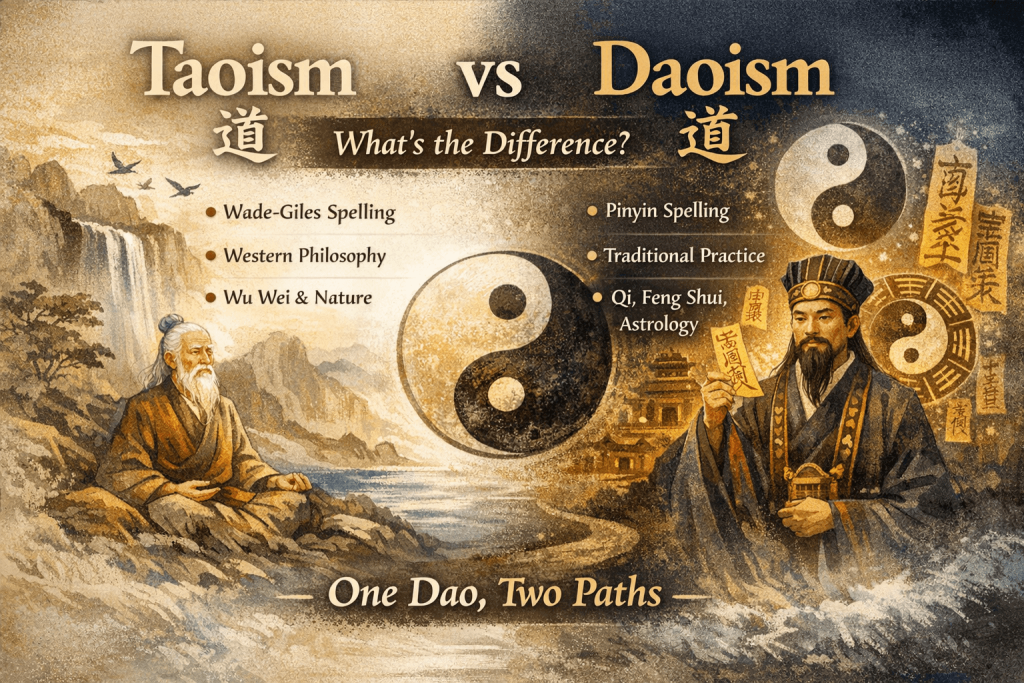
At first glance, Taoism and Daoism appear to be the same, but the difference lies in the way they were romanized from Chinese characters. Both terms point to the same philosophical tradition, but they come from different systems of translating Chinese sounds into the Latin alphabet.
- Daoism comes from Hanyu Pinyin, the modern system used in China today.
- Taoism comes from Wade-Giles, an older Romanization system.
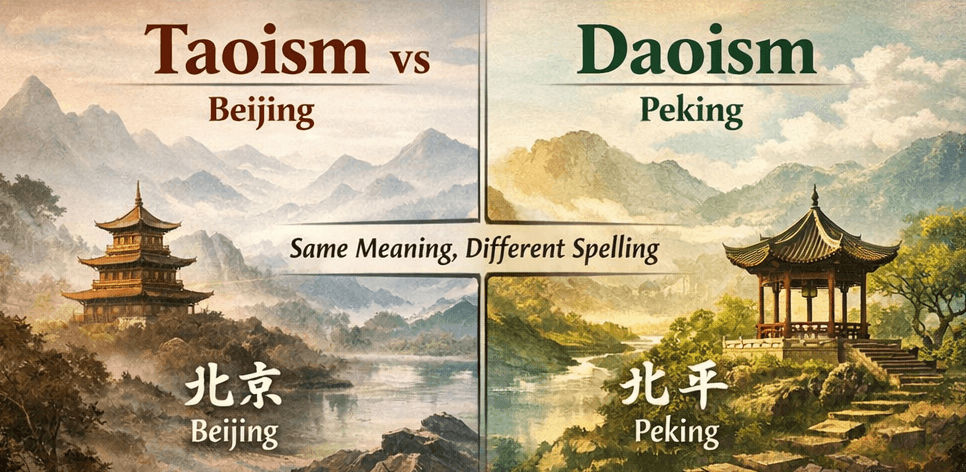
A Simple Comparison: Beijing vs Peking
The same distinction occurs with the names of places. For example, Beijing and Peking refer to the same city.
Similarly, Daoism and Taoism refer to the same Dao (道)—the natural order that governs the universe.
However, over time, these two spellings began to carry different interpretive emphases in Western contexts. While Daoism became the preferred term in modern academic settings, Taoism continued to be widely used in popular culture and Western introductions to Chinese philosophy.
Why Do Two Terms Exist at the Same Time?
To understand the reason behind these two terms, we need to look at how Daoist thought first entered the Western world. During the 19th and early 20th centuries, Western audiences encountered Daoism through:
- Translations of the Tao Te Ching
- Philosophical writings by Lao Tzu and Zhuangzi
- Works by early sinologists and missionaries
At the time, Wade-Giles was the dominant romanization system, which led to:
- 道 → Tao
- 老子 → Lao Tzu
- 道教 → Taoism
Because of this, early Western impressions of Taoism were often shaped by:
- A philosophical rather than religious understanding
- A focus on nature-oriented, minimalist teachings
- Emphasis on Wu Wei (non-forcing, effortless action) as the ideal way to live
The Emergence of “Daoism” in Modern Usage
With the official promotion of Hanyu Pinyin by China in the mid-20th century, academic and cultural institutions gradually adopted terms like:
- Dao
- Laozi
- Daoism
Today, Daoism is more common in academic research and traditional Chinese contexts, while Taoism remains popular in popular writing and Western introductions to Chinese philosophy.
How Are Taoism and Daoism Commonly Understood Today?
Although Taoism and Daoism refer to the same tradition, in practice, the two terms often point to different levels of understanding.
Taoism (Common Western Interpretation)
In Western contexts, Taoism is usually interpreted as:
- A life philosophy rather than a religion
- Focused on inner balance and emotional well-being
- Based on Wu Wei (acting in harmony with circumstances)
- Living in alignment with nature
It is often seen as:
- A mindset for life
- A stress-reduction philosophy
- A form of spiritual wisdom without religious structure
Many people turn to Taoism for its simplicity and its ability to reduce stress, cultivate balance, and encourage harmony with the natural world.
Daoism (The Complete Traditional System)
In traditional Chinese culture, Daoism is much more comprehensive. It includes:
- An organized religious tradition with lineages and practices
- Cultivation systems and internal alchemy for spiritual growth
- Energy frameworks such as Qi, Yin–Yang, and the Five Elements
- Destiny analysis methods like Bazi (Four Pillars of Destiny)
- Practical applications such as feng shui and talismanic systems
In simple terms:
- Taoism reflects the philosophical layer of Daoism as understood in the West
- Daoism represents the full, lived system refined over thousands of years in Chinese tradition
Both are valid, but either one alone—philosophy without practice, or practice without philosophy—does not provide a complete picture.
Is Daoism a Philosophy or a Religion?
The answer is: both.
- Philosophical Daoism focuses on understanding and aligning with the Dao
- Religious Daoism focuses on cultivation, protection, longevity, and achieving harmony between Heaven, Earth, and humanity
In traditional Daoism, philosophy without practice is empty, and practice without understanding is blind. This unity of insight and action is what many Western interpretations tend to overlook.
Why This Distinction Still Matters Today
Understanding the difference between Taoism and Daoism is not about choosing the “correct” term.
It’s about deciding how deeply you want to engage with these ideas.
Do you want to remain at the level of abstract ideas—or are you ready to move into application?
Many people are drawn to Taoism because it:
- Offers a sense of direction
- Helps reduce inner resistance
- Reframes uncertainty into opportunity
But as understanding deepens, new questions naturally arise:
- What path truly fits me?
- When should I act—and when should I wait?
- Why do some choices flow more smoothly than others?
These are exactly the kinds of questions that traditional Daoism has been exploring for centuries.

From Philosophy to Application: Living the Dao
Daoism was never meant to stay abstract.
Throughout history, it has been used to:
- Understand personal strengths and limitations
- Read timing and environmental conditions
- Support major life decisions
- Create balance between individuals, society, and nature
Systems such as:
- Bazi (Four Pillars of Destiny)
- Yin–Yang and Five Element dynamics
These tools were not designed to predict fate, but to help you read the terrain of your life—whether that’s your career, relationships, or personal growth.
When the terrain is clear, decisions become calmer and more confident.
Taoism vs Daoism: Which Term Should You Use?
For most modern readers:
- Taoism feels more approachable
- Daoism is more systematic and complete
Both terms are correct. What truly matters is not which word you choose, but whether you actually apply the wisdom to your life.
Conclusion: One Dao, Many Entry Points
Whether you call it Taoism or Daoism, the essence of the Dao remains unchanged.
Different names simply reflect different ways of entering understanding.
Behind the apparent chaos of life choices, there is always an underlying order.
When you begin to perceive it, action becomes clearer—and decisions feel lighter.
The Dao is not something you must believe in.
It is something that can be experienced, understood, and applied.
Ready to Apply Daoist Wisdom to Real Life?
Understanding the difference between Taoism and Daoism is only the first step.
The true value of traditional Daoist systems lies in personal alignment and practical application: