Daoism, Five Elements
Five Elements (Wu Xing) Meaning Explained: A Daoist Guide to Balance in Modern Life
Explore the Five Elements (Wu Xing) meaning in Daoism and learn how Wood, Fire, Earth, Metal, and Water can guide balance, clarity, and decision-making in modern life.
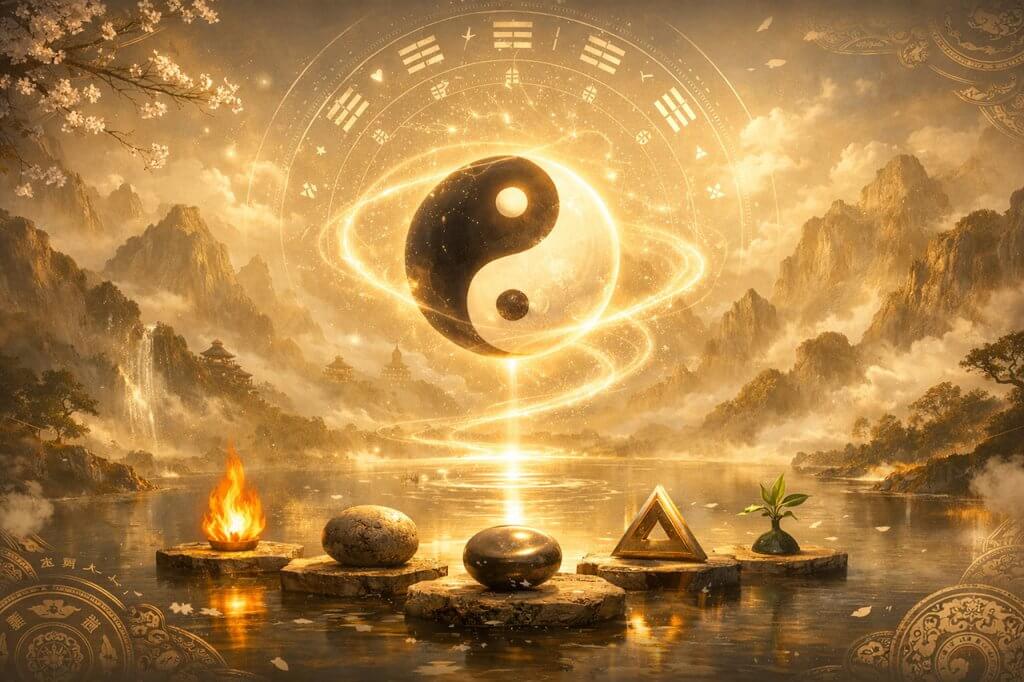
Understanding the Five Elements (Wu Xing) in Daoism and Modern Life
In today’s fast-paced world, many people feel exhausted, overstimulated, or quietly stuck.
This is one reason the Five Elements (Wu Xing) meaning still resonates so strongly in modern life.
In Daoist thought, Wu Xing is not an outdated theory or a set of mystical labels.
It is a practical framework for understanding how energy moves through phases of growth, expression, stability, refinement, and restoration.
A useful way to explain it for modern readers is this:
Wu Xing works like a symbolic operating system for reading patterns in life.
It can help people reflect on emotional rhythm, work cycles, personal balance, and decision-making—not by forcing control, but by showing what kind of response is most appropriate at a given time.
What Is the Five Elements (Wu Xing) Meaning in Daoism?
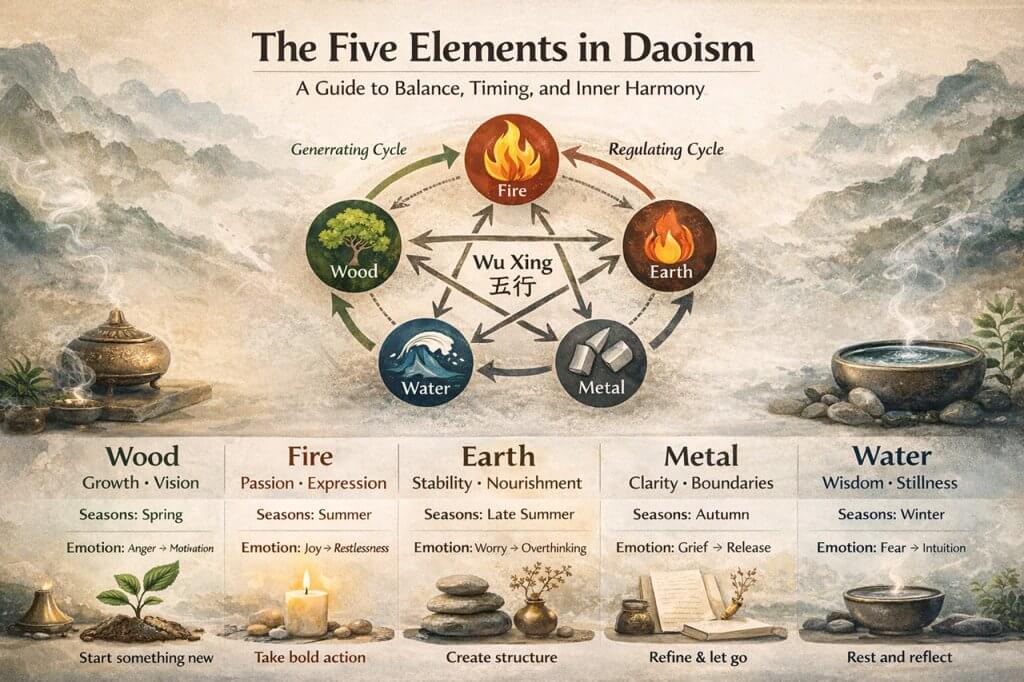
The Five Elements (Wu Xing) meaning in Daoism refers to five dynamic phases of change:
Wood
Growth, expansion, initiative, and vision.
Fire
Expression, activation, visibility, and momentum.
Earth
Stability, nourishment, grounding, and integration.
Metal
Precision, structure, refinement, and clarity.
Water
Wisdom, stillness, storage, and inward strength.
Unlike the Western idea of elements as physical substances, Wu Xing is about movement and transformation.
The word Xing (行) carries the sense of movement, process, and function.
This is why Wu Xing is better understood as a cycle of energetic phases rather than a list of separate materials.
It explains how life grows, peaks, stabilizes, refines itself, and returns to stillness before beginning again.
Why the Five Elements Still Matter Today
Many people today are not lacking information.
They are lacking rhythm, clarity, and balance.
Modern culture often rewards only one kind of energy: constant output.
People are encouraged to move faster, stay visible, respond quickly, and keep producing.
From a Five Elements perspective, that often looks like too much Fire without Water, or too much Wood without the stabilizing role of Earth.
This is why the Five Elements (Wu Xing) meaning still feels relevant.
It helps explain imbalance not as personal failure, but as a mismatch of energy and timing.
A person may not need more motivation.
They may need more rest.
More structure.
More grounding.
Or less pressure to keep pushing in the wrong phase.
Wu Xing Is Not a Fixed Personality Label
One of the most common misunderstandings online is treating the Five Elements as personality types.
That is too limited.
Daoist thought focuses on patterns, not permanent labels
In Daoism, Wu Xing is used to observe how energy behaves under changing conditions.
A person may show more Wood during a phase of expansion, more Metal during a period of discipline, or more Water during retreat, healing, or reflection.
The real question is not “What element am I?”
The more useful question is:
What kind of energy is most needed right now?
If your current phase requires structure, more passion will not solve the problem.
If your life is stagnant, endless reflection may deepen hesitation.
If your routine is overloaded, more expansion can become another form of imbalance.
Wu Xing is valuable because it teaches situational awareness.
The Two Core Cycles of Wu Xing
The Generating Cycle
Each element supports the next:
- Wood feeds Fire
- Fire creates Earth
- Earth bears Metal
- Metal enriches Water
- Water nourishes Wood
This cycle represents development, continuity, and natural growth.
The Regulating Cycle
Each element also restrains another:
- Wood penetrates Earth
- Earth absorbs Water
- Water controls Fire
- Fire melts Metal
- Metal cuts Wood
This cycle prevents excess and preserves order.
Why both cycles matter
Many people think progress means constant expansion.
Wu Xing suggests otherwise.
Healthy growth also requires:
- boundaries
- correction
- timing
- recovery
- restraint
In Daoist thinking, not every limit is negative.
Some forms of limitation are what keep life balanced.
How the Five Elements Apply to Modern Life
1、Decision-Making and Timing
Wu Xing teaches that timing often matters more than force.
If the moment calls for Metal, clarity matters more than enthusiasm.
If the moment calls for Water, reflection matters more than reaction.
If the moment calls for Wood, preparation without movement can become stagnation.
This framework helps explain why effort alone does not always create results.
Sometimes the issue is not intensity, but misalignment.
Work, Burnout, and Momentum
One reason the Five Elements (Wu Xing) meaning remains practical is that it offers a better way to read modern work cycles.
A project may fail not because the idea is weak, but because the cycle is incomplete:
- strong vision without structure
- rapid expansion without recovery
- constant action without reflection
- organization without warmth or momentum
Wu Xing offers a more balanced lens for work and business.
Instead of only asking, “How do I push harder?”
it asks,
“What phase is missing from this cycle?”
Emotional Awareness
In traditional Chinese and Daoist thought, emotional states are often discussed through Five Elements patterns.
This is best understood as a symbolic way of reading imbalance rather than a rigid medical formula.
For example:
- frustration may suggest blocked Wood
- agitation may reflect excessive Fire
- mental heaviness may point to unstable Earth
- rigidity may relate to overactive Metal
- depletion may indicate weakened Water
This helps shift the focus from self-judgment to self-observation.
Instead of asking, “What is wrong with me?”
Wu Xing encourages a better question:
“What kind of energy is out of balance right now?”
Relationships and Communication
People often misunderstand one another not because they lack care, but because they express energy differently.
One person may respond with Fire: immediate, expressive, direct.
Another may respond with Water: quiet, thoughtful, slow.
Another may lead with Metal: precise, reserved, and structured.
Seen this way, Wu Xing can also be useful in relationships.
It provides language for energetic differences, not just philosophical ideas.
A Quick Self-Check: Which Element Feels Missing Right Now?
Before going further, pause and ask yourself:
- Do you need more clarity or stronger boundaries?
- Do you need more rest and emotional recovery?
- Do you need more momentum or visible expression?
- Do you need more grounding and steadiness?
- Do you need a new beginning or a fresh sense of direction?
This simple reflection is one reason the Five Elements (Wu Xing) meaning remains practical.
It helps translate vague stress into something more readable.
Instead of saying, “Everything feels off,”
you begin to notice whether the real issue is:
- too little Water
- too much Fire
- weak Earth
- missing Metal
- or blocked Wood
That kind of language makes self-awareness more actionable.
Real-Life Five Elements Examples in Modern Life
Abstract philosophy becomes more useful when you can recognize it in daily situations.
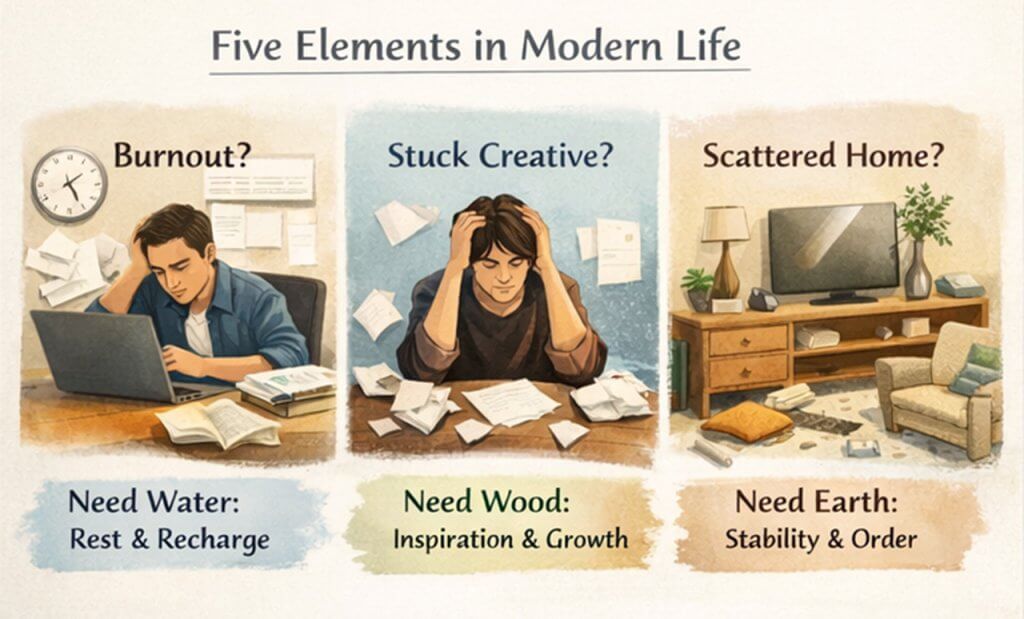
The overwhelmed founder
A person with strong vision, nonstop output, and constant urgency may look productive on the outside.
But if there is too much Fire and Wood without enough Earth or Water, burnout becomes likely.
The stuck creative
Someone with ideas, sensitivity, and depth may spend too much time in reflection.
Without enough Wood to initiate movement, Water can turn into delay rather than wisdom.
The disciplined but joyless routine
A person may have strong structure, control, and efficiency, yet still feel emotionally flat.
This can happen when Metal is strong but Fire is weak.
The scattered home environment
A room may feel busy, noisy, or mentally draining even when nothing is obviously wrong.
In Five Elements terms, the space may need more Earth for stability or more Metal for visual clarity.
These examples do not define people permanently.
They simply show how Five Elements thinking can turn modern stress into something easier to understand.
How Five Elements Thinking Can Shape Your Space
The Five Elements (Wu Xing) meaning also extends to physical space.
In Daoist and Feng Shui traditions, different materials, colors, shapes, and arrangements are often used symbolically to support a certain quality of energy.
For modern readers, this can be understood simply:
your environment influences your mental rhythm.
A space that feels scattered may benefit from more Earth-like stability.
A space that feels dull may benefit from Wood-inspired vitality.
A space filled with visual noise may benefit from Metal-like clarity and restraint.
This is one reason Five Elements–inspired decor, jewelry, and symbolic objects remain meaningful today.
They are not just decorative.
They can serve as daily reminders of the kind of balance, focus, or grounding a person wants to cultivate.
Wu Xing as Reflection, Not Control
n authentic Daoist thought, Wu Xing is not meant to guarantee outcomes or control fate.
It works better as:
- a framework for awareness
- a language for timing and adjustment
- a reminder that life moves in cycles
- a way to notice imbalance before it becomes struggle
This is part of what makes the Five Elements so compelling for modern readers.
It does not promise certainty.
It offers orientation.
And in a world full of noise, orientation can be more useful than rigid answers.
Final Thought: Balance Is Not Forced
The deepest insight behind the Five Elements (Wu Xing) meaning is simple:
Balance does not come from doing everything equally.
It comes from responding appropriately.
Sometimes life asks for growth.
Sometimes it asks for expression.
Sometimes it asks for stability.
Sometimes it asks for refinement.
Sometimes it asks for rest.
Wu Xing does not define you forever.
It helps you understand what this phase of life is asking from you now.
FAQ
What is the Five Elements (Wu Xing) meaning in Daoism?
The Five Elements, or Wu Xing, describe five dynamic phases of change—Wood, Fire, Earth, Metal, and Water. In Daoism, they are used to understand movement, balance, timing, and transformation rather than fixed physical substances.
Is Wu Xing about personality?
Not in a fixed or simplistic way. Daoist thought uses Wu Xing to observe changing patterns of energy, behavior, and timing rather than to lock a person into one permanent type.
How can the Five Elements apply to modern life?
Wu Xing can help people reflect on decision-making, burnout, emotional balance, communication, and work rhythm by identifying what type of energy is excessive, missing, or mistimed.
Is Wu Xing the same as Feng Shui?
Not exactly. Wu Xing and Feng Shui are closely related, but they are not identical. Wu Xing describes patterns of change and energetic relationships, while Feng Shui applies those principles to space, placement, and environmental harmony.
Can Five Elements symbols really help?
They are best understood as tools of reflection and awareness. Their value often lies in helping people stay mindful of balance, timing, and personal direction in daily life.
Discover symbolic pieces inspired by Wood, Fire, Earth, Metal, and Water—designed to support balance, reflection, and intentional living in everyday life.
Understand Bagua and life direction through Daoist symbolism—————Bagua Meaning Explained
Explore Yin Yang meaning in daily balance———————————Yin Yang Meaning Explained
Explore core Daoist symbols beyond superstition———————Daoist Symbols and Their Meaning