Daoism
Bagua Meaning Explained: A Simple Daoist Guide to Change, Balance and Life Direction
What does Bagua mean in Daoism? Discover a clear, modern explanation of the Bagua symbol, the Eight Trigrams, and how this article system helps people understand change, balance, timing, and direction in everyday life.
Bagua Meaning Explained: How the Daoist Symbol Helps You Understand Change and Life Direction
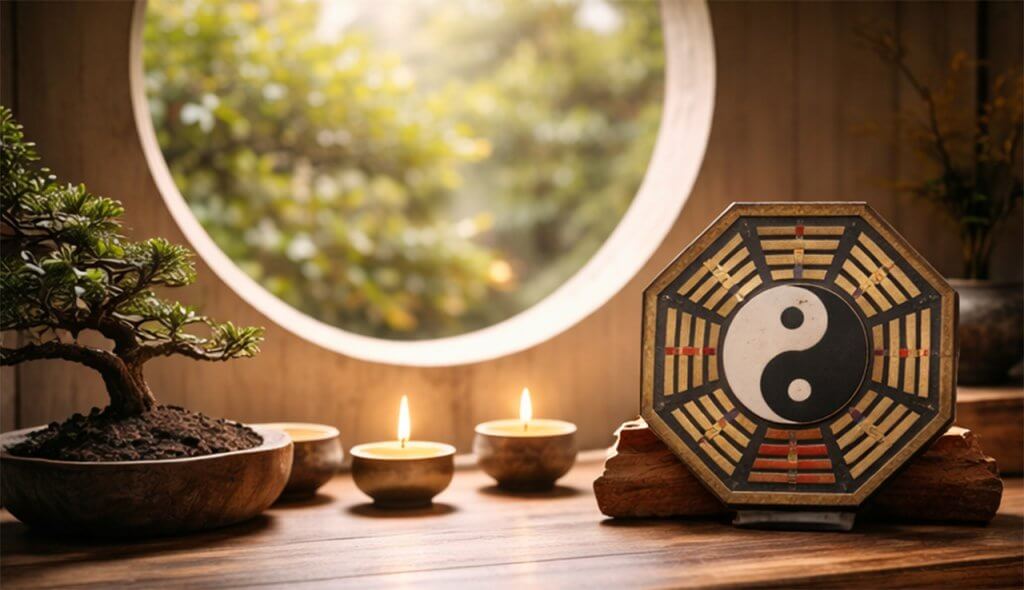
Bagua meaning is often misunderstood, especially by Western readers who first encounter it through Feng Shui charts, mirrors, or decorative symbols online. It may look mystical at first, but in Daoist thought, Bagua is not just a spiritual ornament or a superstition-based symbol. It is a practical symbolic system used to understand change, balance, timing, and direction.
In modern life, where people face uncertainty, emotional overload, constant decisions, and mental distraction, Bagua still feels surprisingly relevant. Rather than promising certainty, it helps people recognize patterns. Rather than encouraging control, it teaches awareness. And rather than giving rigid answers, it helps people move more wisely through changing conditions.
For beginners, the most useful way to understand Bagua is simple: it is a map of how life moves.
What Is Bagua?
The Simple Meaning of Bagua
Bagua (八卦) literally means “Eight Trigrams.”
Each trigram is made of three lines. These lines are either:
- Solid lines, representing Yang
- Broken lines, representing Yin
Different combinations of these lines create eight core patterns. In Daoist thought, these patterns describe how energy behaves, how situations unfold, and how change takes shape.
Bagua is not merely a diagram. It is a symbolic language for reading movement, balance, tension, and transformation.
Why the Eight Trigrams Matter
The eight trigrams are traditionally known as:
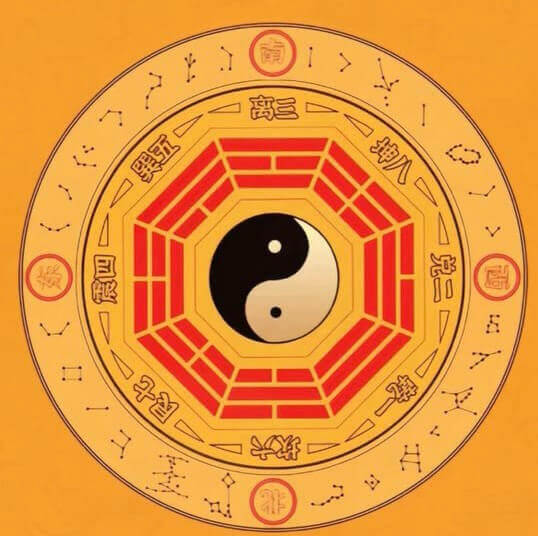
Qian 【乾】
Kun 【坤】
Zhen【震】
Xun 【巽】
Kan 【坎】
Li 【离】
Gen 【艮】
Dui 【兑】
These names are often translated as Heaven, Earth, Thunder, Wind, Water, Fire, Mountain, and Lake. But for many Western readers, those literal translations can feel distant or overly abstract.
A more useful modern reading is to treat each trigram as a pattern of change.
Some suggest initiation.
Some suggest receptivity.
Some suggest movement.
Some suggest penetration.
Some suggest risk.
Some suggest clarity.
Some suggest stillness.
Some suggest openness or joy.
This is where Bagua becomes practical. It is less about memorizing labels and more about learning how different conditions behave.
Bagua in Daoism: A System of Change, Not Superstition
Bagua Is Not About Controlling Fate
A common misunderstanding is that Bagua exists to predict the future or control destiny. In Daoist thought, that is not the main point.
Bagua helps people understand:
- when to act
- when to pause
- when to adapt
- when to stop forcing
- when a situation is shifting direction
It does not command reality. It reveals the nature of the moment.
Think of Bagua as a Map, Not a Magic Object
One of the simplest ways to explain Bagua to a Western audience is to compare it to a map or weather system.
A weather map does not create the storm.
It does not control the wind.
It shows what conditions are forming so that you can respond more intelligently.
Bagua works in a similar way. It helps you recognize the pattern of a situation before reacting blindly. That is why Bagua still matters today. It offers orientation, not illusion.
What the Bagua Symbol Represents
Yin and Yang in Motion
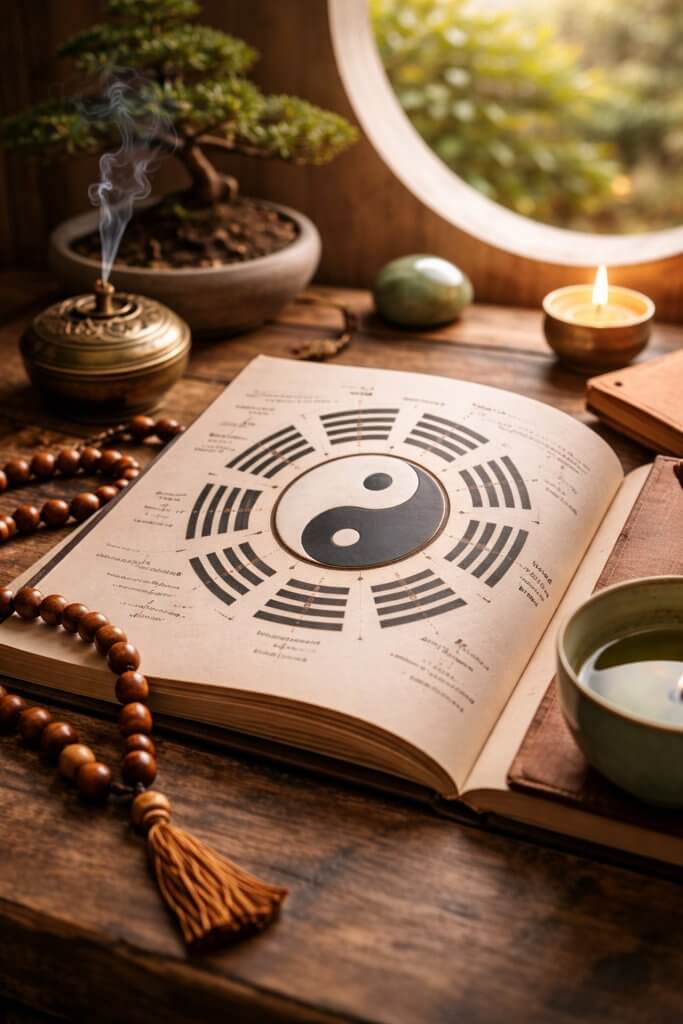
At the center of Bagua is the interaction between Yin and Yang. The trigrams are built from Yin and Yang lines, which means Bagua is fundamentally about polarity in motion.
It does not describe life as fixed. It describes life as changing through tension, response, balance, and transformation.
A Model of Cycles, Not Static Meaning
Bagua is useful because it reflects cyclical thinking. Instead of asking whether a situation is simply good or bad, Bagua asks:
- What phase is this in?
- What force is increasing?
- What force is declining?
- Is the right response action, restraint, patience, or adjustment?
This is why Bagua remains relevant in modern life. It helps people read cycles instead of reacting only to surface events.
How Bagua Applies to Modern Life
Decision-Making Under Uncertainty
When life feels unclear, many people try to solve the problem by moving faster. They overwork, overthink, or force decisions before the situation is ready.
Bagua suggests a different approach: understand the condition first.
Useful reflection questions:
- Is this the right time to push forward?
- Is the situation growing, unstable, or blocked?
- Is resistance a warning sign or simply part of the process?
- Would clarity come from action or from waiting?
This makes Bagua especially helpful for decision-making, transitions, and periods of uncertainty.
Personal Balance and Energy Use
Many people feel stuck not because they lack ability, but because they are using energy in the wrong way or at the wrong time.
Bagua can help you notice:
- where energy is being overextended
- what part of life feels neglected
- when restraint is wiser than expansion
- when stillness is more productive than pressure
This makes Bagua a useful framework for self-awareness, especially in a world that constantly rewards speed over alignment.
Space and Environmental Awareness
Bagua is also closely associated with Feng Shui, where it is used to understand how space influences attention, mood, and behavior.
In modern terms, this can include:
- designing a workspace that supports focus
- reducing visual clutter that increases stress
- creating a home environment that feels calm and intentional
- using symbolic objects as reminders of balance and direction
This is one reason Bagua continues to appeal to modern readers. It connects inner clarity with outer environment.
Bagua Is Symbolic, Not Superstitious
Symbols as Tools of Awareness
In Daoist culture, symbols are not valuable because they magically change reality. They are valuable because they help people remember a principle, hold an intention, or relate to life more consciously.
That is why Bagua still appears in homes, workspaces, and personal objects today. Used well, it becomes a visual anchor for awareness.
Bagua in Daily Living
For many people today, Bagua becomes meaningful when it moves beyond theory and into everyday life. That connection often happens through carefully chosen objects, including Feng Shui décor and symbolic jewelry that reflect balance, protection, and intentional living.
Explore Feng Shui décor and symbolic jewelry inspired by Bagua principles →
Bagua vs Popular Misunderstandings
Common Simplifications
In popular culture, Bagua is often reduced to:
- a lucky symbol
- a mirror above the door
- a decorative spiritual pattern
- a rigid Feng Shui formula
These interpretations are not always completely wrong, but they are incomplete.
What Bagua Actually Offers
In a deeper Daoist framework, Bagua helps explain:
- why effort sometimes fails even when intention is strong
- why waiting can be strategic rather than passive
- why direction matters more than speed
- why balance is dynamic rather than fixed
This is what makes Bagua distinct. It is not only a symbol to look at. It is a way of understanding movement.
Why Bagua Resonates With Modern Western Readers
It Does Not Require Blind Belief
Many people are drawn to Bagua because it can be approached without dogma. It does not require worship or unquestioning belief. It can be understood philosophically, symbolically, or practically.
It Matches a Pattern-Based Mindset
Modern readers often prefer systems that explain complexity without oversimplifying it. Bagua offers that. It does not force life into rigid categories. It helps people observe patterns, timing, and relationships.
It Connects Meaning With Lifestyle
Bagua also fits naturally into modern lifestyle design. It can influence how people think, how they organize space, and what symbolic items they choose to keep close in daily life.
Bring Bagua-inspired balance into your space or daily wear →
How Beginners Can Start Understanding Bagua
Start With Observation, Not Memorization
You do not need to memorize all eight trigrams immediately. A better starting point is to use Bagua as a reflective tool.
Begin by asking:
- What in my life is expanding?
- What feels blocked or strained?
- Where do I need stillness instead of force?
- What am I resisting that may already be changing?
- Which direction feels more natural, even if slower?
This approach makes Bagua more accessible and more useful for beginners.
Use Symbolic Objects Intentionally
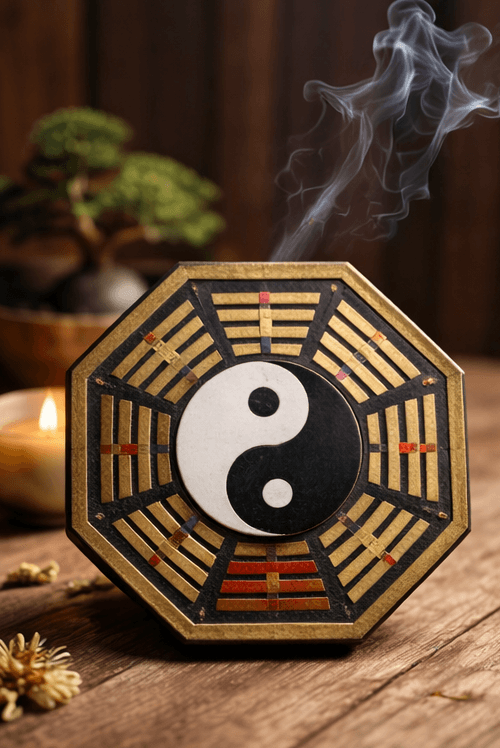
A Bagua symbol, Feng Shui object, or piece of symbolic jewelry becomes meaningful when it is used with awareness. Its value is not in superstition, but in what it reminds you to notice.
That reminder may be balance.
It may be restraint.
It may be protection.
Or it may simply be the need to pause before reacting.
Final Thought: Bagua Is a Map, Not a Command
Bagua does not tell you exactly what will happen. It helps you understand where you are, what forces are shaping the moment, and which direction may involve less resistance.
That is why Bagua still matters in modern life. It does not offer fantasy control. It offers awareness, timing, and a clearer relationship with change.
For many people today, that awareness also extends into the objects they choose to live with—whether through Feng Shui décor that supports an intentional space, or symbolic jewelry that carries reminders of balance and protection into everyday life.
Explore Bagua-Inspired Living
If the meaning of Bagua resonates with you, you may also enjoy symbolic pieces designed for everyday balance, intention, and visual harmony.
Frequently Asked Questions About Bagua
Not exactly. Bagua is a broader symbolic system rooted in Daoist thought and change theory. In Feng Shui, Bagua is often applied to space, layout, and environmental balance.
The Bagua symbol represents the Eight Trigrams, which describe different patterns of change, energy, and response. It is often used to understand timing, movement, and balance.
Yes. Beginners can start by understanding Bagua as a way to observe patterns, timing, and direction, without needing to master every trigram immediately.
Because symbols can serve as daily reminders. Many people use Bagua-inspired décor or jewelry to reflect balance, protection, focus, and intentional living.