Daoist Symbols
Wu Yue Zhen Xing Tu Meaning: Five Sacred Mountains Symbol Explained
Discover the true Wu Yue Zhen Xing Tu meaning through Daoist symbolism, the Five Sacred Mountains, spatial balance, grounding, and modern cultural decor.
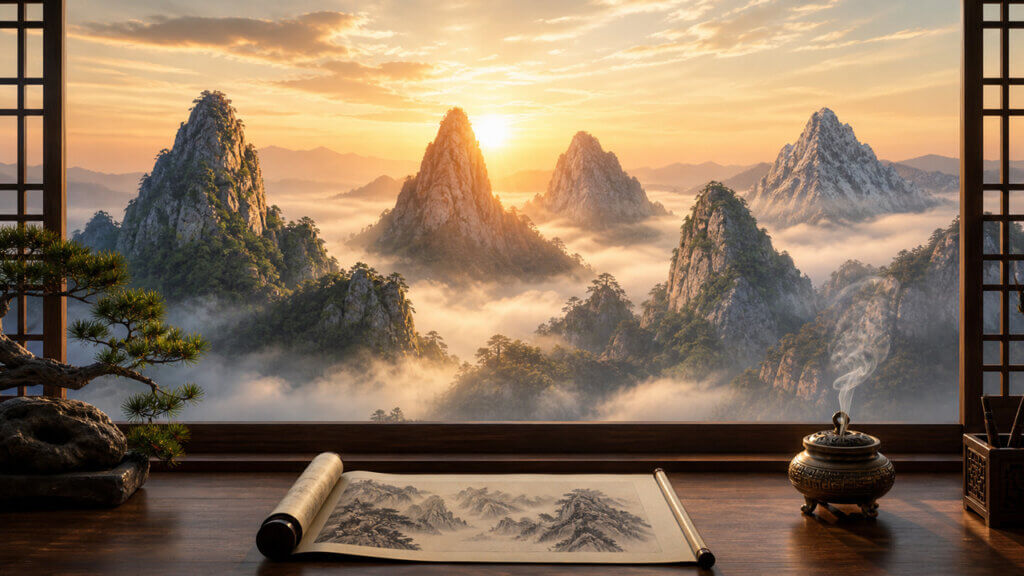
Wu Yue Zhen Xing Tu: The Daoist Map of Sacred Mountain Balance
Introduction: What Does Wu Yue Zhen Xing Tu Meaning Really Mean?
Wu Yue Zhen Xing Tu meaning refers to the symbolic meaning of the “True Form Diagram of the Five Sacred Mountains” in Daoist culture. At first glance, it may look like an abstract pattern, an ancient map, or a talismanic design. But its deeper meaning is not limited to protection. It is about sacred geography, mountain stability, direction, and the Daoist way of seeing nature as a living structure.
Unlike simple lucky charms, Wu Yue Zhen Xing Tu is not mainly about quick wealth or instant success. It is better understood as a symbolic map of balance. It represents how the Five Sacred Mountains anchor the world through five directions: east, west, south, north, and center.
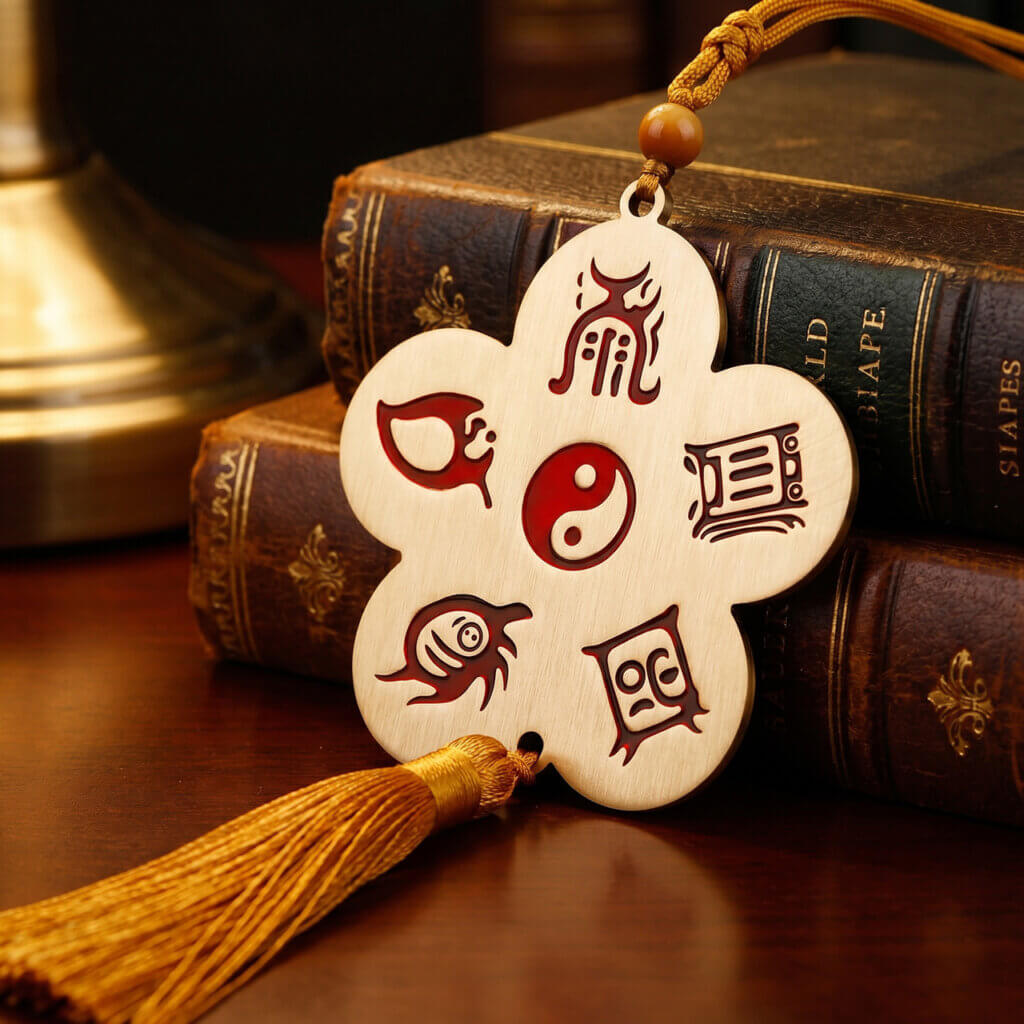
Wu Yue Zhen Xing Tu is not a regular picture of mountains. It is a Daoist symbolic diagram that shows the “true form” of sacred mountains and their role in grounding space, direction, and inner stability.
For readers exploring Daoist culture today, this symbol offers a way to understand how ancient Chinese thought connected landscape, body, home, movement, and inner orientation. A mountain was never only a mountain. It could also become a sign of support, boundary, center, and quiet strength.
What Is Wu Yue Zhen Xing Tu?
Wu Yue Zhen Xing Tu can be translated as “The True Form Diagram of the Five Sacred Mountains.”
Word-by-Word Meaning
Wu Yue / 五岳 means the Five Sacred Mountains.
Zhen Xing / 真形 means true form, real form, or hidden essential shape.
Tu / 图 means diagram, map, chart, or image.
The full phrase does not simply mean “a picture of five mountains.” It refers to a sacred diagram that reveals the deeper symbolic form of the Five Sacred Mountains.
In Daoist culture, “true form” suggests that the visible world may have a deeper pattern beneath its surface. A true-form diagram is not only decorative; it shows the inner structure of a sacred place or natural force through symbolic lines and forms.
This is why Wu Yue Zhen Xing Tu can feel unusual to modern eyes. It does not follow the style of a realistic landscape painting. It does not try to show mountains as they appear from a distance. Instead, it presents mountain forms as symbolic structures, almost like a spiritual topography.
The result is a diagram that sits between image, map, talisman, and philosophy. It is visual, but not merely visual. It is geographical, but not only geographical. It is symbolic, but not empty decoration.
Why “True Form” Matters in Daoist Thought
The idea of “true form” is one of the most important keys to understanding Wu Yue Zhen Xing Tu meaning.
In everyday seeing, people often look at the outer shape of things. A mountain appears as stone, height, slope, forest, mist, and distance. Daoist symbolic thinking looks further. It asks what kind of hidden order a mountain carries. It asks how a place participates in the movement of heaven, earth, direction, time, and life.
Outer Appearance and Inner Pattern
A mountain has an outer appearance, but it can also have an inner pattern. The outer appearance is what the eye sees. The inner pattern is what the symbol points toward.
Wu Yue Zhen Xing Tu belongs to this second layer. It does not try to copy the mountain. It tries to express what the mountain means within a Daoist worldview.
This makes the symbol very different from ordinary mountain art. A painting may show beauty. A map may show location. A true-form diagram points toward presence, structure, and sacred order.
True Form as a Way of Seeing
To understand “true form,” it helps to think of it as a way of seeing. Daoist culture often pays attention to what is hidden beneath the surface: the rhythm behind change, the balance behind form, and the quiet order behind nature.
Wu Yue Zhen Xing Tu invites this kind of seeing. It asks the viewer to look beyond shape and notice relationship: mountain and direction, center and boundary, stillness and movement, outer space and inner state.
This is why the symbol remains meaningful today: it asks a simple but powerful question — where is your center, and what helps you remain grounded?
The Five Sacred Mountains Explained
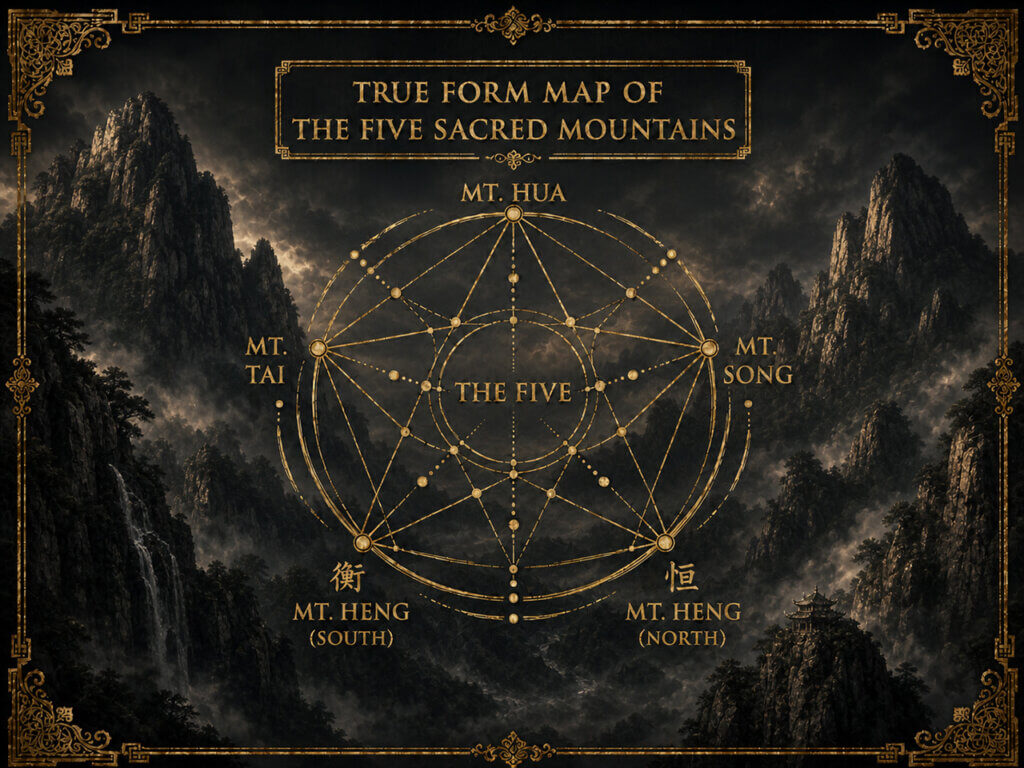
To understand Wu Yue Zhen Xing Tu meaning, we must first understand why the Five Sacred Mountains matter.
In traditional Chinese cosmology, the world can be symbolically understood through five directional mountains. Each mountain corresponds to a direction and is often connected with the Five Elements. This idea also connects with the broader relationship between direction, element, and natural order explained in Five Elements Meaning in Daoist Thought.
East: Mount Tai
Mount Tai is connected with the east and the Wood element. It symbolizes sunrise, renewal, growth, and the beginning of life’s movement.
The east is where light first appears. Because of this, Mount Tai is often associated with beginnings, vitality, and renewal. In symbolic terms, it represents the first movement of life after stillness.
South: Mount Heng
The southern mountain is connected with Fire. It symbolizes brightness, vitality, warmth, and visible expression.
The south carries the feeling of expansion and illumination. In the Five Sacred Mountains system, it reflects the moment when life becomes visible, active, and expressive.
West: Mount Hua
Mount Hua is connected with the west and Metal. It represents strength, discipline, resilience, and the power of refinement.
The west is often linked with harvest, completion, and the ability to refine what has grown. Mount Hua’s steep and powerful image also makes it a fitting symbol for endurance and sharp clarity.
North: Mount Heng
The northern mountain is connected with Water. It symbolizes stillness, depth, conservation, and wisdom.
The north carries the quality of quiet storage. It is not weak or empty. It is deep, inward, and protective in a subtle way.
Center: Mount Song
Mount Song is connected with the center and Earth. It represents grounding, balance, stability, and the core that holds the directions together.
The center is not simply another direction. It is the point that allows the other directions to relate to one another. Without a center, the four directions become scattered. With a center, space becomes ordered.
Together, the Five Sacred Mountains form a symbolic system of spatial order. Wu Yue Zhen Xing Tu is not only a mountain diagram. It is also a map of balance.
Wu Yue Zhen Xing Tu and Sacred Geography
Wu Yue Zhen Xing Tu belongs to a larger Daoist understanding of sacred geography. In this view, land is not only physical space. Mountains, rivers, directions, valleys, caves, and paths can all carry symbolic meaning.
A sacred mountain is not sacred only because it is tall or beautiful. It becomes sacred because it is seen as a meeting point between heaven, earth, and human life.
Mountains as Anchors of the World
Mountains create orientation. They stand above the surrounding land and become visible points of reference. In symbolic culture, this gives mountains a powerful role: they help people locate themselves.
The Five Sacred Mountains extend this idea into a full system. East, south, west, north, and center become more than directions on a compass. They become expressions of movement, season, element, balance, and stability.
Wu Yue Zhen Xing Tu condenses this worldview into visual form. It does not only show mountains. It shows a world held together by mountain order.
Sacred Geography and the Home
The same idea can be brought into a modern space in a quiet way. A home also needs orientation. It needs entry points, resting points, working areas, and places of stillness.
This is why mountain-based symbols can feel natural in entryways, studies, studios, meditation rooms, and personal spaces.
A symbol like Wu Yue Zhen Xing Tu gives the space a sense of rootedness. It quietly suggests that a room is not only a place to store objects, but a place where energy, attention, and emotion gather.
The Core Meaning of Wu Yue Zhen Xing Tu in Daoist Philosophy
1、Grounding and Stability
The most important Wu Yue Zhen Xing Tu meaning is stability. Mountains are ancient, rooted, heavy, and difficult to move. They give shape to the land and create a feeling of support.
In Feng Shui language, this is close to the idea of “mountain backing” or kao shan / 靠山. It can be understood as a symbolic reminder of support, steadiness, and inner grounding.
At its core, Wu Yue Zhen Xing Tu is a symbol of standing firmly before moving forward.
This makes the symbol especially suitable for homes, studios, offices, and personal spaces where people want a quiet sense of steadiness.
2、Directional Harmony and Spatial Balance
Daoist thought often emphasizes harmony with the natural layout of the world. The Five Sacred Mountains connect the four cardinal directions with the center, creating a complete symbolic structure.
This is why Wu Yue Zhen Xing Tu can be understood as a Daoist map of spatial balance. It reminds us that a stable life needs both direction and center. For readers who want to understand how direction works in another Daoist system, the comparison between Early Heaven vs Later Heaven Bagua can also be helpful.
In daily life, this meaning feels especially relevant. Many people are surrounded by speed, pressure, online noise, and constant decision-making. A symbol based on mountain order can serve as a quiet visual anchor.
It says: return to your center before moving outward.
3、Protection Through Order
Wu Yue Zhen Xing Tu has traditionally been associated with protection, especially in contexts related to mountains, travel, and sacred geography.
Its protective meaning is closely tied to direction, grounding, clarity, and spiritual confidence. Rather than pointing to sudden luck, it speaks to the quiet strength that comes from being centered and aligned.
4、Balance Between Movement and Stillness
The Five Sacred Mountains are fixed, yet they belong to a world of movement. Seasons change. People travel. Rivers flow. Light shifts. But the mountains remain as reference points.
This creates one of the deeper meanings of Wu Yue Zhen Xing Tu: balance does not mean stopping life. It means having a stable center while life continues to move.
The symbol is not about escaping the world. It is about moving through the world with more steadiness.
What Wu Yue Zhen Xing Tu Is Not
Understanding what Wu Yue Zhen Xing Tu is not can make its meaning clearer.
It Is Not a Simple Lucky Charm
Wu Yue Zhen Xing Tu is often connected with protective meaning, but it should not be reduced to a simple lucky charm. Its meaning is richer than luck. It carries ideas of sacred geography, direction, stability, mountain presence, and spatial order.
It Is Not Only Decoration
The symbol can be visually beautiful, especially when used in brass, copper, wood, paper, or carved designs. But its value does not come only from appearance. Its visual form is connected to a larger cultural meaning.
A thoughtful design should allow the symbol to remain recognizable and meaningful, rather than turning it into a random abstract pattern.
It Is Not the Same as Bagua
Bagua and Wu Yue Zhen Xing Tu both belong to Chinese symbolic culture, but they are not the same. Bagua focuses on trigrams, change, polarity, and natural patterns. Wu Yue Zhen Xing Tu focuses on sacred mountains, true form, direction, and grounded spatial order.
It Is Not a Replacement for Personal Judgment
As a symbolic object, Wu Yue Zhen Xing Tu can remind people of steadiness, clarity, and grounded presence. But daily decisions still require awareness, responsibility, and practical judgment.
This distinction makes the symbol more meaningful, not less. It allows the object to remain a cultural anchor rather than becoming an exaggerated promise.
How Wu Yue Zhen Xing Tu Differs from Other Daoist Symbols
Wu Yue Zhen Xing Tu vs Bagua
Bagua is based on eight trigrams and is often used to explain change, direction, natural forces, and relationships. If you are new to this symbol system, you can first read Bagua Symbol Meaning: Understanding Daoist Symbolism to build a clearer foundation.
Wu Yue Zhen Xing Tu is different. It is more directly connected with sacred mountains, true-form diagrams, and mountain-based spatial order.
Simple Difference
Bagua helps us understand patterns of change.
Wu Yue Zhen Xing Tu helps us understand sacred stability and spatial balance.
Wu Yue Zhen Xing Tu vs Ordinary Talismans
Many Daoist talismans use written strokes, sacred names, ritual patterns, or symbolic scripts. Wu Yue Zhen Xing Tu is more diagrammatic. It looks like a sacred map rather than ordinary writing.
This makes it visually distinctive and especially suitable for modern cultural jewelry, brass charms, door ornaments, travel accessories, and home decor.
Wu Yue Zhen Xing Tu vs Five Elements Symbols
Five Elements symbols focus on the relationship between Wood, Fire, Earth, Metal, and Water. Wu Yue Zhen Xing Tu may connect with the Five Elements through the Five Sacred Mountains, but its center is still mountain geography and true-form symbolism.
The Five Elements explain movement and transformation. Wu Yue Zhen Xing Tu gives those ideas a grounded spatial form.
How to Apply Wu Yue Zhen Xing Tu in Modern Spaces
You do not need to be a Daoist practitioner to appreciate the philosophy of the Five Sacred Mountains. Today, Wu Yue Zhen Xing Tu can be understood as a cultural symbol of grounding, balance, and spatial harmony.
Entryways and Doors
A brass charm featuring Wu Yue Zhen Xing Tu can be placed near an entryway or door as a symbolic boundary of stability.
It marks the transition between the outside world and the inner calm of the home.
For a related decorative piece, you can explore the Daoism Light Brass Five Emperor Coin Charm, a meaningful brass accent for homes, studios, and shop entrances.
Behind a Desk or Work Chair
In Feng Shui language, placing a mountain-related symbol behind your seat can represent backing or support.
A stable symbol behind the workspace can create a feeling of focus, structure, and confidence.
This is especially suitable for offices, studios, study rooms, and creative workspaces.
Meditation Rooms and Quiet Corners
In a meditation room or quiet corner, Wu Yue Zhen Xing Tu can serve as a visual focal point.
Its mountain symbolism helps create a mood of stillness, rootedness, and inward return.
This makes it suitable for people who want their space to feel meaningful without being overly decorative.
Travel Accessories and Vehicle Use
Because Wu Yue Zhen Xing Tu is connected with direction, mountains, and symbolic protection, it can work well as a travel charm or compact decorative accent.
It symbolizes steady travel, clear direction, and calm presence during movement.
If used inside a vehicle, it should be placed only where it does not obstruct the driver’s view or interfere with safe driving. Always follow local traffic laws and safety rules.
Why Wu Yue Zhen Xing Tu Still Matters Today
Wu Yue Zhen Xing Tu still matters because the need for stability has not disappeared. Modern life moves quickly. People change homes, jobs, cities, routines, and identities more often than before. Many spaces are visually full but emotionally unsettled.
A symbol like Wu Yue Zhen Xing Tu speaks to a quieter need: the need to feel oriented.
It does not need to promise miracles to remain meaningful. Its strength comes from the way it brings together mountain symbolism, directional order, and inner steadiness.
In a world full of movement, Wu Yue Zhen Xing Tu reminds us that stability is not the opposite of change. It is what allows change to happen without losing center.
A Symbol for Grounded Living
Grounded living does not mean staying still forever. It means knowing where you stand before you move.
This is why the Five Sacred Mountains are such a powerful image. They do not reject movement. They give movement a reference point.
In the same way, Wu Yue Zhen Xing Tu can be understood as a visual reminder of grounded living. It encourages a slower, more centered relationship with space, choice, and daily rhythm.
A Quiet Form of Cultural Beauty
Many modern interiors are designed for speed, brightness, and convenience. Wu Yue Zhen Xing Tu brings a different feeling. It carries an older visual language: abstract, symbolic, restrained, and rooted in landscape.
This makes it valuable not only as a Daoist symbol, but also as a form of cultural beauty. It does not need to dominate a room. Its presence can be subtle.
A small object, a brass charm, or a carefully placed decorative detail can carry the feeling of sacred mountains without making the space feel heavy.
A Bridge Between Ancient Symbol and Modern Life
The lasting value of Wu Yue Zhen Xing Tu is its ability to move between worlds.
It belongs to Daoist history, but it can still speak to modern homes. It comes from sacred geography, but it can still help people think about personal space. It carries protective meaning, but it can also be appreciated as a symbol of balance, focus, and inner orientation.
This is where its modern value becomes clear: Wu Yue Zhen Xing Tu gives ancient mountain symbolism a quiet place in everyday life.
Daoism Light Interpretation: From Sacred Mountain Symbol to Modern Living
At Daoism Light, Wu Yue Zhen Xing Tu is understood as a cultural symbol of grounding, balance, and quiet protection.
Its value lies in what it helps people remember:
- Stand with more stability.
- Move with clearer direction.
- Return to your center before making decisions.
- Bring sacred mountain symbolism into daily life.
- Let traditional symbols become part of modern space and personal style.
Wu Yue Zhen Xing Tu works naturally in pendants, brass charms, door ornaments, travel accessories, and home accents.
Compared with more familiar symbols like Taiji or Bagua, Wu Yue Zhen Xing Tu feels more niche, more mysterious, and more connected to sacred mountain culture.
Its appeal also comes from its quietness. It does not need to be loud or obvious. A small brass charm, a subtle wall detail, or a carefully placed decorative object can carry the feeling of mountains without making the space feel heavy.
FAQ
What does Wu Yue Zhen Xing Tu mean?
Wu Yue Zhen Xing Tu means “True Form Diagram of the Five Sacred Mountains.” It refers to a Daoist symbolic diagram connected with China’s Five Sacred Mountains, sacred geography, mountain stability, direction, and traditional ideas of protection.
Why is Wu Yue Zhen Xing Tu connected with the Five Sacred Mountains?
Wu Yue Zhen Xing Tu is connected with the Five Sacred Mountains because these mountains represent direction, sacred geography, and the symbolic order of the land. Together, they form a complete structure of east, south, west, north, and center.
Is Wu Yue Zhen Xing Tu a religious item?
It originates from Daoist culture, but today it can also be appreciated as a cultural and philosophical symbol of balance, nature, stability, and spatial harmony.
Anyone can appreciate it respectfully, regardless of religious background.
Is Wu Yue Zhen Xing Tu the same as Bagua?
No. Bagua is based on eight trigrams and focuses on change, relationships, and natural patterns. Wu Yue Zhen Xing Tu is based on the Five Sacred Mountains and focuses more on sacred geography, mountain stability, spatial balance, and directional order.
Where should Wu Yue Zhen Xing Tu be placed?
It can be placed near an entryway, behind a desk, in a study room, meditation space, or home entrance. It may also be used as a travel accessory when safely placed.
Near a door, it can symbolize a stable boundary. Behind a desk, it can symbolize support. In a meditation room, it can represent grounding and quiet focus.
Does Wu Yue Zhen Xing Tu bring protection?
Traditionally, it has been associated with protective meanings. Today, it can be understood as a symbolic expression of grounding, direction, cultural blessing, and inner stability.
Conclusion: Bringing the Mountains Home
Understanding Wu Yue Zhen Xing Tu meaning allows us to see it as more than an ancient Daoist diagram. It is a timeless symbol of sacred mountains, spatial balance, directional order, and inner grounding.
It offers a meaningful way to connect traditional Daoist symbolism with everyday life. It also shows why mountain symbols remain powerful across cultures: they speak to the human need for support, orientation, and a sense of order.
Wu Yue Zhen Xing Tu carries that meaning through a uniquely Daoist visual language. It is not only about where mountains stand, but about how a person, a home, or a life can return to order.
Explore the Daoism Light Brass Five Emperor Coin Charm, a meaningful brass accent inspired by traditional Daoist and Feng Shui symbolism, designed for homes, studios, and shop entrances.