Daoism
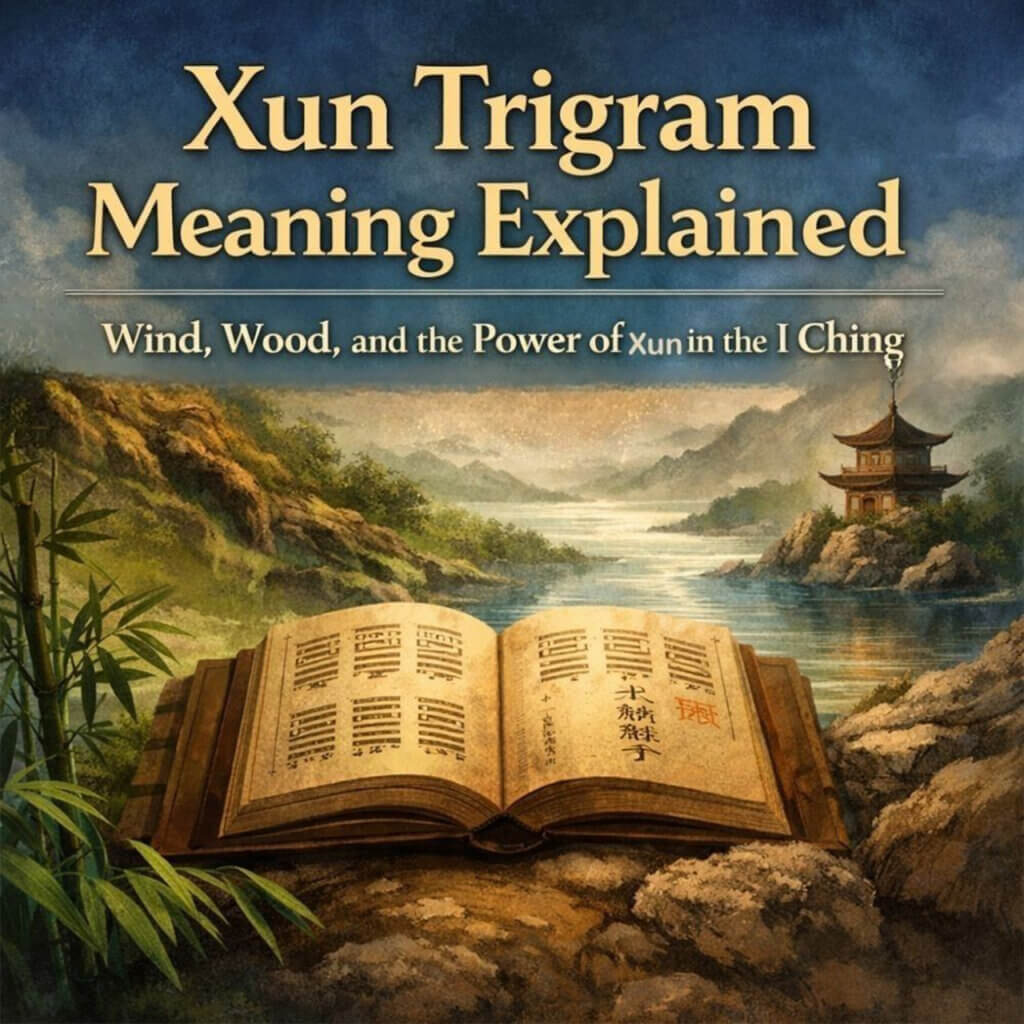
Xun Trigram Meaning: ☴ Wind, Wood, and Southeast Symbolism in the I Ching
Xun Trigram Meaning Explained for modern readers: discover how ☴ Xun in the Bagua and I Ching represents wind, wood, gradual influence, and the cultural meaning of the Southeast trigram.

Xun Trigram Meaning Explained: ☴ Wind, Wood, and the Meaning of Xun in the I Ching
Why the Xun Trigram Still Matters
The Xun Trigram Meaning still matters because ☴ Xun is not only a symbol in the Bagua. It also represents a way of understanding how change happens.
In the Bagua and the I Ching, Xun is commonly associated with Wind, Wood, and the kind of influence that works gradually rather than forcefully. It does not rely on impact alone. Instead, it enters with conditions, spreads quietly, and shapes things over time.
This is part of what makes Xun important in Daoist-related cultural understanding. It shows that not all movement is direct, not all strength is loud, and not all change begins with confrontation.
To understand the Xun Trigram Meaning is to understand one of the subtler patterns within the Bagua: a pattern of entry, circulation, extension, and steady effect.
What Is the Xun Trigram?
The Symbol of Xun: ☴
☴ Xun is one of the eight trigrams of the Bagua. It is traditionally associated with:
- Chinese name: 巽 (Xun)
- Natural image: Wind
- Element: Wood
- Direction: Southeast
- Core associations: entry, movement, influence, extension, adaptability
In the Bagua system, each trigram expresses a distinct mode of energy and transformation. Xun represents a pattern that does not rely on shock or direct pressure. Its movement is quieter and more continuous.
Why Xun Is Linked to Wind and Wood
The traditional meaning of Xun becomes easier to understand through its two main symbolic images.
Wind moves without always being seen. It enters spaces, passes through openings, and alters the atmosphere through circulation rather than collision.
Wood suggests living growth. It has roots, direction, and extension. It does not appear fully formed at once, but develops from within and expands in stages.
Together, these two images help explain why Xun is often understood as a force that works through gradual entry and sustained influence.
The Deeper Meaning of Xun in the Bagua
At a deeper level, the Xun Trigram Meaning is not simply “gentle” or “soft.” It describes a way in which movement and influence can happen without relying on blunt force.
Xun is not about impact, but entry
Some trigrams are easier to recognize because they are dramatic. Xun is different.
Its character is not sudden impact, but entry.
Not pressure, but circulation.
Not aggressive action, but effect through continuity.
This is why Xun often feels more subtle than other trigrams. Its power is not missing. It is simply expressed through a different mode.
Xun as a cultural pattern of movement
In Daoist cultural understanding, symbols are not only visual signs. They also reflect patterns of movement in nature and life.
Xun can be read as one of these patterns:
- movement that follows openings
- influence that works through continuity
- growth that extends from a root
- change that forms gradually rather than abruptly
Seen this way, Xun is not merely a symbolic label. It expresses a recognizable way that life unfolds.

Xun and Its Place in the Bagua
Within the Bagua, Xun is commonly linked to the Southeast. In traditional interpretation, this position is often associated with themes such as:
- extension
- cultivated growth
- gradual development
- circulation and continuity
- long-term support
Why the Southeast matters
The Southeast association does not mean Xun should be reduced to a simplistic formula. Its value is not only directional. It is also symbolic.
The Southeast placement helps show that Xun belongs to a larger system in which direction, movement, and quality of energy are all connected.
This is one reason Xun is meaningful in spatial interpretation. It is not just a point on a map. It reflects a type of atmosphere: one of movement, spread, and living development.
Xun is not just a “wealth corner”
In popular writing, Xun is sometimes flattened into a quick idea about money or prosperity. That is too narrow.
Xun is better understood as a trigram connected with the conditions that allow growth to continue.
That may include:
- support rather than blockage
- circulation rather than stagnation
- order rather than compression
- rooted extension rather than scattered excess
When prosperity is linked to Xun, it is usually in this broader sense of cultivated continuity, not instant gain.
Xun Compared with Other Trigrams
Xun and Zhen: gradual entry vs sudden activation
A useful way to understand Xun more clearly is to compare it with Zhen, the trigram often associated with thunder.
Zhen awakens and activates.
Xun enters and permeates.
Zhen can feel like a beginning marked by shock, movement, or release. Xun works differently. It changes the situation through gradual spread and ongoing influence.
This comparison helps clarify that Xun is not the trigram of sudden breakthrough. It is the trigram of steady effect through time.
Xun and Qian: adaptive movement vs direct force
Another useful comparison is with Qian, often associated with Heaven, initiative, and direct creative force.
Qian advances outward.
Xun moves through conditions.
Qian is often recognized through decisiveness, strength, and active initiation. Xun represents another kind of effectiveness—one based on responsiveness, entry, and extension rather than direct assertion alone.
How the Meaning of Xun Extends into Everyday Understanding
Although the Xun Trigram comes from the traditional system of the Bagua and the I Ching, its meaning does not remain only at the level of abstract symbolism.
In Daoist-related cultural understanding, Xun represents more than wind as a natural image or wood as a Five Elements correspondence. It reflects a state of entering with conditions, moving gradually, and taking effect over time.
Xun and the image of wind
The nature of wind is not direct collision, but movement, entry, and influence that works without always being seen.
For this reason, Xun expresses a way of moving that follows conditions, enters gradually, and changes the atmosphere over time.
Xun and the image of wood
Wood suggests more than growth alone. It also carries the ideas of rootedness, order, upward movement, and extension.
So the connection between Xun and wood is more than a simple Five Elements label. It points to a kind of development that expands from a base rather than rising through sudden force.
How to Arrange the Xun Area in Your Space
In Bagua-based spatial interpretation, ☴ Xun is commonly linked to the Southeast and associated with Wind, Wood, circulation, and steady growth.
Rather than treating this area as a place for forceful “wealth fixes,” it is often more meaningful to shape it around clarity, lightness, and living support.
What works well in a Xun area
A balanced Xun area often benefits from elements that reflect movement, life, and healthy development, such as:
- healthy green plants
- natural wood materials or wood-toned decor
- soft green or natural color palettes
- clean surfaces and uncluttered placement
- natural light, airflow, or a sense of gentle circulation
- symbolic objects connected to growth, harmony, refinement, or sustained prosperity
These choices do not need to feel overly mystical. In practice, they work best when they support a space that feels breathable, orderly, and alive.
What to avoid in a Xun area
Because Xun is associated with circulation and gradual development, this area is usually less suited to:
- heavy clutter
- broken, dusty, or neglected objects
- dark, compressed, stagnant arrangements
- an overly cold or metallic visual feel
- decorative themes that feel harsh, crowded, or forceful
When the Xun area feels blocked, the space may seem heavy, closed, or lacking vitality.
A better way to understand Xun space
It is more useful to understand the Xun area not as a shortcut to results, but as an area that reflects the conditions under which growth can continue.
That usually means:
- room to breathe
- steady support
- circulation
- order
- living energy
In this sense, arranging the Xun area is less about superstition and more about reinforcing a spatial quality that matches the symbolic character of Xun.
Common Misunderstandings About the Xun Trigram
Misunderstanding 1: Xun is only about softness
Xun is often described in quiet terms, but that does not mean its effect is weak.
Its influence may be subtle, but it is also persistent, penetrating, and cumulative. What it lacks in drama, it gains in continuity.
Misunderstanding 2: Xun is only a Feng Shui symbol
Xun can certainly be used in spatial interpretation, but its meaning is broader than placement alone.
It belongs first to the symbolic system of the Bagua and the I Ching, where it expresses a mode of movement, development, and influence.
Misunderstanding 3: Xun only means prosperity
Prosperity may be one theme associated with Xun, especially through the Southeast, but that is not its full meaning.
Xun also speaks to movement, extension, continuity, entry, and the way change takes shape gradually through time.
Final Thoughts: The Quiet Character of ☴ Xun
The Xun Trigram Meaning is not dramatic, and that is precisely why it is worth understanding.
Xun shows a form of movement that does not depend on force to be effective. It moves through entry, spread, and continuation. It works through wind, wood, direction, and time.
Within the Bagua, this makes Xun one of the clearest symbols of influence that develops gradually yet remains real.
FAQ
What does the Xun Trigram mean in the I Ching?
The Xun Trigram usually represents wind, wood, gradual influence, entry, circulation, and a mode of change that works through continuity rather than force.
What direction is Xun in the Bagua?
Xun is commonly associated with the Southeast in the Bagua system.
How is Xun different from Zhen?
Zhen is often associated with thunder, activation, and sudden movement, while Xun is associated with wind, gradual influence, and steady entry.
How is Xun different from Qian?
Qian is often linked to direct creative force and initiative, while Xun reflects movement that works through conditions, adaptation, and extension.
Is Xun only about Feng Shui?
No. Xun is part of the broader symbolic system of the Bagua and the I Ching. Its meaning includes direction, movement, natural imagery, and cultural interpretation.
How should I arrange the Xun area in my home?
A Xun area is often better supported by healthy plants, wood elements, natural light, clean surfaces, and a sense of gentle circulation. It is usually best to avoid clutter, neglect, and heavy visual pressure in this space.
browse Bagua-inspired pendants and symbolic charms