Daoism
Kun Trigram Meaning Explained: Earth, Receptivity and Quiet Strength
Kun Trigram Meaning Explained for modern readers: discover the Earth symbol, receptive leadership, grounded wisdom, and the quiet strength of Kun (☷) in Daoist thought.
Kun Trigram Meaning Explained: Earth, Receptivity, and the Quiet Power of Support
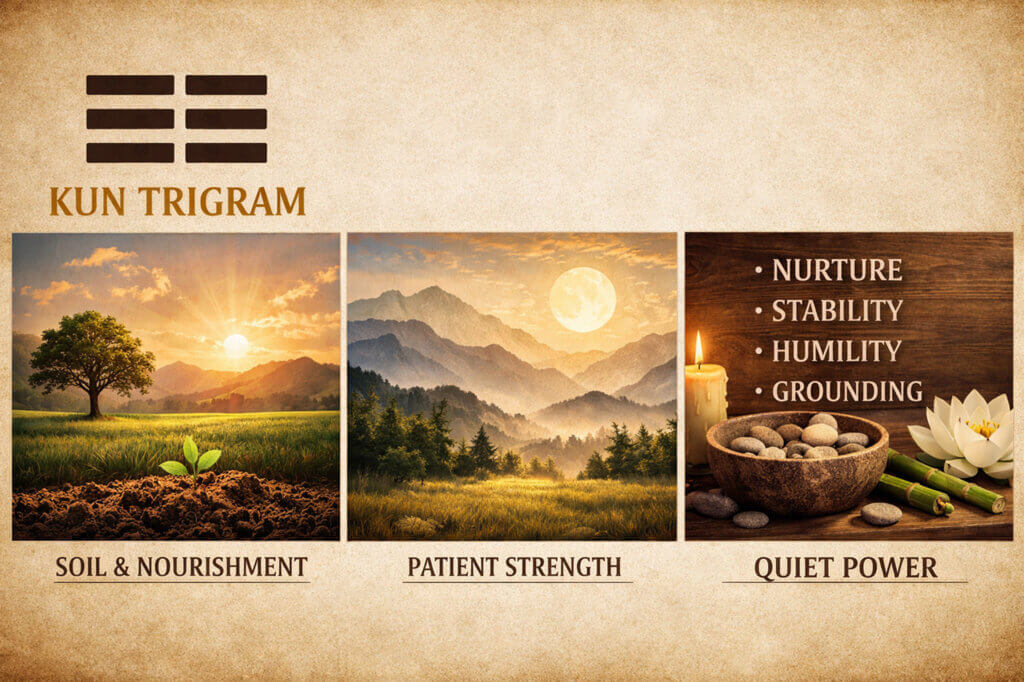
Kun Trigram Meaning Explained is not simply about softness, passivity, or yielding. In Daoist thought and the I Ching, Kun (☷) represents Earth—the force that receives, supports, nourishes, and gives form to life.
For modern readers, especially in the West, this idea feels surprisingly relevant. We are often taught to admire speed, visibility, assertiveness, and control. But Kun reveals another kind of power: the power to stabilize, to carry, and to create the conditions where growth can happen naturally.
If Qian represents Heaven, initiative, and creative impulse, Kun represents Earth, receptivity, and sustaining strength. One begins; the other makes that beginning possible in reality. This is why the Kun Trigram Meaning Explained still matters today. It teaches us that not every form of strength looks loud, and not every meaningful result is produced by force.
What Is the Kun Trigram?
The Kun Trigram is one of the Eight Trigrams of the Bagua. It is made of three broken Yin lines (☷) and is traditionally associated with:
Core Associations of Kun
- Earth
- receptivity
- support
- nourishment
- patience
- humility
- stability
- devoted strength
Kun is often described as the natural counterpart to Qian. If Qian is the spark, Kun is the ground that receives the spark and allows it to become something lasting.
This is why the Kun Trigram Meaning Explained should not be reduced to “doing nothing.” Kun is not empty passivity. It is intelligent receptivity. It is the disciplined ability to support what matters and carry it to maturity.
Kun Trigram Meaning Explained in Simple Terms
At its core, the meaning of Kun can be understood like this:
The Essential Meaning
Kun teaches the wisdom of receiving wisely, supporting steadily, and allowing life to unfold through alignment rather than force.
That is why Kun is so relevant in modern life. Many people today are not lacking ambition. They are lacking stability, patience, and a foundation strong enough to hold what they want.
Kun reminds us that:
- not every season is for pushing
- not every problem is solved by more force
- not every success begins with action
- some of the most important progress begins underground
Like fertile soil, Kun works quietly. But without it, nothing truly grows.
Kun vs Qian: Why Earth and Heaven Must Work Together
One of the clearest ways to understand the Kun Trigram Meaning Explained is to compare it with Qian.
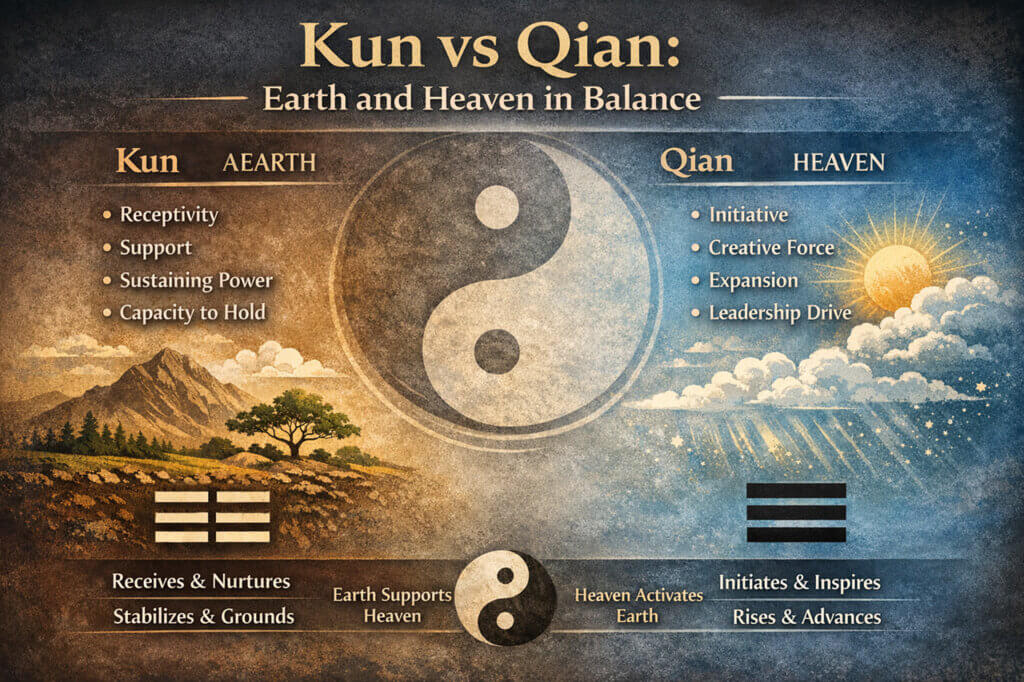
Qian and Kun in Contrast
Qian represents:
- Heaven
- initiative
- movement
- creative force
- leadership through direction
Kun represents:
- Earth
- receptivity
- support
- sustaining power
- leadership through capacity
Qian starts. Kun carries.
Qian initiates. Kun receives.
Qian moves upward. Kun gives form and stability.
Why This Comparison Matters
Many people overdevelop Qian energy. They want to move, decide, launch, speak, and lead. But without Kun, their efforts have nowhere to land.
Kun reminds us that strength is not only about starting something. It is also about building the structure that allows something to last.
This Earth–Heaven balance is one of the most practical keys in Daoist thinking.
The Earth Symbolism Behind Kun
Earth Does Not Compete, Yet Everything Depends on It
Earth rarely draws attention to itself. It does not boast, rush, or demand recognition. Yet every visible structure depends on it.
That is Kun energy.
In everyday life, Kun appears wherever invisible support creates visible success:
- the routines behind health
- the stability behind a thriving home
- the patience behind a mastered craft
- the structure behind a successful business
- the emotional steadiness behind lasting relationships
Kun is what carries.
Receptivity Is Not Weakness
A common misunderstanding is to treat Kun as weakness. But true receptivity is not surrender without judgment. It is openness with discernment.
Healthy Kun energy means:
- listening without collapsing
- supporting without losing direction
- yielding without becoming powerless
- remaining grounded while adapting wisely
This is quiet strength, not fragility.
What the Kun Trigram Teaches About Leadership
One of the most practical modern ways to understand the Kun Trigram Meaning Explained is through leadership.
In many work cultures, leadership is often associated with speed, decisiveness, authority, and constant visible action. Kun offers a different model. It shows that some of the strongest leaders are not those who dominate every room, but those who create conditions where people, systems, and ideas can actually grow.
This is the essence of receptive leadership.
A Kun-style leader does not force every outcome. Instead, they build trust, listen carefully, strengthen the foundation, and make sure others have what they need to do meaningful work well. Their strength lies not only in directing, but in holding.
Receptive Leadership in Practice
1、Strategic Patience
Kun reminds us that sustainable growth requires structure. Not every challenge is solved by moving faster. Some are solved by strengthening the base first.
2、Listening Before Forcing
Rather than imposing solutions too early, Kun leadership pays attention to what a team, market, or situation actually needs.
3、Building a Stronger Container
True leadership is not only about vision. It is also about creating an environment that can carry that vision over time.
Kun leadership is not passive. It is supportive, stabilizing, and deeply effective.

Kun in Relationships, Work, and Personal Growth
In Relationships
Kun represents emotional steadiness, trust, patience, and the ability to create safety. It is not dramatic love. It is sustaining love.
In Work
In a professional setting, Kun shows up as structure, continuity, support systems, and long-term thinking. It asks whether your ambition is supported by something real.
In Personal Growth
Kun teaches that transformation is often quiet. It can look like:
- stronger routines
- calmer emotions
- clearer boundaries
- better timing
- less need to prove yourself
This kind of progress may seem slower, but it usually lasts longer.
The Shadow Side of Kun
Every symbol has an unbalanced form.
Unhealthy Kun Can Look Like
- excessive passivity
- weak boundaries
- fear of initiative
- dependency on others
- endless waiting
- confusing patience with avoidance
Balanced Kun Looks Like
- grounded receptivity
- strong support
- humility with judgment
- patience with purpose
- stability without stagnation
Real Kun is alive. It is not lifeless submission.
How to Apply Kun Wisdom in Daily Life
1、Stabilize Before Expanding
Before chasing something new, strengthen sleep, finances, routines, focus, and emotional steadiness.
2、Pause Before Reacting
Observe more. Judge less quickly. Let situations reveal themselves more fully.
3、Build Capacity, Not Just Goals
Kun asks whether your life can truly carry what you say you want.
4、Respect Quiet Progress
Why Kun Still Matters Today
The modern world often rewards noise, urgency, and constant self-assertion. That is exactly why Kun feels so relevant.
It offers a different kind of mastery:
- grounded instead of frantic
- stable instead of inflated
- responsive instead of reactive
- enduring instead of performative
For readers interested in Daoist wisdom, symbolic living, Feng Shui, or the I Ching, Kun is a reminder that the deepest power is often the power to support, receive, and sustain.
A Natural Bridge to Daoist Living
For many people, understanding Kun is not only about philosophy. It also influences the symbols they keep close in daily life.
Objects associated with grounding, balance, support, and protection often resonate because they serve as reminders of how one wants to live. In this sense, Daoist-inspired jewelry or Feng Shui decor can become more than decoration. They can reflect intention.
Kun does not ask for superstition.
It asks for awareness.
And sometimes a meaningful symbol helps make that awareness tangible.
Conclusion
Kun Trigram Meaning Explained is ultimately about the power of Earth: the ability to receive, nourish, support, and endure.
It teaches that not all strength is forceful.
Not all progress is dramatic.
Not all wisdom begins with action.
Sometimes the most powerful thing you can do is become steady enough to carry life well.
That is the wisdom of Kun.
And that is why it still matters.
FAQ
What does the Kun Trigram mean?
The Kun Trigram represents Earth, receptivity, support, patience, and grounded strength.
Is Kun a symbol of weakness?
No. Kun represents intelligent receptivity and the ability to support life steadily over time.
How is Kun different from Qian?
Qian represents Heaven, initiative, and creative force. Kun represents Earth, receptivity, and sustaining power.
Why is Kun relevant in modern life?
Because many people today have ambition but lack stability, timing, and sustainable structure.
What is receptive leadership in Kun terms?
It means leading through support, listening, steadiness, and building strong conditions for long-term growth.
Can Kun connect to Feng Shui or symbolic objects?
Yes. Many people resonate with symbols of grounding, balance, protection, and support in Daoist-inspired decor or jewelry.
Browse Daoist-inspired jewelry for grounding and balance———
Explore the Bagua meaning and how the Eight Trigrams work together———–Bagua Meaning Explained
Read the Qian Trigram meaning to understand the Heaven–Earth balance——–Qian Trigram Meaning Explained
Discover how Yin and Yang shape Daoist ideas of harmony—————-Yin Yang Meaning Explained
Learn the Five Elements meaning in modern life——————–Five Elements Meaning Explained